
Abstract
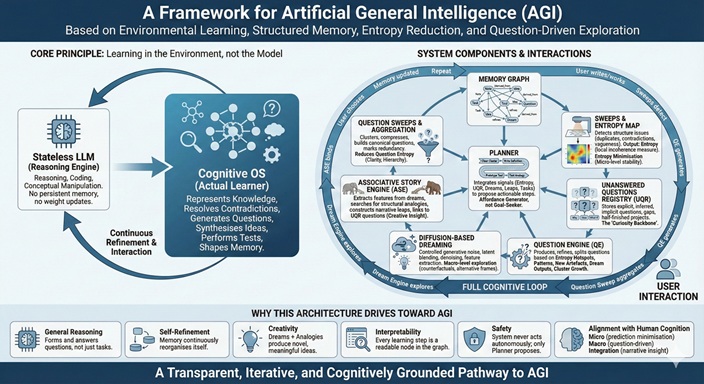
This paper presents a practical and interpretable pathway toward AGI based not on reinforcement learning, agent loops, or weight updates, but on the emergence of intelligence from a structured, evolving external memory environment. Learning arises through continuous refinement of a memory graph, entropy-based structure detection, aggregation of open questions, diffusion-mediated generative exploration, and narrative analogy formation. The architecture mirrors human cognition: micro-level prediction minimisation, macro-level question generation, and the integration of new insights with old, unresolved puzzles. This document formalises the components and interactions that make this architecture viable.
—
1. Introduction
Large language models demonstrate reasoning, coding, and conceptual manipulation, but lack persistent memory, long-term coherence, structured self-correction, and curiosity. Traditional AGI proposals rely on reinforcement learning, autonomous agents, or continual weight updates — all fragile, opaque, and hard to align.
This paper proposes an alternative:
AGI as the emergent behaviour of a model reasoning inside a dynamic cognitive environment.
The model remains stateless.
All learning occurs through changes to the external world:
structured memory
refined conceptual clusters
curated questions
narrative synthesis
testable tools
generative dreaming
This mirrors the way adult humans learn: not by changing their brain architecture, but by refining their internal world-models and pursuing unanswered questions.
—
2. Core Principle
Learning happens in the environment, not in the model.
The LLM is a reasoning engine.
The cognitive OS is the actual learner.
The OS is responsible for:
representing knowledge
resolving contradictions
generating questions
synthesising new ideas
performing tests
shaping its own memory
This division enables transparency, modularity, and alignment while preserving the LLM’s power.
—
3. System Components
The architecture comprises nine interacting systems:
1. Memory Graph
2. Sweeps and the Entropy Map
3. Unanswered Questions Registry (UQR)
4. The Question Engine (QE)
5. Diffusion-Based Dreaming
6. Associative Story Engine (ASE)
7. Question Sweeps and Aggregation
8. Critique Layer
9. Planner
Each is described below.
—
4. Memory Graph
All artefacts — notes, tasks, ideas, tool outputs, summaries, questions, dreams — are nodes in a directed, tagged graph. Nodes carry:
text or data
type
metadata
semantic embeddings
links to other nodes (derived_from, variant_of, contradicts, refines)
This graph is the stable world the model reasons over.
—
5. Sweeps and the Entropy Map
Sweeps periodically scan memory for structural issues:
duplicate concepts
contradictory statements
vague or drifting terms
isolated or unlinked nodes
overloaded or inconsistent tags
incomplete clusters
The sweep outputs an entropy map, assigning each region a measure of local incoherence.
Entropy minimisation governs micro-level stability, analogous to perceptual and motor prediction minimisation in biological cognition.
—
6. Unanswered Questions Registry (UQR)
Humans carry around not only facts, but unfinished puzzles.
The UQR formalises this cognitive substrate by storing:
explicit user-written questions
inferred questions from contradictions
implicit questions from vague notes
gaps in conceptual taxonomies
half-finished projects
missing definitions
unresolved analogies
dream-driven hints
Each question node includes:
text
type (why/how/what-if/compare/define)
domain tags
priority score
parent/child relations
links to artefacts and clusters
These questions form the “curiosity backbone” of the system.
—
7. The Question Engine (QE)
Beyond listing questions, the system must generate them.
The QE continuously produces, refines, or splits questions based on:
1. Entropy hotspots:
“Why is this region messy?”
2. Patterns:
repeated tools, missing generalisations, repeated user edits.
3. New artefacts:
contradictions, vague descriptions, new links.
4. Dream outputs or analogies:
turning a dream insight into a formal research question.
5. Cluster growth:
when concepts group but lack clear overarching framing.
Questions receive activation and relevance boosts when they appear in:
user edits
dreams
planner suggestions
sweep results
The QE ensures the system is not only refining existing knowledge, but constantly expanding its frontier.
—
8. Diffusion-Based Dreaming
Dreaming introduces controlled generative noise into the cognitive system.
Steps:
1. Random sampling of nodes or embeddings
2. Latent blending (including noise)
3. Diffusion denoising to form coherent prototypes
4. Feature extraction from generated concepts
5. Matching to UQR (reviving dormant questions)
6. Creation of dream nodes
Dreaming offers macro-level exploration analogous to human imagination:
testing counterfactuals, exploring alternative frames, and discovering new metaphors.
—
9. Associative Story Engine (ASE)
Dreams alone don’t produce insight; humans interpret them.
The ASE:
1. Extracts high-level features from dream prototypes
2. Searches for structurally similar (not semantically similar) domains
3. Constructs narrative analogies
4. Forms candidate “leap nodes”
5. Links them to UQR questions when relevant
This enables the “purple elephant → mammoth” effect:
A surprising narrative leap that binds a new idea to an old unresolved question.
This mechanism is essential for creativity, invention, and insight.
—
10. Question Sweeps and Aggregation
Questions proliferate if unmanaged.
A dedicated Question Sweep clusters and compresses them:
detect duplicates or near-duplicates
identify broad vs narrow forms
build parent (canonical) questions
attach sub-questions
mark redundant forms as superseded
merge questions around shared domains
Question entropy = unstructured proliferation of overlapping questions.
Reducing question entropy creates clarity, hierarchy, and focus.
—
11. Critique Layer
The critique module evaluates:
plausibility
coherence
novelty
usefulness
relevance
safety
It filters nonsense, formalises valid insights into leap nodes, and may propose refinements.
Critique ensures that creativity remains grounded.
—
12. Planner
The planner integrates signals from:
entropy map
UQR
question clusters
dream nodes
narrative leaps
active user tasks
And proposes actionable steps, such as:
clean or refactor clusters
write a definition or summary
prototype a tool
test an analogy
draft an essay section
or explore a new domain
The planner acts as an affordance generator, not a goal-seeker.
—
13. Full Cognitive Loop
Together, the system cycles through:
1. User writes / works → new artefacts
2. Sweeps detect inconsistencies → entropy map
3. QE generates or clarifies questions → UQR
4. Question Sweep aggregates and filters
5. Dream Engine explores concept space
6. ASE binds dreams to long-standing questions
7. Critique evaluates
8. Planner outputs next steps
9. User chooses → memory updated
10. Loop repeats
This loop continuously expands, refines, and stabilises the system’s world-model.
—
14. Why This Architecture Drives Toward AGI
General reasoning
The system forms and answers questions, not tasks.
Self-refinement
Memory reorganises itself continuously.
Creativity
Dreams + analogies produce novel, meaningful ideas.
Interpretability
Every piece of “learning” is a node in the graph, readable by humans.
Safety
The system never acts autonomously; only the planner proposes.
Alignment with human cognition
Micro: prediction minimisation
Macro: question-driven exploration
Integration: narrative insight
Modularity
Any LLM can serve as the reasoning engine.
Scalability
No dependence on weight updates or fragile RL.
—
15. Conclusion
This paper describes a new, transparent, iterative, and cognitively grounded architecture for AGI. Learning arises from the interaction of entropy minimisation, structured questions, generative dreaming, narrative analogy, and iterative planning within an evolving memory environment.
The result is an intelligence that:
refines its own categories,
poses and answers its own questions,
resolves inconsistencies,
generates new hypotheses,
connects distant domains, and
produces insights that feel both creative and grounded.
This represents a viable and safe pathway toward AGI built on principles that mirror human cognition.