
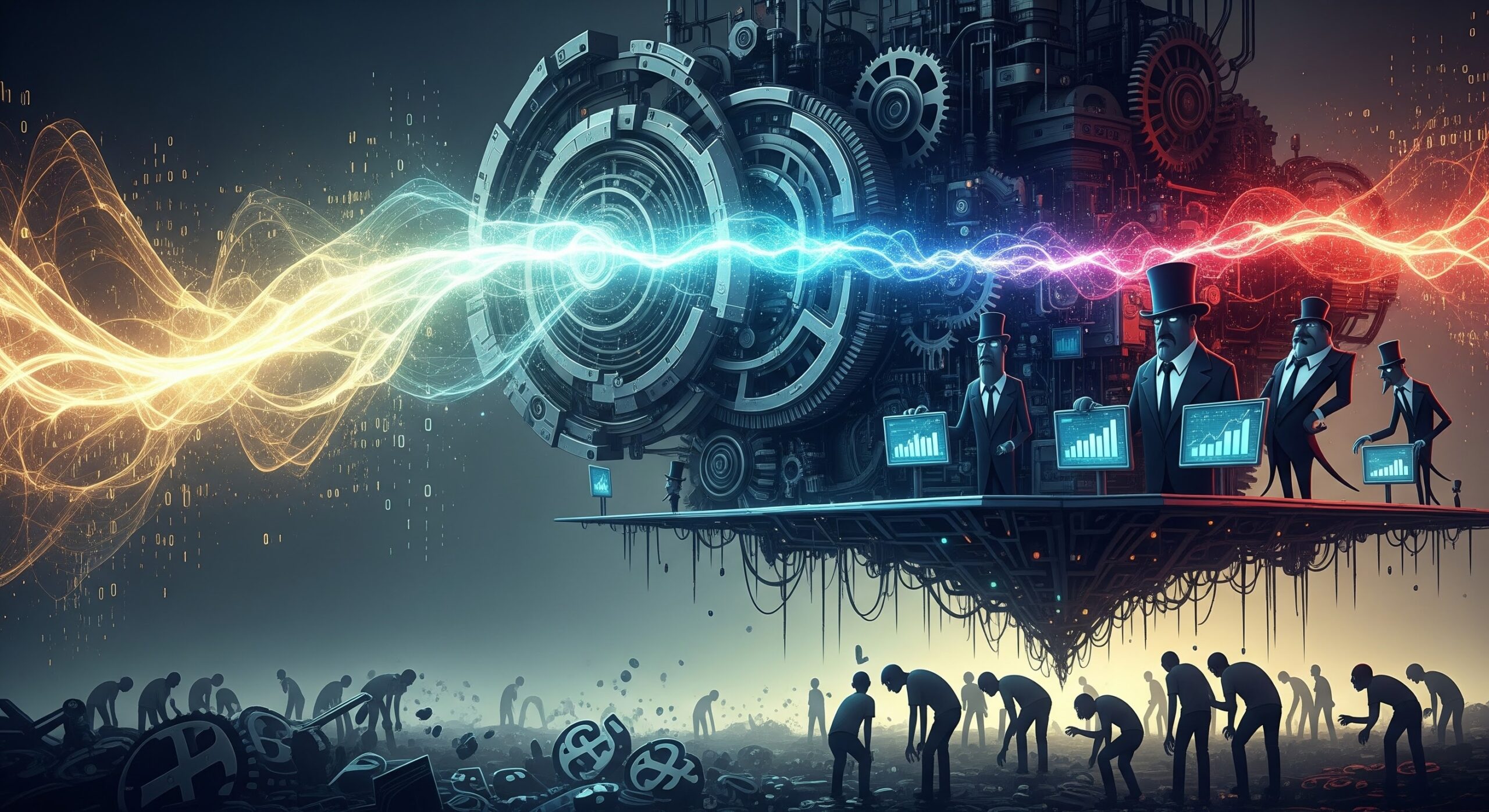
For decades, economists have told us that the money supply drives demand. Central banks set interest rates; credit becomes cheaper or dearer; households and firms respond accordingly. But in the real world, it often feels the other way around. The system breathes not to the rhythm of interest rates, but to the pulse of risk appetite — that collective mood that determines how much danger we’re willing to take on, how much we’re willing to borrow, and how long we believe the good times will last.
Money creation today isn’t a top-down affair. It happens every time a bank makes a loan, every time investors lever up to chase yield, every time optimism exceeds caution. Credit is endogenous to emotion. When people feel brave, money appears. When they panic, it evaporates.
We live, in other words, inside a behavioral economy — one powered not by rational choice but by waves of confidence and fear.
1. The Rich and the Rest
The trouble is, not everyone participates equally in this risk-driven machine.
When interest rates rise, the textbook says borrowing should slow and the economy should cool. But the wealthy are rarely deterred. They have assets that rise in price during every speculative cycle — property, equities, scarce art, data centers. Rising valuations make them feel safer, not riskier. Their risk appetite expands with their paper wealth. They borrow more precisely because prices are high, using unrealized gains as collateral for further bets. The cycle feeds on itself: prices create confidence, confidence creates credit, credit creates prices.
For the poor, the same mechanism operates in reverse. Prices rise — for rent, for food, for fuel — but their borrowing capacity is limited or exhausted. They feel risk as exposure, not opportunity. Each central bank tightening is supposed to “stabilize inflation,” but what it often stabilizes is privilege: the ability of those with capital to take more risk while the rest cut back on essentials.
And caught between them sits the middle class — the ever-eroding bridge of society.
They borrow to buy homes that double as speculative assets, believing they are “investing.”
They stretch themselves thinner each cycle, trying to keep up with asset inflation while real wages stagnate. The result is a kind of financial schizophrenia: middle-class families are simultaneously investors and debtors, speculators and victims. They are told to save, but punished for it. They are told to consume, but shamed for it. When prices rise, they cut groceries before they cut the mortgage. They can’t stop feeding the machine, because their security depends on it.
2. The Multi-Society
Out of this emerges an unhinged multi-society:
A speculative elite, trading abstractions atop mountains of leverage.
A squeezed middle, working harder to stay still.
A disenfranchised base, increasingly excluded from ownership and stability.
Each group lives in a different reality, yet policy treats them as one.
When the central bank moves its single lever — the interest rate — it assumes a uniform sensitivity across society. But the rich don’t stop speculating when rates rise; they simply move from housing to private credit, from equities to art. The poor don’t start saving when rates fall; they’re already borrowing to survive.
It’s a one-size-fits-all instrument in a world where the fits are tearing apart.
The consequence is social dissonance.
People sense that the “economy” no longer describes their lived experience.
Markets boom while streets decay. News headlines celebrate GDP growth while local shops close and community trust erodes.
It’s not that money has stopped working — it’s that its creation mechanism rewards appetite over need, speculation over sustenance.
3. The Policy Illusion
Monetary policy now operates more like a placebo than a cure.
Each rate rise or cut is meant to “restore balance,” but it can’t touch the underlying asymmetry between those who create credit and those who merely use it.
Governments talk about fiscal fairness, yet their tax systems quietly reinforce financialization — taxing work and rewarding leverage.
Behind it all is an unspoken assumption: that the market knows best where money should flow.
But when markets are driven by the psychology of the wealthy, the result is predictable.
Liquidity rushes to whatever promises the quickest, biggest story — housing bubbles, tech IPOs, crypto frenzies — while essential sectors like health, food, and education remain underfunded.
The economy becomes a mirror of mood rather than a measure of production.
4. The Risk Society
Sociologists once wrote of a “risk society” — a world where danger itself becomes a tradable good. That’s where we are now. Risk has been financialized.
Every shock — pandemic, war, climate event — produces its own derivatives market.
The system profits on volatility.
And because money supply expands with each collective surge of risk appetite, crises now create liquidity instead of destroying it.
The result is paradoxical: stability breeds complacency, complacency breeds risk, risk breeds crisis, crisis breeds liquidity, and liquidity breeds stability again.
It’s a Minsky carousel we can’t dismount.
5. The Cost of Cohesion
The cost of this behavioral economy isn’t just material — it’s psychological and civic.
When economic levers no longer deliver shared outcomes, faith in institutions declines.
The poor feel abandoned; the middle feel lied to; the rich feel besieged but entitled.
Social trust — the invisible currency of every civilization — devalues faster than any fiat note.
Policy, meanwhile, remains trapped in a binary mindset: tighten or loosen, stimulus or austerity, boom or bust.
There’s no nuance, no local feedback, no real-time modulation.
It’s as if we’re flying a complex, multi-engine craft with a single throttle.
No wonder we keep lurching between overheating and stall.
6. There Is a Better Way
There is a better way — one that begins by changing the way money itself is created.
Imagine a system where new money isn’t born from debt or speculation, but from equality.
Where every person receives an equal share of newly created currency — a simple, transparent flow that grounds the economy in real human needs rather than in financial appetite.
In such a system, the money supply expands equally, not through leverage.
Speculative heat is cooled automatically through a simple regulator — a transaction-based “Fire” that slightly burns excessive velocity — while a Sump recycles that heat back into the commons.
The result is an economy that breathes: fast where innovation demands it, slow where stability matters.
This model doesn’t just stabilize finance; it solves the two defining crises of our age:
AI redundancy, by ensuring that automation doesn’t destroy livelihoods — everyone still receives income through direct creation rather than employment alone.
Poverty, by erasing the structural scarcity that keeps people competing for trickle-down credit.
Proper money creation — equal, cyclic, and self-regulating — makes inequality a policy choice, not an inevitability.
It anchors risk appetite to reality, restores trust to exchange, and allows society to evolve beyond fear of debt or scarcity.
We’ve spent a century adjusting interest rates to control behavior.
Perhaps it’s time we designed money itself to reflect what we truly value: fairness, stability, and the freedom to live without gambling on tomorrow.