
The leaked Microsoft memo may have been a poor choice of words. Perhaps “make people addicted” was just the crude internal language of a growth team trying to say: make the product useful, habitual, indispensable. But that is exactly the problem. We have built a commercial culture in which addiction is close enough to success that the phrase can appear in a strategy document and everyone knows what it means.
The scandal is not that one company said the quiet part out loud. The scandal is that the quiet part has become ordinary.
Modern commerce no longer merely asks what people need and then tries to meet that need. Increasingly, it asks where the human being is vulnerable. Where are they lonely? Where are they anxious? Where are they bored? Where are they ashamed? Where do they want status, comfort, stimulation, validation, relief? Then it builds a product around that wound and calls the result innovation.
The old promise of business was satisfaction. The new promise is return.
A satisfied person leaves. A dependent person comes back. So the ideal customer is not the person whose problem has been solved, but the person whose problem has been managed into a loop. Hungry, but never nourished. Connected, but still lonely. Informed, but never calm. Entertained, but never restored. Productive, but never free.
This is the deeper meaning of addiction commerce. It does not simply sell addictive products. It arranges life so that the product becomes the easiest relief from the conditions the market itself has helped create.
Work exhausts you; the market sells escape.
Loneliness grows; the market sells connection.
Anxiety rises; the market sells control.
Status becomes insecure; the market sells identity.
Attention is shattered; the market sells productivity.
The self is hollowed out; the market sells self-improvement.
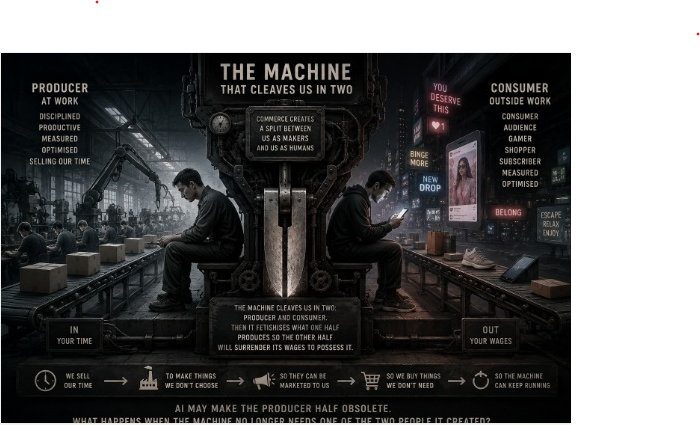
Then, to complete the circle, you must work inside the machine to earn the money to buy relief from the machine.
This is where the human being is cleaved in half. On one side is the worker: disciplined, employable, punctual, efficient, measurable. On the other side is the consumer: tired, craving, ashamed, overstimulated, looking for comfort. The first half earns the wage. The second half hands it back.
And then we fetishise the things we make so we do not have to look at what the making has done to us.
The phone is magic. The app is progress. The assistant is empowerment. The platform is community. The brand is identity. The algorithm is convenience. The subscription is freedom. The AI helper is a companion, a secretary, a therapist, a genius in your pocket. We praise the object so we do not have to mourn the person being reorganised around it.
This is not a Luddite argument. Tools really can liberate. An AI assistant could reduce drudgery. It could help a disabled person navigate bureaucracy, help a worker understand a contract, help a parent plan a week, help a student learn, help a small business compete with a large one. The horror is not the tool. The horror is the business model wrapped around the tool.
A humane AI helper would aim to disappear. It would give you capacity back. It would help you understand, decide, complete, and leave. But an addictive AI helper has the opposite incentive. It must remain between you and the world. It must become the interface to memory, work, friendship, curiosity, planning, writing, choice. It must make itself useful, then necessary, then intimate, then hard to remove.
That is why “addiction” is not merely an unfortunate metaphor. It names the direction of travel.
We already know this pattern. Social media did not begin by saying it wanted to make teenagers anxious. Food companies did not say they wanted to engineer compulsive eating. Gambling apps do not advertise despair. Productivity software does not announce that it will colonise every spare minute. Each industry speaks the language of freedom while optimising for return, retention, engagement, frequency, dependence.
And when people break under the pressure, the system individualises the failure. You need discipline. You need wellness. You need therapy. You need mindfulness. You need a better routine. You need another app.
The wound becomes a market.
This may be the central sickness of modern life: not that we desire too much, but that our desires are increasingly designed from outside us. The landscape of the mind is no longer left alone long enough to grow its own paths. It is surveyed, tested, nudged, gamified, monetised, and trenched. The person experiences this as anxiety, compulsion, restlessness, loneliness, burnout, depression, debt, and shame. Society calls these mental health problems, which they are. But they are also environmental problems. They are what happens when the human nervous system is forced to live inside a marketplace optimised for capture.
The United States shows this most nakedly, but it is spreading everywhere. Where public life weakens, commercial life expands. Where community disappears, platforms arrive. Where secure work declines, hustle culture grows. Where healthcare is expensive, wellness is sold. Where politics fails, brands offer belonging. Where religion fades, fandoms and lifestyle identities take its place. The market does not merely fill the void. It profits from keeping the void open.
So perhaps the leaked memo matters less as an accusation against Microsoft than as a diagnosis of the age. It reveals the grammar of the system. Addict them first. Help them later. Capture the habit. Build the platform. Own the interface. Become the environment.
The question is not whether one AI assistant is dangerous. The question is what happens when every tool is designed by institutions that benefit when we cannot put the tool down.
A healthy society would make people more capable of leaving. Leaving the app. Leaving the job. Leaving the abusive platform. Leaving the compulsive loop. Leaving the identity someone sold them. Leaving the market long enough to remember they are alive.
An unhealthy society calls dependence engagement.
The machine of commerce has learned to sell us back fragments of ourselves: attention, friendship, confidence, memory, pleasure, agency, calm. And because we are tired, we buy them. Because we are ashamed, we blame ourselves. Because we are trapped, we call the trap convenience.
That is the cleaving.
We make the thing.
The thing remakes us.
Then commerce asks us to worship it.