
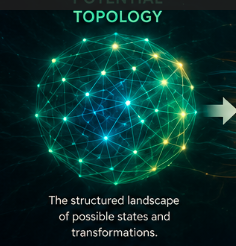
A developing framework for understanding possibility, constraint, flow and persistence – from physical organisation to life, mind and society.
DAVID J CAMPBELL
July 2026
| Potential is the topology of possible change. Objects are not primary. Persistent organisation is primary. |
WORKING ESSAY / RESEARCH INVITATION
We usually picture reality as a collection of things. Particles exist. They combine into atoms. Atoms form matter. Matter occupies space, responds to forces and eventually becomes stars, cells, brains and societies.
This object-first picture has been extraordinarily productive. But it may also place the most stable and visible products of reality at the beginning of the explanation. A particle appears to be a thing because it persists. A person appears to be a thing because a recognisable pattern continues through time. A storm, a memory, a species and a nation can also be treated as things, despite constantly exchanging their contents with the world around them.
Perhaps the deeper question is not “What are things made from?” but “How does anything become stable enough to appear as a thing?”
Potential Topology begins there. It proposes that objects are not the primary constituents of reality. What is primary is structured possibility: the pattern of changes, relations and forms available from any given state. An object is then a relatively persistent organisation within that structure.
Potential Topology, or PT, is not yet a completed physical theory. It does not derive quantum mechanics, general relativity or consciousness from a new mathematical foundation. It is better understood as a developing conceptual framework and research program. Its purpose is to ask whether possibility, constraint, flow, closure and persistence can provide a common language beneath apparently separate domains.
That ambition demands both imagination and restraint. The value of PT will not be decided by how many phenomena can be redescribed in its vocabulary. It will be decided by whether the vocabulary can be made precise, whether it clarifies real problems and whether it eventually produces models or predictions that existing frameworks do not.
1. Reality includes what can happen next
Reality is never only what exists at a frozen instant. Every actual state also contains a range of possible continuations.
A ball near the top of a hill may roll down one side or the other. A seed may germinate under some conditions but not others. A sentence may lead naturally into several possible thoughts. A society may be stable, near transformation or trapped in a repeating pattern.
These possibilities are not all equivalent. Some are immediately accessible. Some require energy or a rare sequence of events. Some are effectively blocked. Others are strongly favoured by the organisation of the situation.
Potential therefore has three inseparable aspects:
- Possibility – what changes could occur.
- Constraint – which changes are prevented, suppressed or difficult.
- Direction – which changes are favoured over others.
In ordinary physics, potential often refers to a measurable quantity such as gravitational or electrical potential energy. PT uses the word more broadly. It does not mean merely stored energy waiting to be released. It means the structured capacity of a state to become otherwise.
The hill gives the ball gravitational potential, but the deeper point is not that the ball contains a mysterious reserve. The arrangement of the ball, hill and gravitational field makes some future movements more accessible than others. The geometry of the situation guides its development.
A flat surface leaves many directions approximately equal. A slope privileges one direction. A valley gathers trajectories into a basin. A barrier separates regions. A narrow channel restricts movement. A loop allows activity to return to its starting conditions.
Potential is not an invisible hand pushing objects from behind. It is the structured availability of pathways through which change can occur.
2. Topology is the shape of possibility
In mathematics, topology concerns spaces and relations that retain meaningful properties through continuous transformation. PT uses the word in a broader but related sense: the organisation of relations, pathways, boundaries and continuities within a space of possibilities.
Topology tells us what is connected to what, but connection can be represented in several ways:
- Graph topology describes which distinctions are related.
- Field topology describes how influence and possibility vary across a region.
- Landscape topology describes which transitions are easy, difficult or attractive.
- Knot topology describes organisations that resist dissolution or unwinding.
- Information topology describes similarity, difference and meaningful adjacency.
These traditions developed separately because they serve different mathematical and scientific purposes. PT suggests that they may be different views of a shared underlying problem: how distinctions are related, and how those relations constrain change.
This requires a distinction between potential and topology, but not a separation. Potential without structure would be an undifferentiated capacity in which no possibility was more accessible than another. Topology without potential would be a static arrangement with no capacity to change.
Potential is the capacity for change; topology is the organisation of that capacity.
They are conceptually distinguishable but ontologically entangled. Potential has a topology, and topology expresses potential. It may therefore be more accurate to treat Potential Topology itself as the primitive, rather than imagining featureless Potential first and structure being added later.
3. From difference to flow
Imagine a set of possible states connected by pathways. The pathways need not be physical roads. They might represent transitions between energy states, molecular configurations, bodily conditions, thoughts, actions or social arrangements.
Some pathways are wide and easy. Others are narrow, costly or unstable. Some exist only under particular conditions. This produces gradients: structured differences in accessibility, stability or attraction.
Change through this structure is flow. A river flows downhill because the physical landscape constrains the movement of water. Heat flows along thermal gradients. Chemical reactions develop along energetic pathways. Attention moves through a landscape shaped by memory, salience, emotion and immediate circumstances.
Structured differences generate directed change.
Within PT, a field can be understood as a pattern of potential extended across a region. A wave is a propagating change in that pattern. Potential does not replace fields and waves. Potential is the capacity for organised change; a field is its distributed structure; a wave is a travelling reorganisation of that structure.
The distinction matters because the same field can support many local events, while local events can in turn alter the field. This is where PT moves beyond a one-way landscape metaphor. Flow can create structure.
4. Closure: how a process becomes a thing
Most disturbances dissipate. A ripple spreads and fades. A temperature difference equalises. A temporary association breaks apart. A thought arises and is forgotten.
But some processes recur. A flow may loop back into the conditions that sustain it. A pattern may channel energy or material in ways that reinforce the pattern itself. A set of reactions may reproduce the environment required for those reactions to continue.
This is closure. A closure is not necessarily sealed off from the world. Most persistent systems are open: they survive by exchanging energy, matter or information with their surroundings. What closes is the causal or organisational loop.
A flame maintains the chemical conditions of combustion while fuel remains available. A vortex preserves a recognisable form while the fluid passing through it changes. A cell continually replaces its components while maintaining a boundary, metabolism and internal organisation. A habit recreates the circumstances that make the habit likely to recur.
PT uses the word knot for a particularly robust closure: an organisation that resists dissolution because its activity contributes to its own continuation. This does not mean every persistent system is literally a mathematical knot, nor does it establish that elementary particles are knotted vortices. “Knot” is initially a relational category: a self-maintaining pattern of organised change.
An object is a process stable enough to be treated as a thing.
A whirlpool persists while its water changes. An organism persists while its atoms change. A conversation persists while its words and mental states change. A self persists despite sleep, growth, forgetting and transformation. Identity lies less in permanent possession of particular components than in the continued reproduction of a relational organisation.
5. The universe rewrites its own pathways
A simple landscape guides the movement of things without being changed by them. Potential Topology is more recursive. Closures do not merely travel through an independent background; they can alter the conditions of future movement.
A path becomes easier through use. A river cuts a deeper channel. A developing tissue changes the chemical and mechanical environment affecting nearby cells. A memory changes which future thoughts become accessible. A social institution changes the options available to the people living within it.
PT calls this backreaction. The topology shapes the flow. The flow creates closures. The closures alter the topology.
| POTENTIAL TOPOLOGY -> FLOW -> CLOSURE -> BACKREACTION -> TRANSFORMED TOPOLOGY |
This cycle is the real engine of PT. It replaces a one-directional ladder in which fundamental Potential produces fields, then particles, matter, life and mind. That hierarchy may describe increasing complexity, but it misses the reciprocal process.
Reality does not simply unfold from a fixed foundation. It modifies the conditions of its own unfolding. A stable organisation changes what can happen around it. Those changes permit new organisations. Over time, accumulated closures reshape the possibility space in which future events occur.
The universe is not merely populated by objects. It is historically sculpted by the things that have managed to persist.
6. Bohm’s quantum potential as an anchor
The physical inspiration for PT comes partly from David Bohm’s interpretation of quantum mechanics. In the de Broglie-Bohm approach, particles have actual positions and follow trajectories guided by the wavefunction. Bohm’s 1952 formulation showed that this interpretation could reproduce the empirical predictions of nonrelativistic quantum mechanics while retaining a continuous account of individual processes [1].
By rewriting the Schrodinger equation in a Hamilton-Jacobi-like form, Bohm identified an additional term commonly called the quantum potential. It depends on the form of the wavefunction and describes how the wider quantum configuration affects particle trajectories. Contemporary presentations often treat the guiding equation rather than the quantum potential as fundamental, so PT should not picture a classical particle being pushed by a strange new force [2].
The important inspiration is more general. In a two-slit experiment, the path followed by a particle depends upon the overall experimental arrangement. Opening or closing a slit changes the wavefunction and therefore the possible trajectory, even when the particle is described as passing through one particular slit. Local movement cannot be understood in isolation from the structure of the wider situation.
Perhaps physical motion is guided not only by local pushes and collisions, but by the global structure of possible relations.
This is close to what Bohm and Basil Hiley later discussed as active information: form can guide movement without acting like a simple transfer of mechanical energy. But PT has not established that its broad concept of Potential is identical to Bohm’s quantum potential.
Bohm’s potential might be the fundamental Potential of PT, one physical manifestation of a more general relational structure, or simply the analogy that first revealed the wider pattern. PT may eventually require a formalism quite different from the quantum-potential formulation.
Bohm therefore provides an anchor: an existing physical approach in which the shape of a wider state guides local trajectories. He does not provide proof of the entire PT ontology. The task is to extend the intuition without borrowing authority that has not been earned.
7. One grammar across different scales
The attraction of PT is that the same abstract language recurs in very different fields: possibilities and constraints, pathways and barriers, gradients and flows, attractors and phase transitions, feedback and closure, persistence and reorganisation.
Same grammar does not mean same mechanism.
A particle, a cell, a thought and a nation may all persist through relations, yet the equations governing them are not interchangeable. PT earns its value only when the shared grammar reveals something that domain-specific language obscures.
Physical organisation
In physics, the strongest speculative PT proposal is that what we call particles may be stable excitations or closures within a deeper field of potential. Physics already contains vortices, solitons, topological defects and stable field configurations. These demonstrate that persistent, localised organisation can arise from fields without requiring a separate substance at their centre.
They do not prove that every elementary particle is a literal knot. The disciplined PT hypothesis is narrower: elementary objects may be better understood as stable organisations of an underlying physical structure than as indivisible beads of substance. This remains a research conjecture.
Biological form
Biology provides a clearer example of structured possibility. An embryo is not assembled like a machine from a complete miniature blueprint. Genes, chemical signals, cell mechanics, tissue boundaries and environmental conditions interact dynamically.
Alan Turing’s 1952 work on morphogenesis showed how interacting and diffusing chemicals could destabilise an initially uniform state and generate spatial pattern [3]. Modern developmental biology goes well beyond reaction-diffusion, incorporating mechanical forces, migration, adhesion, gene regulation and feedback. The broader lesson is that form can emerge through interactions among local processes operating within global constraints.
PT describes this as navigation through a changing developmental topology. Genes participate in shaping a landscape of viable transformations. Chemical gradients create directional tendencies. Tissue boundaries create channels and barriers. Feedback stabilises some pathways and suppresses others. An organ can be described as an attractor or closure reached through many slightly different microscopic routes.
Biological form is guided wandering through a constrained space of possible organisations.
Mind and cognition
The mind also operates through structured accessibility. At any moment, not every memory, thought or action is equally available. Perception, bodily state, expectation, emotion, habit and social context shape what can be noticed and what can happen next.
A familiar thought is easy to revisit because previous activity has strengthened its pathway. Trauma may produce deep defensive attractors. Learning creates new connections. Attention temporarily reshapes the relative accessibility of mental states. A mind can therefore be modelled as navigating an internal topology while also navigating its physical and social environment.
A conscious system, in PT terms, may maintain a distinction between itself and its surroundings, model part of its own condition, represent alternative futures, select actions, learn by changing its internal topology and reshape the external topology through action.
This does not yet explain why such organisation is accompanied by subjective experience. Calling consciousness navigation would only rename the problem. The defensible claim is that consciousness may depend upon a richly integrated, recursively self-modelled topology of accessible states, while the relationship between that organisation and experience remains unresolved.
8. Navigation before consciousness
Navigation is usually associated with an agent choosing a route. PT uses the term more broadly. A falling stone follows a gravitational landscape. A molecule follows chemical possibilities. A cell responds to gradients. An animal selects among environmental paths. A person navigates physical, emotional, social and conceptual possibilities.
These are not equivalent. A rock does not represent its destination. A bacterium may respond adaptively without constructing a rich internal world model. A human can imagine absent possibilities, compare them, suppress immediate impulses and act toward distant goals.
Navigation therefore exists in degrees. At its simplest, it is structured movement through a field of possibilities. Agency emerges when a closure modifies its movement in response to sensed conditions. Higher agency emerges when a system models possibilities that are not immediately present. Conscious navigation arises when the model includes the system itself as an actor within those possibilities.
This suggests continuity from physics to mind without eliminating thresholds. Nothing requires a new magical substance to appear when life or consciousness begins, yet new organisational capacities genuinely emerge: sensing, memory, anticipation, valuation, self-modification, imagination and reflective choice.
No new fundamental substance need be introduced at higher levels, but genuinely new organisations and causal powers can emerge.
9. Classical reality as stabilised possibility
Quantum theory presents reality as a structured spread of possible outcomes, while experience presents a largely stable world of definite events. PT approaches this transition through closure.
Before an outcome is stabilised, several pathways may remain physically accessible. Interaction with an apparatus and environment introduces extensive constraints and feedback. Some differences become amplified, recorded and distributed through the surroundings. A possible outcome becomes a durable fact when it is incorporated into a network of mutually reinforcing consequences.
A detector changes state. A mark appears. Photons scatter. Records are created. Observers remember. In PT language, measurement is a transition from fluid relational possibility to stable macroscopic closure.
This does not yet choose between interpretations of quantum mechanics. It may support a collapse-like picture, in which unrealised alternatives remain potential but do not become actual worlds. It might instead be compatible with branching, where observers occupy one stable channel within a larger structure.
Under what physical conditions does a spread of possibilities become a self-reinforcing, effectively irreversible actuality?
That question overlaps with decoherence, measurement theory and the emergence of classical records. PT will need to show whether its concept of closure adds explanatory or mathematical value. Until then, it remains a promising interpretation rather than a solution.
10. Could spacetime itself be emergent?
The most ambitious PT possibility concerns gravity. General relativity describes gravity not as an ordinary force but as curved spacetime. Matter and energy affect geometry, while geometry shapes the motion of matter.
PT asks whether geometry itself might be a large-scale expression of a deeper relational topology. On this view, mass would not be a separate substance sitting inside an independent spatial container. Matter and geometry might both emerge from the same underlying network of potential relations.
Stable closures would alter local accessibility. At large scales, this altered accessibility could appear as curved geometry and geodesic motion. The hypothesis can be stated carefully: spacetime curvature may be the coarse-grained geometric expression of deeper changes in relational possibility.
This is not a derivation of Einstein’s equations. A successful PT theory of gravity would need to recover general relativity wherever it has been tested, including Newtonian gravity in the weak-field limit, gravitational redshift, lensing, orbital dynamics and the conservation structures built into relativistic geometry.
The point would not be to replace Einstein where Einstein works. It would be to explain what spacetime geometry emerges from, why gravity is universal and what happens where the smooth geometric description may fail. This is a long-term direction, not the best place to begin formalising PT.
11. A minimal Potential Topology model
The first formal experiment should not attempt to reproduce the universe. It should model the core PT cycle.
Begin with:
- A collection of distinguishable states or nodes.
- Weighted relations representing accessibility between them.
- A quantity or excitation able to flow through those relations.
- Rules by which activity strengthens, weakens or redirects pathways.
- Recurrent paths capable of becoming self-maintaining.
- Feedback through which closures alter surrounding accessibility.
The model would ask when unstructured flow dissipates, when recurrent loops appear, when a loop becomes robust against disturbance, whether closures cooperate or compete, and whether layers of closure produce higher-order organisations.
Later versions could ask whether an organisation can build a partial model of its surrounding possibilities and use that model to predict or act. The aim is to demonstrate computationally that topology guides flow, flow creates closure, and closure reshapes topology.
The model might begin as a weighted graph, cellular system or relational kernel. Its first success would not be reproducing quantum mechanics or consciousness. It would be showing that the proposed cycle has non-trivial dynamics and produces identifiable forms of persistence.
12. What PT is – and is not
PT currently occupies several levels, and they should not be confused.
| Level | Current status |
| Descriptive grammar | Systems can be represented through possibilities, constraints, paths, gradients, attractors and closures. This is the strongest level. |
| Interpretive framework | The same relational grammar may illuminate physical, biological, cognitive and social processes. It must show that it does more than rename existing ideas. |
| Ontological proposal | Persistent organisation may be more fundamental than discrete objects. This is philosophically substantial but still requires sharper formulation. |
| Physical conjecture | Particles may be stable closures, quantum possibility may have real relational structure, and spacetime may emerge from deeper topology. These remain open hypotheses. |
| Scientific theory | PT does not yet possess a uniquely defined fundamental object, governing equations, derivations of established laws, distinctive predictions or clear falsification criteria. |
Admitting these limits is not an embarrassment. It is how the framework becomes capable of development rather than protection. A theory that explains everything only after the event explains nothing. A useful PT must eventually risk being wrong.
13. The next research program
The immediate task is not to add more grand examples. It is to make the core precise.
- Establish a concise charter defining distinction, relation, potential, topology, gradient, flow, field, wave, closure, knot, backreaction, agent, navigation and information.
- Clarify the relationship with Bohm by separating Bohmian particle dynamics, the guiding equation, quantum potential, active information and PT’s own additions.
- Build a dynamic relational network in which flows produce closures and closures modify relations. This will force the central terms to become measurable rather than metaphorical.
- Test the same abstract architecture against carefully chosen cases in quantum physics, morphogenesis and cognition, while preserving the distinction between shared grammar and different mechanisms.
- Actively seek cases where the language fails, becomes circular or merely renames existing explanations.
- Only after the core dynamics prove useful should PT attempt a fundamental physical formalism or emergent account of spacetime.
14. Why pursue it?
Potential Topology may turn out to be wrong as fundamental physics. It may become a useful modelling language rather than an ontology. It may divide into separate physical, cognitive and social theories. Or it may reveal a genuine common structure beneath fields that have developed different vocabularies for related organisational principles.
Any of these outcomes could be worthwhile. Modern knowledge is extraordinarily specialised. Physics studies fields and symmetries. Biology studies regulation, development and evolution. Neuroscience studies networks, prediction and integration. Social science studies institutions, incentives and collective behaviour. Each discipline has good reasons for its own language, but reality does not respect departmental borders.
A cell is simultaneously a physical system, a chemical process, an evolved organism and an information-processing agent. A human mind is biological, experiential, social and historical. Matter shapes environments, environments shape organisms, and organisms reshape the possibilities available to one another.
Potential Topology asks whether the bridges between these levels can be understood through a shared logic of structured possibility and persistent organisation.
Its deepest intuition is simple. Reality is not composed only of what has already become actual. Every state exists within a shaped field of what could happen next. Some possibilities flow and disappear. Some return upon themselves. Some form closures strong enough to persist, combine, sense, remember and act. Those closures reshape the field from which they emerged.
Reality is structured potential continually resolving into events, flows and closures. What we call an object is a pattern that has learned, in some physical sense, how to continue.
That is the proposal. Not that everything is literally a knot. Not that topology is a magical answer to every scientific problem. Not that a new vocabulary can replace mathematical and experimental work.
The proposal is that possibility has structure, that structure guides change, and that persistent organisation may be more fundamental than the objects through which we usually describe the world.
Potential Topology is an attempt to understand that continuation – and an invitation to help turn a suggestive framework into something clearer, formal and testable.
Selected starting points
[1] David Bohm, “A Suggested Interpretation of the Quantum Theory in Terms of Hidden Variables I and II,” Physical Review 85 (1952). https://journals.aps.org/pr/abstract/10.1103/PhysRev.85.166
[2] Stanford Encyclopedia of Philosophy, “Bohmian Mechanics.” https://plato.stanford.edu/entries/qm-bohm/
[3] Alan M. Turing, “The Chemical Basis of Morphogenesis,” Philosophical Transactions of the Royal Society B 237 (1952). https://doi.org/10.1098/rstb.1952.0012
[4] Potential Topology Examples, working project notes, 2026.
This essay is a working statement intended to ground further discussion, criticism and formal development.