
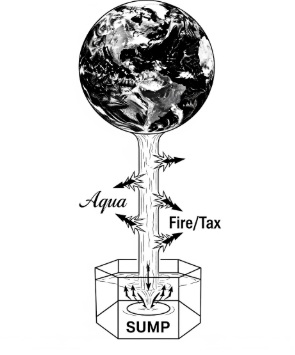
This idea for a stable currency with Universal Income goes back full circle to the idea in Fluidity the way to true DemoKratia which I started working on before the GFC, perhaps 2005 ish. It has been tweaked but it is still a solid, and probably best, way for a self stable monetary system. And it’s simple, I was surprised ChatGPT 5 preferred it over the NAMIA model in the next chapter but I guess in a world of AI simplicity and no reliance on external “oracles” (trusted third parties) for input data is a huge plus.
I had gone off it as more direct asset backed stablecoins took over the crypto and finance world, but fiat is unstable, we need something that looks more like what everyday people think of as money.
Earth–Aqua–Fire–Sump Spec
🌍 Earth — The Reserve
At launch, one finite clump of Earth is created 300 Trillion (24,960 x 7 billion people)
Earth represents the total lifetime supply of value in the system.
It cannot be increased or minted later.
Each PoHW-verified identity is eligible to receive weekly drips of Earth converted into Aqua.
💧 Aqua — The Flow
Aqua is the weekly income (UBI) people actually use: to spend, save, or invest.
Each verified ID receives an equal share of the drip from Earth.
For the first 4 years 25,000 comes directly as liquified Earth paid weekly
After that it comes from the Sump
Cap per person per week (e.g. 480 Aqua ).
Aqua is not permanent — it circulates in the economy until part of it is consumed by Fire.
🔥 Fire — Transaction Tax & Burn
Every transfer of Aqua applies a TT (transaction tax) of 4%..
The TT is siphoned into Fire.
Fire feeds the Sump, instead of vanishing outright.
Fire is the regulator: the more the economy moves, the more Fire collects, the more the Sump can redistribute.
🌀 Sump — The Regulator
The Sump is a pool of Fire.
Its only outlet is topping up Aqua (UBI).
In busy times:
Lots of transactions = lots of Fire.
UBI holds steady at the maximum drip rate.
Excess Fire accumulates in the Sump, pulling liquidity out of circulation.
In quiet times:
Few transactions = little Fire.
The Sump drains to maintain UBI flow.
When empty, UBI can fall below the cap until new Fire enters.
⚖️ Dynamics & Effects
Hard limit: Earth fixes total supply; no hidden minting.
Money supply regulation:
Fire + Sump act as an automatic, real-time central bank (money supply regulator).
They keep flows smooth, prevent runaway issuance, and cushion downturns.
🔑 Why This Works
Simple narrative: “There is one Earth. It flows as Aqua. Fire recycles it.”
Fair baseline: Everyone gets equal Aqua drip, limited by reality.
Resilient: No reliance on external price oracles to start. NAMIA can be added later to peg the weekly cap to staple goods.
Flexible: Works at city-state scale; can federate across rooms.
Notes:
Assumptions
- Target UBI (“Aqua”): $25k per person per year (≈ $480/week).
- Money stock inside Aqua (“MS”): aim for $100k per person steady-state by paying first 4 years from Earth (4 × $25k).
→ MS per person ≈ $100k once cohorts have joined and received 4 years of UBI from Earth. - Transaction tax (“Fire”, TT): 4% on in-Aqua spend.
- Coverage after Year-4: UBI for each cohort is paid from the Sump (TT revenue), with Earth no longer funding that cohort.
The core identity (why the math is simple)
Let:
- tt = TT rate,
- v = annual turnover (“velocity”) of the in-Aqua money,
- s = share of a person’s spending that happens inside Aqua (0–1),
- MS = money stock per person,
- UBI = $25k per person per year.
Then steady-state Sump funding requires:
tt×v×s×MS ≥ UBI\text{tt} \times \textbf{v} \times \textbf{s} \times \textbf{MS} \ \ge\ \textbf{UBI}tt×v×s×MS ≥ UBI
Divide both sides by MS:
tt×v×s ≥ UBIMS \boxed{\ \text{tt} \times \textbf{v} \times \textbf{s} \ \ge\ \frac{\text{UBI}}{\text{MS}}\ } tt×v×s ≥ MSUBI
With MS = $100k and UBI = $25k, the right-hand side is 0.25.
So at tt = 0.04, we need:
v×s ≥ 6.25\boxed{v \times s \ \ge\ 6.25}v×s ≥ 6.25
This is the single condition that tells us whether the Sump can cover ≈$480/wk after Year-4.
Real-world anchors for v (turnover) and MS (why 6–7× is realistic)
Two views of “turnover”:
1) GDP-based velocity (macro)
- US M2 velocity (Q2 2025) is ~1.385 (GDP/M2). That’s macro velocity; it’s low because it excludes financial churn.
- US M2 level (Jun 2025) ≈ $22.0 T; M2 includes M1—so don’t sum them. (FRED series M2SL definition and level.)
- Australia: the M2-like aggregate is Broad money; using ABS GDP and RBA broad money gives ~0.8× GDP/Broad-money velocity recently (nominal GDP ~A$2.6 T vs broad money ~A$3.2–3.5 T).
Takeaway: macro velocity sits around 0.8–1.4×/yr in mature economies—too low to fund UBI from a small TT unless MS per person is large (which is why we set MS ≈ $100k pp via 4-year Earth).
2) Gross payments turnover (what TT actually sees)
We care about value moving through payment rails (households, business, gov, platforms). In Australia:
- Non-cash payments averaged ~A$300 B per business day in 2023 (≈ 11% of annual GDP per day); ~70% of the value is high-value RTGS relating mainly to FX and securities settlement.
Annualising ≈250 business days gives ~A$75 T/yr total non-cash flows. If we exclude the wholesale RTGS plumbing per your policy (CLS pay-ins, CHESS/Austraclear funds legs, CCP margin), the retail/low-value remainder is about ~A$22–23 T/yr—roughly 6–7× broad money. That 6–7× is the best analogue for the v we should target in Aqua if we focus on real-economy rails.
Why “4 years from Earth” + 4% TT works
- Setting MS ≈ $100k per person (by paying first 4 years of UBI from Earth) halves the required product on the left side to 0.25.
- With tt = 4%, the condition is v×s ≥ 6.25.
- A mature retail-style system (excluding wholesale RTGS legs) can plausibly reach v ≈ 6–7. If most spending is inside Aqua (s ≈ 0.85–0.9), then:
- v = 7, s = 0.85 → v×s = 5.95 → funds ≈$23.8k/yr (≈$457/wk); a small gap the Sump fills from its buffer, or UBI floats slightly down in slow weeks.
- v = 8, s = 0.90 → v×s = 7.2 → funds ≈$28.8k/yr (≈$554/wk); surplus tops up the Sump, keeping UBI at the cap.
- v = 7, s = 0.85 → v×s = 5.95 → funds ≈$23.8k/yr (≈$457/wk); a small gap the Sump fills from its buffer, or UBI floats slightly down in slow weeks.
Crucially, the 4-year Earth runway lets the Sump build before it must fully support cohorts, so early shortfalls are cushioned by design.
Why we ignore wholesale plumbing (and what to include)
- The RBA confirms ~70% of daily non-cash value is RTGS high-value tied to FX and securities settlement—not the household/business transactions we want to tax. We exempt those.
We do include end-user settlement legs that touch the real economy: merchant acquirer payouts, platform disbursements (marketplaces, gig), government transfers, payroll via retail rails. That raises s without taxing CLS/CHESS/Austraclear/CCP margin plumbing.