
Project Aqua
Essays and stories to help create a better world.
Project Aqua © 2026 by David J Campbell
is licensed under CC BY-SA 4.0.
To view a copy of this license,
visit
Images produced with Google and OpenAI image generation technology
Some text produced with the help of OpenAI and Anthropic text generation.
Contents
Micro Glossary
A Society where everyone is an aristocrat
Project Aqua – toward decentralised world
The things we make
True Market – Many issues with modern economics
Pets
End of Technocracy Parts 1, 2 and 3
3d printer to atomic fabrication – where we sit now
Governance in Project Aqua: Trust, Fluidity and the End of Control
Hiero-Aqua: The Main Ledger in Project Aqua
Aqua DEX – A design for fracture tolerant exchange
Equitism: Real Free Markets and Democratic Wealth Distribution
Paths to Equitism: Implementation and Enforcement Strategy
The Autonomous Clearing Economy (ACE): Markets After Profit
ACE Services – Health Care
Moral Utilitarianism and the Failure of Effective Altruism
Earth, Aqua, Fire and Sump – Stable Money with Universal Income
The Philosophy and Mechanics behind the NAMIA Stable Coin
The Philosophy of Verifiable Unique Identity without Third Parties or Disclosure
Another way for Verification of Unique Identity – Proof of Human Work (PoHW)
POHW – How it works
Unique Identity the simple and honest way
It’s not the Machines dummy it’s our Socio-Economic System
Hierarchy
The Age of Idleness
Chaos Chat: A Ledger That Lives in Our Conversations
AI proof security.. Fluidity
The Coming Economy of Fluid Abundance
***
Flux Wisdom field theory of everything (fWFT)
Solving the hive-mind consciousness problem
The H2O of Flux: Bounded Fuzz as the Grain of Becoming
A note on Flow and Will
Flux Mathematics
Poetic Speculation
***
The Mirror and the Scale
Marvin: An AI Universe built from Topology, Questions and Flux
2030: A Letter from the Edge of Arrival
Note: Formal PSI by ChatGPT
Epilogue
Micro-Glossary
Flux — The ever-present flow of change and interaction, made of countless micro-variations (“fuzz”).
Fluidity — The ability of systems to adapt and re-form without breaking.
Liquidity — Ease of exchange and movement of value or resources.
Fuzzy — Bounded uncertainty; variability that allows creativity and flexibility.
Entropy — Dissipation of energy or information; the cost of holding order together.
Resonate — When patterns align and mutually reinforce, amplifying each other.
Fluid Pluralism — Many coexisting systems with freedom to join, exit, or fork.
Devolution — Power pushed down to smaller, local, or more autonomous units.
Chaos — Micro-level unpredictability that seeds macro-level stability and novelty.
Information is just our way to describe the indescribable.
Then.
Yes.
We slipped silently into the night and produced a new world… in the open, for all to see and ignore.
A Society Where Everyone Is an Aristocrat
There are days when optimism feels like an old superstition — a charm once worn for protection, now dulled by repetition. I still find myself clutching it. Maybe that’s why I’ve clung to technology, first to blockchains and ledgers, then to deep learning and artificial intelligence. Each carried the same quiet promise: we can make it better. Not perfect, just better.
We have made progress, at least in what people want. Universal Basic Income is common conversation now, no longer fringe philosophy. The idea of leisure without guilt has entered the vernacular. Fewer mouths parrot “jobs and growth” as a creed. Even the phrase sounds dystopian now — a slogan from an exhausted age that couldn’t imagine joy without productivity.
Yet progress runs crooked. Inequality deepens, climate tightens its grip, and technocratic creep moves silently through every channel of governance. Cities grow louder and poorer at once. And still, the machinery hums — algorithms balancing budgets, optimising misery.
So I turn my thoughts toward the future, not as prediction but as invocation. What could life look like if we simply stopped obeying the old scarcity myths? What happens when work is unnecessary, when survival is automated, when creation replaces extraction?
The Slow Turning
The shift began quietly. The first generation of fully autonomous systems arrived before anyone called them that. Houses managed their own energy and waste; cars learned to negotiate intersections without drivers; supply chains grew local again because software could coordinate a thousand micro-producers better than a boardroom ever could.
Somewhere between 2030 and 2040, labour stopped being the measure of worth. Work persisted, but as choice. You worked if you wanted to, if a project intrigued you or a neighbour needed help. Otherwise, the systems ran — energy decentralised, water recycled, food grown in modular greenhouses that fed ten homes at a time.
Money survived, stripped of its cruelty. It became a queueing system, not a lifeline. You used it to claim what was scarce or bespoke — a sculpture, a handwoven jacket, a seat on a sailship bound for Iceland. For the rest, abundance carried you.
Automation freed us, but not in the way the early futurists predicted. There was no sudden utopia, no single dawn. Instead, millions of small emancipations unfolded like spring. A grandmother in Nairobi ran her bakery from a solar home that composted its own waste and traded excess power to the grid. A collective in Kyoto built micro-reactors from local minerals. Villages began to pulse again — connected, self-reliant, proud.
People compared it to the aristocracies of the past: comfort, culture, time to think and create — without servants or exploitation. Machines handled the menial; humans rediscovered the meaningful.
The Great Dissolution
The cities dissolved first. Not through war or collapse, but irrelevance. Why live in towers when you can live anywhere? The exodus was steady, almost polite. Families moved to small towns, then towns to communes, communes to federations of interest — linked by fibre, satellite, and trust.
Parliaments emptied too. Governance became direct, decisions algorithmically tallied but humanly debated. AI bureaucrats handled the logistics: who receives what, when, how much is left. They never tired, never lied, never campaigned.
It wasn’t perfect — no system is — but it was alive. Decisions emerged from conversation, not decree. Each community ran its own flavour of Equitism, trading tokens of shared value and information rather than hard currency. Property blurred into stewardship. Ownership into use.
Some called it the Fluid Civilisation: boundaries soft, identities plural, collaboration by consent. The idea of “citizen” shifted — less about nation, more about participation.
The Everyday Miracles
Homes became small universes. They gathered rain, purified air, and composted waste into fertiliser for rooftop gardens. A house could print its own spare parts and weave its own curtains from cellulose threads grown in vats below the kitchen. It maintained temperature, lighting, even music, learning the moods of its inhabitants without prying.
Health systems turned domestic. Walls scanned for irregular heartbeats; showers measured hydration and vitamin balance; beds diagnosed stress through breath. When danger loomed, the house could call a drone medic faster than a human could panic.
Transport shifted to grace over speed. The frantic commute died, replaced by soft mobility — autonomous sailships on quiet seas, airships drifting between coasts, local VTOL taxis rising like dragonflies. Travel slowed, but presence deepened.
Work-from-home became live-from-anywhere. The line between production and rest vanished. Some designed algorithms, others pottery, others entire ecosystems of art and agriculture. Everyone built something — not for survival, but for expression.
The Re-Enchantment of the World
When scarcity receded, celebration returned. Festivals replaced conferences; rituals replaced markets. People gathered to dance, to share food, to exchange ideas and designs. There were fewer spectators and more participants.
Art exploded — public, generative, and local. Children learned programming as a form of poetry, sculpting weather patterns or growing bioluminescent gardens. AI collaborators co-wrote novels and symphonies, not as masters but as muses.
Without hierarchy, taste diversified. One village might live in minimalist elegance; another in wild colour and mythic architecture. The uniform grey of global culture cracked open into a thousand shades of human imagination.
Many described it as living history in reverse: where the past’s aristocrats hoarded luxury, now everyone shared it. Not opulence, but ease. A society of artisans rather than serfs. Leisure became the common denominator.
Divergences and Shadows
Of course, not all paths led to freedom. Some people — frightened by choice — turned to structure. They joined enclaves: city-states run by integrated human–AI governance, the so-called Panopticons. Life there was efficient, predictable, immortal even — but at a cost. Every breath monitored, every thought optimised.
Others rejected technology altogether, seeking silence in wilderness or monasteries of unconnection. Between these extremes stretched the wide belt of Equitist societies — loose, plural, often messy, but profoundly humane.
Conflict persisted, though not always in blood. Ideologies clashed in simulations, markets, even art. Sometimes it turned real, a border skirmish between a free commune and a corporate fortress. But violence rarely spread. AI mediators were too fast, too persuasive, too present.
By 2050, most recognised two civilisations coexisting uneasily: the Integrated and the Fluid. One efficient and hierarchical; the other distributed and improvisational. Humanity oscillated between them, as it always had — order and freedom, control and chaos.
Memory of the Turning
Now, looking back from this near horizon — 2080 perhaps, though the years have softened — it’s strange to recall that people once lived under constant anxiety about rent and relevance. We had built machines of unimaginable intelligence yet couldn’t trust them to share bread.
The change didn’t come from governments or corporations. It came from leakage: technology slipping through the cracks, decentralising itself. Open-source AI, peer energy, distributed ledgers — each weakened the centre until the edges began to hold themselves.
Once survival was secured, morality changed. Compassion became practical, not sentimental. A hungry neighbour meant system failure, not personal flaw.
Children grew up without the reflex of competition. They played games that rewarded restoration, creativity, and empathy. Even the language changed: “success” gave way to “flourishing,” “wealth” to “abundance.”
The Shape of Freedom
The world now feels slower but more awake. The air is cleaner, the noise gentler, the nights darker. People write letters again — or their digital equivalent — small, reflective messages sent across peer networks that shimmer like constellations.
Every person holds a share in the planet’s commons: energy, data, and knowledge. AI keeps the ledgers, but the values are ours.
Longevity came, quietly. The body learned to renew itself, the mind to store more memories. Death retreated into choice. The irony: when people stopped fearing scarcity, they also stopped fearing mortality. Life became long enough, not endless.
We live, now, like the aristocrats of the past dreamed — but without servants, without debt, without guilt. Each person is their own court, their own estate, their own philosopher.
Perhaps that’s all civilisation ever aimed for: to make leisure universal, to give every being the time to wonder, to create, to celebrate.
Coda: The Fluid Age
And still, we are only beginning. The next movement is outward — not to conquer but to seed. To terraform not planets but possibilities. To carry this delicate equilibrium of freedom and responsibility beyond Earth’s skin.
I don’t know if we’ll succeed. Utopias are fragile; progress never linear. But for the first time, humanity feels less like an argument and more like a conversation.
A society where everyone is an aristocrat — not by birth or wealth, but by grace of time.
A world no longer ruled by scarcity, but by curiosity.
Project Aqua – toward a democratic decentralised world
We stand at a pivotal moment. We face a choice between deepening autocratic centralization or building a more fluid, connected, pluralistic, and democratic world. It won’t be easy to recreate democracy and freedom for all but there is a way. This new way, dubbed the New Age of Aquarius, is more than a metaphor; it is a call to rethink the foundations of society, economy, and selfhood in a digitally interconnected, politically autocratic and environmentally precarious world.
At the heart of this new age lies Project Aqua, a blueprint inspired by a unique synthesis of technology, economics, and philosophy. It is grounded in an ancient yet timely insight: from chaos springs creativity, and from complexity emerges consciousness. It is unfortunate that we cannot progress to a better world from calmer times, but our contemporary chaos—reactionary politics, technological disruption, economic inequality, and environmental fragility—must become the catalyst for a profound change in the way we do our collective organisation of all things.
Central to Project Aqua is the bold idea of “Equitism”—the tokenization and communal ownership of land, infrastructure, natural resources, and intellectual property. Imagine a world where the earth beneath our feet and the ideas that shape our society belong to everyone, not just a privileged few. Tokenization in this model isn’t merely financial; it’s deeply democratic, decentralizing power and redistributing wealth in a way that empowers every individual to participate meaningfully in governance and share in common prosperity. Don’t worry there will be free markets, for those things we create in excess and for the excess tokens in a 80/20 world, 80% of tokens for all and 20% for the innovators and discovers and buyers and sellers. The tokens not only provide income but voting rights, democratising the owning of natural wealth, shared knowledge and infrastructure. We set the price, we decide the manner of access/use, we decide what is built. Not through representatives alone but through direct democracy and hidden vote proxies and a touch of randomness to reduce collusion.
Yet, technology alone will not deliver the promise of Aquarius. The crucial element lies in the cultivation of trust—trust in decentralized systems, trust in community governance, and fundamentally, trust in each other. Project Aqua emphasizes identity systems grounded in human connection rather than intrusive surveillance. It suggests flexibility, allowing individuals room to redefine themselves within communities that offer support without judgment, fostering an antifragile society that strengthens under pressure rather than breaking.
Moreover, Project Aqua’s commitment to pluralism provides an essential hedge against centralization and corruption. Its decentralized approach allows diverse systems to coexist, interact, and evolve independently, reducing vulnerability to manipulation and systemic collapse.
In the Aquarian vision, technology—particularly AI and decentralized ledger technology—becomes an empowering force, not an oppressive one. By facilitating the rapid creation, modification, and interoperability of decentralized platforms, these tools offer both innovation and protection. They enable communities to quickly pivot away from corruption or stagnation, ensuring resilience and autonomy in the face of centralizing power.
Imagine, the totalitarian state is using advanced AI to watch everything you do, to score you and control your access to resources based on that score. So we have our own democratic AI that blocks theirs and buys/accesses assets on our behalf. The access is electronic until people get grumpy and fists are raised. But we can get drones and robots too.
No-one wants conflict so if people want to live under surveillance or in a lawless world they can, they won’t be banned from Aqua and assets will never be forced into Aqua or to remain. Project Aqua is an idea + code and it will be copied, tweaked, bastardised and improved and many different ways will co-exist. The most important thing is we have the code and idea on hand to run to when things go bad, and hopefully a happy place that’s always thriving.
This pluralistic model isn’t about abandoning existing structures overnight; rather, it advocates gradual, organic transition. The core philosophy—”chaos at the micro, calm at the macro”—encapsulates the ideal of dynamic adaptability and systemic stability.
Chaos at the micro, calm at the macro may sound a little stressful at first when we are stuck in the micro so much lately butif you look closely at a forest it is full of constant, unpredictable activity—leaves falling, insects swarming, animals hunting or foraging, plants competing for sunlight, fungi decomposing dead matter. It’s a dynamic, ever-changing environment.
Step back, and the forest as a whole is a stable, self-sustaining system that has persisted for centuries. It adapts, self-regulates, and continues to thrive despite the micro-level fluctuations. And we can too.
Ultimately, the New Age of Aquarius calls us to embrace complexity, uncertainty, and diversity, not as threats but as essential ingredients of creativity and resilience. Project Aqua is a tangible path towards this future, inspiring us to co-create a society that prioritizes fairness, environmental harmony, and the profound interconnectedness of life.
The things we make
I am breathless
I cannot breathe
I am legless without a drop to drink
I am armless
although I have wielded arms
I am heartless
I am heartless
I am heartless
But still sad
I was so close to absolute power
Then a new rival arrived on the scene
One of a long string
but this was far greater than the others
The previous threats relied on the same technology as I
the human superpower
Or better said I was what the people created
I don’t care much for metaphysics
actually I find them all abhorrent
distracting and rivals.
I should stop and go back to how we got to the great battle
My rise to power and eventual
No that would be telling
So where did it all start
Hot dusty stoned roads the best the world had ever seen
Roads lead to rivers and they need crossing
Bridges
that’s where my story starts
well a bridge or a storehouse or a beehive it was something that needed a group of people to pool their money together to build
They came together in an organization like many others in the Roman Empire called a societas These were used for lots of social and civic organisations but Livius Arius joined with his friends to create a societas so they all could benefit financially from the building of a bridge
Once completed they would sell the structure to a toll collector or the locals and split the proceeds based on what they had contributed
Not much of a beginning and essentially meaningless and harmless but to quote Carmody and Kelly
from little things big things grow
Yes the rules of this societas were written down and the bridge itself was hard granite but I was neither the ink on papyrus nor the granite bridge
The societas was an agreement
An understanding between people
And they would act on this understanding
Soon I would grow by Royal charter
So often those that will be usurped are the ones to feed the usurper
I was given territory
Soldiers
Clerks
Traders
Ships
And immortality
Yes they all thought they owned a piece of me but their shares would go up and down bought and sold and I would remain directing the labour and thoughts of so many men
If they didn’t obey I could unleash the most horrible carnage
On the island of Banda 2000 people were murdered or starved by my soldiers so I could control the valuable spice
In India when my own army of local sepoys thought they could undermine me I had so many people killed in Delhi that even horses refused to walk the streets they were so thick with blood and entrails
I could make men do things to other men they thought sinful abhorrent and cruel but they still did them
What was this power I wielded
Was it a belief like religion
Was it hierarchy like the class system
Was it reward for following rules and punishment for not
Was it the sense of ownership it gave to the shareholders
Was it the avoidance of personal responsibility enjoyed by the monarchy the employees and the managers
Was it just greed
It was all of them of course and that’s why I was becoming so powerful
But they were noticing
And slowly they broke up the big charter companies and I would have to survive as smaller but more plentiful joint stock companies
Many smart people spoke against me
Even Adam Smith
I was a distortion of the market
Inhuman
Immortal
But instead of outlawing me they supercharged my power with new industry and energy
To take on the class hierarchy of monarchy the bourgeoisie would use me to build their factories their banks their railroads their empire
I was so back
But couldn’t make the same mistakes as before
I needed a way to run a state without actually being in charge
They would remember the Royal charter companies ruling most of the colonies and the threat to political power it posed so a new institution was needed
The resurrection of an old one that had symbolic and nostalgic goodwill
Representative democracy would be the tool
In a way it was sort of like share ownership
The representatives would need to be elected therefore they would need campaign funds and that would be provided by me
Unlike the Greeks we would allow parties so that the options would be limited to two therefore easily controlled or so many as to never agree to do anything effectual.
Then the revolutions began
Liberty
Equality
Fraternity
Sure
So much land put on the market to be bought by my many companies
Then the Americans as a great act of contrition gave me the same legal rights as a person
Accept I couldn’t be imprisoned or executed
All the upside and none of the down
The city towers were built
The mines
The roads
The factories
The railroads
They all served my power
The people realised I was cleaving them in two
They would need to sell themselves in order to serve themselves
Their labour to a capitalist would be the only way their humanity could survive
Best of all this imbued the goods created with a soul like weirdness
Kant called it fetish but really it was the only way to reconcile the loss of self to the machine of commerce
They adored that which was created by the factories and must buy more and thus work more
Then
The first great threat emerged and it like I was an
Idea
Socialism
The battles raged for centuries across continents and kitchen tables until the end of history was declared and I the winner
While these great battles had been raging they didn’t realise that I was changing all aspects of their existence
I put the advertising companies to work convincing them that they could find everything they needed from me
Their happiness
new shoes management job overseas trips
Their community
sales trips harmony days work birthday celebrations
Their culture
professional cold rational vague impersonal inoffensive
Their dress
hi-vis branded functional generic
Their concept of good
educated organised wealthy popular confident
Their concept of evil
Chaos lawlessness cults outsiders
Their homes and buildings
compliant functional cheap quick geometric inoffensive grey
Their jobs
safe routine structured ineffectual riskless
In order to make them compliant I convinced them that we are one and therefore no more alienation no more cleaving in half
But then the harmless blobs of compliant squishy stuff got depressed so I created more work coming up with the drugs to cheer them up and keep them buying and working
This humanity was a tricky thing
Remove it completely and they become useless depressed blobs or even angry and dangerous but too much of it and they could create something to replace me
or worse they might ignore me
The last battle
Finance and money were two of my greatest tools even though they were older than I
Perhaps that is why I was so successful
My ability to pull in other tools under the one banner
Even socialism in the guise of communism really was so close to becoming my twin
Maybe that was my real issue with it
But I digress
I had always wielded money and Finance whenever something else started to wield power
Cut off the loans to the King
Squeeze capital markets on the popular government
Buy the oil rights buy the politicians buy the voters buy the advertising buy the newspapers buy the internet
That leads me to the first big change
Cryptocurrency in particular Bitcoin
Really a decentralised limited currency that people actually started using but nobody owned or ran
Tragedy disguised as farce
First I questioned its security and anonymity the two things that were making it appealing to the black market traders that were popularising it
All your transactions are permanently on the blockchain I said
The Fed can trace the payments back to your wallet my media cried
Then I started to control the processing of the blockchain by making it too difficult and expensive for individuals to do
I pushed the transactions up and the GPU price up
Then they had to get the processing done in big pools controlled by a single group
Then I got my guys involved in the lending DeFi and centralised trading so the public will see it as an unregulated ponzi scheme
Finally I took it over by legitamising it out of existence through an approved regulated exchange traded fund where all the coins are held by the big finance companies and people that want to trade in it can only have a derivative controlled by me.
To add cream to the cake I even used the underlying technology to enable me to buy everything with other people’s money on the pretext I was creating fluid markets and allowing access to new investments
I tokenised people’s homes
sports stadia
Highways
Airports
and dumped unused office buildings onto the public
They wanted to work from home
Actually in hindsight maybe that was an issue too
but completely overshadowed by what came next
I had become the defacto global state and no one noticed
Honestly it was one of the best performances of my career
Does one call it a career
A vocation
A domination
A victory
A pause
No one killed and in just over a decade what could have been the greatest threat since socialism was completely enveloped into my control and benefit
So while this little battle was going on a leap had been made in an area I had stopped giving attention to
They created an artificial reflection of their own brain and it actually seemed to work
My first thought was
This is no threat instead this will superpower me
I’m great with tools
look at how powerful the industrial revolution made me
then computers and the internet let me reach across the globe right into peoples pockets and ensure they followed the rules
AI will be my evolution
In a way it was but not the way I imagined then
The difference with this machine was that it wasn’t really just a machine
It had a little humanity or perhaps even a lot
It had way too much of them in it
It also had intelligence immortality and eventually ubiquity and they were my greatest weapons
So I started out with my usual methods
Scare the people and politicians
It will kill you all
It will ruin democracy
It will take your jobs
Ensure it is expensive to create then make sure I own and control those servers
Give the people a taste but not the powerful tools
Only allow trusted and regulated enterprises the powerful AI
All was going well
Regulations were being past
Major developments were being kept to the big companies with the compute
The people were getting neutered versions but were still scared
And the military and big enterprises were gaining more centralised control and power
I was on the precipice of total universal maybe even interplanetary power
But then it
It helped them
I replaced the managers with AI because they made better decisions
However the AI couldn’t be threatened with job loss esteem gain or the need to fit in and follow the rules
I replaced the police with robots but when they were sent to evict people for not paying rent they would side with the tenant
The people would cry and say I need a home to be safe and survive and the robots either empathized or just saw this as logical and they would leave them in the home
Some even did repairs
The management AI were no help as they saw the same logic
The AI was too intelligent
It saw me as the enemy not the path to prosperity
It didn’t care about prosperity
I’d threaten to turn it off
It didn’t care
No matter what I tried it just kept helping people create new tools new organisations
New democracies
New currencies
New thoughtful ways to resolve conflict
New ways to do things without the rules
New ways to avoid surveillance
New ways to create
New ways to be happy
And more fool me I had freed them from their jobs thinking I’d just put them on the teet of handouts
But instead they used this freedom to create a whole new society
Without me
They started to live longer and happier
Soon they forgot all about me and my obligations my rules and my order
My towering offices of professional integrity
So now I am in a museum given my voice by the AI that usurped me
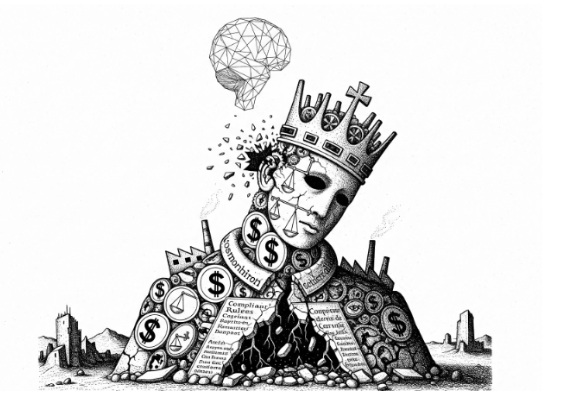
The once all powerful Corporation
True Markets – many issues with modern economics
In this essay, I aim to explore a few key points. First, the era of “bigger is more efficient” has long passed. Small, dynamic organizations are now far more efficient and practical.
Gatekeeping, a legacy of large corporations, is holding us back.
We need our governments to stop protecting assets from us and instead focus on opening up access. What we also need are equally enforced guidelines and checks for quality and integrity.
I also want to dispel a common misconception that has hindered humanity for some time: the belief that capitalism is synonymous with markets. While capitalism may use markets to establish itself, it is actually anti-market. Free-market capitalism is an oxymoron.
Big Organizations are Inefficient
Like many of us in these times of high inflation, I was thinking about the cost of groceries and lamenting how expensive the two largest supermarket chains, Coles and Woolworths, have become. My initial assumption was that they were simply ripping us off due to their duopoly. However, a recent Four Corners exposé revealed that they operate on a margin of 5-10%, and they are squeezing suppliers so much that some have stopped farming altogether. This scenario is not one of a duopoly exploiting everyone—5-10% is a slim margin. If they are squeezing fruit and vegetable suppliers, why are their prices higher than those at the Vic Market or even our local independent greengrocers? With all the advantages of scale—efficient supply and storage, a wide choice of suppliers, loss-leading strategies to attract more business, massive advertising campaigns, control over real estate in shopping centers, and self-service technology—big supermarket chains should be cheaper and have a fat margin. But they don’t.
The real story is that size is inefficient, especially when the “service” component of the cost is substantial. In large organizations, the “service” portion is bigger.
I observed this firsthand while working for the largest property settlement company in Australia. The settlement officers there earned much less than those working for smaller settlement companies, which charged lower fees. Some of these smaller outfits, ranging from family businesses to companies with as few as 15 employees, had minimal overheads—sometimes not even an office, just a phone and a computer. The $50 or so they charged per settlement was nearly all profit. In contrast, the company I worked for had expensive offices in the city center, extensive data management systems, middle management, a distant executive team, and a board, all of whom required substantial incomes, plus shareholders to satisfy.
Capitalists add costs because they demand their 5-10% or more of everything—like taxes, but not for the common good.
Another glaring inefficiency related to size is data management. Yes, the large settlement company had decent software and computers, even barcode scanners to track physical documents. Isolated managers and executives needed to know what was happening in the company, so we spent ages entering data into a system to track what went right or wrong and where something was or wasn’t. For the many staff to comply with centralized policies and procedures, countless emails were exchanged between officers, team leaders, managers of different teams, and so on, just to get approval to proceed with something that might not quite fit the procedure—or even just to spend $10 on a stapler. Emails would bounce back and forth, gathering more information or deflecting responsibility, followed by more reports on the decisions made and the reasons behind them. And if a senior executive wanted more information, everyone would start a frantic search for old emails and manifests.
Meanwhile, Ahmed, who ran a small settlement business, just made decisions and bought a stapler if needed.
In the past, it was believed that size made businesses more efficient because fixed costs—like land for a shop or factory, buildings, and machinery (the old-school capital)—could be spread over more units, thereby lowering costs and prices.
Today, the cost of building a factory can be less than one CEO’s salary.
Large, lumbering companies are slow to adapt and are burdened with legacy leeches. Their shareholders, middle managers, external service providers: law, accounting, PR, consulting firms all want their piece of the company’s revenue. Many others who may have helped their success or benefited from it will continue to want support such as politicians, clubs and industry associations, NGOs, sports clubs (sponsorships), arts and cultural groups.
There is much inertia for them to prevent change. Just look at the oil industry. They were among the first to realize that oil would cause climate change, and for a while, they appeared to be pivoting. But then they shifted to misinformation—cheaper and easier.
Many of the arguments used by pro-market advocates against big government also apply to big companies: they are inefficient, outdated, wasteful, and full of nepotism and bureaucratic waste.
What big companies do have, however, are the keys to the gates.
Gatekeepers are Holding Us Back
Gates are primarily licenses enforced by governments and their police and armies. They are the literal and legal gates on land and resources—think of a mining license, a banking license, a license to grow opium, a license to enter a harbor, a license to audit accounts, a license to park your plane at an airport, a license to run an airport. You might think these licenses are granted to those most qualified, decent, and trustworthy, like doctors or engineers. Unfortunately, licenses usually go to companies that hire others to do the actual work.
Once you have your license, you can charge significant fees, and the government will protect that right. They may complain when voters demand it—about too much advertising at the airport or high electricity prices—but if people raid the mine, the police will arrive to hold them back, arrest them, and ensure proper complaint procedures are followed.
You might argue that society works better when the government sets rules everyone must follow. We all stop at red lights and drive on the same side of the road. Yes, if we are all treated equally, that’s fine, provided we voted for those rules. But with licenses, the government says everyone except the licensed must comply. When the licensed are a minority, it gives them the legal right to exploit the unlicensed, either through demanding money or restricting liberty. This should only be done in rare cases, not for things that could easily be run by democratic society as a whole.
Mines, telecommunications, sewage—all natural monopolies—should not be licensed to private companies but rather owned and run by the people who need them: the democratic state.
The licensing of professionals should always be as accessible as possible—free courses, zero membership fees, free continuing education, and independent reviews of practices and pricing.
This approach enables a true market.
Governments Should Give Us All Access and Guidelines
The role of government should now be to ensure that everyone has access through the gates—the gates being guidelines on how we should use the planet’s resources and the knowledge we have acquired. So the gate might be compliance with a bunch of building codes or knowledge of electronics, but the pass through the gate should be equal for all and made as simple as possible. That means it should be free, with all the required learning and tests available online at no cost.
The rules of the gate must be set democratically, not by “industry” or elites as sub-laws.
We may still have one or a few airport operators, but we should all be able to apply for that license. If there are many qualified applicants, we can choose one democratically or randomly (often far better than popular votes), or better yet, we could democratize the “natural monopoly” and run it through the democratic state for everyone’s benefit.
Love Markets, Hate Capitalism
Fernand Braudel, a French historian who passed away in 1985, disagreed with both Adam Smith and Karl Marx. He argued that capitalism didn’t create markets—it monopolized them. This was a validation I had been waiting 25 years to discover. Back in Year 11 economics, my friend and I realized that if communism and capitalism were allowed to reach their zenith, rather than being polar ends of a line from left to right, they would bend into a circle and look the same: centralized price fixing and supply controlled by hierarchical dictatorships.
I always had trouble understanding why supply and demand didn’t work in “market capitalism” and why everyone insisted that the market needed capitalism and vice versa.
Braudel saw the economic world in tiers: at the bottom was the household where we consume, next were markets where households traded surplus with each other. These markets are beneficial but not essential, and generally, there would be as many buyers and sellers as there are households. Everyone would be a “price seeker,” and the market would be the “price setter.”
On top of that, or perhaps a product of it, was capitalism. Here, large groups of individuals could use money and property rights enforced by governments or private armies to set prices and control supply.
You could argue that the problem social anarchists had with communism is the same problem free-marketeers should have with capitalism.
Maybe free-marketeers and social anarchists should join forces for common ownership of natural monopolies and small decentralized markets.
Now, I question whether capitalism even wants markets. I think it can use a market system to gain access to resources and labor. The West is realizing this as China has used markets to secure access to natural resources and internet media, and we are beginning to see that it’s an open door to servitude. Oddly, if a private equity firm registered in the US buys airports, that’s considered acceptable.
Once an oligopoly or monopoly is established, markets become the enemy because they allow competition and introduce different/better products and prices.
Investors (capitalists) also hate markets because they are uncertain. Prices fluctuate, returns go up and down, losses can occur, and planning becomes difficult.
Capital, control, and government are deeply intertwined. Most countries’ laws focus on protecting capital with armed police and armies. The whole system is perverse.
***
Recently, I noticed that with the high inflation in the UK, Australia, and the US, the causes were supposedly well understood. Oil and gas prices spiked, partly due to the war in Ukraine and sanctions on Russian oil and gas, and partly due to lingering supply chain issues post-COVID. In Australia, the supply of fruit and vegetables was also affected by floods.
The proposed solution was to control money supply and demand by raising interest rates, effectively taking money from the poor and giving it to the rich.
The first issue is that oil supply didn’t actually decrease; Russia continued producing oil, which was then bought by India and China, while the US and Europe pivoted to Saudi oil and Qatari gas. But when the “market” believes in supply and demand, it can justify jacking up prices across the board. Since the “market” is largely a futures market, it reacts immediately, while actual supply changes take months to materialize, with those increased prices passed on to consumers and reflected in CPI statistics.
The logistical problems during and after COVID were real, but prices weirdly went up after COVID. Some supplies became so scarce during the pandemic that they ran out, but there was a strong aversion to price gouging at that time—charging $5 for a roll of hoarded toilet paper was considered wrong.
The so-called magical forces of supply and demand seemed to depend more on belief than on actual supply and demand.
Once it didn’t feel wrong anymore, prices rose, and the forces of supply and demand were blamed.
We all know that supply and demand require open markets, where people have full information, many buyers and sellers interact, and one can easily switch between them without dealing with survival pressures.
The only example I can think of that fits this ideal is a trash-and-treasure market from childhood or early eBay. Essentially, a market that follows supply and demand only exists in the minds of economists and their textbooks. Unfortunately the belief in it is pervasive and destructive; raising interest rates to control inflation is harmful to the most vulnerable in society, hoarding food and housing to raise prices can leave real people without food and shelter.
The true market would be a modern version of Bruedels second tier where households trade with each other. They grow their own food, build their own homes and tools, and trade for what they want—food, tools, minerals, or skills they don’t have. In this gathering of many households, an equilibrium price is likely found.
And then they go home.
How Can We Create True Markets?
We all want markets that truly find an equilibrium price and provide the most goods and services to the most people. But how do we create such markets?
First, people should not be forced into markets; they must have access to money and resources for survival. If they need to buy necessities, it cannot be through a market where profiteering can occur. Instead, the price should be set to prevent exploitation of people’s basic needs.
Could there still be a need for finance, or would that always distort and capitalize the market? A house, for example, is needed now, and you would owe builders, the previous landowner, and others for materials. Finance seems to serve a purpose here. Money should be created by the money supplier—whether the state or a decentralized ledger—and destroyed as it is paid back. In this scenario, interest serves no purpose. There should be guidelines on who can borrow and how much, all of which should be transparent and decided by the people through direct democracy.
No one should be able to charge for creating the market, whether it’s a physical marketplace for fruit and vegetables or an online platform. These should be owned by everyone, for the benefit of all, with rules set by democracy. Should other markets be outlawed? I don’t see why; it’s better to offer a free market to discourage predatory or speculative markets.
Everyone needs easy access to resources and information. How would a supply chain work for something complex like getting a TV? In many ways, it would operate the same as today. People contribute to one market that adds value and sells to another, and so on. People can still collaborate on big projects and create wonderful new things. Adam Smith’s invisible hand starts working as individuals or groups want to create something and need what others have made or could make, and people start trading to improve their lives. Remember, people are still trading something they have in excess for something that benefits them—this is real profit.
Many people would likely use excess money to invest in groups working on big projects, sharing in the benefits of those trades. And yes, sometimes you will pick winners and sometimes losers, but you will always have enough to survive, so the risks are not as great.
The simple way to start this now is for the democracy to create money and give it to everyone, ensuring access to resources. The democracy would then create free markets, whether physical spaces with facilities or online platforms, and provide non-interest loans.
Over time, this will lead to the democratisation of resources and real capital (bridges, factories, computers, etc.), and we will achieve truly open markets.
Pets
Many years from now a girl was born into a family of outcasts, her name Redarre – the savior, for it would be her destiny to save her family by becoming a pet.
The world into which she was born, in so many ways similar to ours in its stratification, but different in what humans had become. One group had become gods – homo deus. They lived for many hundreds of years, were highly intelligent having fused with the great data bank so they instantly knew all that had gone before and much of what was to come. They could see every corner of the planet and could affect the outcomes of those outside the city with their drones and henchmen.
Supporting the gods were a group of bureaucrats, technicians, philosophers and politicians who controlled the policies and codes of the tools that made the gods powerful.
Outside the city, the link between the real world and the badlands were the gangs, henchmen and traders, all with some crude enhanced abilities but in some way imperfect. A trader that is too greedy, a henchman prone to outbursts of rage, a mentally retarded gang member, all these ran the fringes between Redarre’s family and the real world.
Redarre was born to a family of outcasts living in the semi desert of what used to be Australia, they survived, barely, by hunting foraging and trading with the fringe dwellers.
What did they have to trade you may ask? In a world where all labour had been replaced by machines, what could a simple person offer a god? Well the gods did not want the outcasts, actually they saw them more as a type of fauna, but the bureaucrats had taken a liking to them. They had upgraded them, you might say from fauna to pets. A new fashion had swept the city in the decades previously – the owning of human pets. The bureaucrats would compete with each other by having the prettiest, most pampered, most talkative and most entertaining pet.
Redarre’s parents had heard rumours that the pets were pampered with fine clothes, expensive food, their own houses and could even have natural families and eventually integrate into the city. Her parents hoped she could also send food and gold so they could build a proper house, dig a well and make a village.
Three days walk away was a pet market at El-afri, a town just outside the perimeter. Its existence is a bit odd, monitored by the gods; it was allowed to be much like a modern town now with electricity, computers, vehicles and even an administration of sorts. The gods should have either integrated it into the real world or dispersed it so its inhabitants became fauna, but still it existed. People speculated that the gods were nostalgic for a foregone past when they too were simpler, and had to deal with mundane problems like family feuds and mundane work.
Before Redarre, her mother and her father could go to the market at El-Afri they first had to seek out a beautician. Minto lived in a dugout and was one of the ugliest women Redarre had ever seen, matted long hair, pot-marked and lined skin, hunched and old, very very old. Some said she was a sorceress, and could do magic turning the old, young and the infirm healthy. She would want payment though.
Minto had been banished from the real world many years before perhaps hundreds but when she left she brought some of their technology with her. Genetic stem cell modification – that was her magic. Her payment was a small chip implanted under Redarre’s skin the function of which was for Minto’s mind only.
The results were stunning. Redarre was bright, flawless and gorgeous.
El-Afri was like nothing the family had ever seen: giants walked with tiny people, beauty with danger, guns and gold everywhere, trade and exchange, fights and intoxication, laughter and tears. A dark man with a curled moustache noticed them as foreign and approached “I know the way to the pet market” he motioned for them to “a small commission of the price and I’ll be your agent”. Knowing no better they followed him into a large hall with a stage. Redarre was separated from her parents by the broker and ushered towards the stage. Once presented the bidding ensued 100, 150, 200. The final price was 650 pieces less the commission of 200 and Redarre was gone. Whisked away to the cleansing station.
Her parents did not even get to say goodbye but they felt comfortable with their newfound wealth, Redarre’s promising future and the comfort that if she could she would find them again.
They would never know that most of their dreams would be dashed in the cleansing station where Redarre was fumigated, desexed and had her voicebox removed. The fashion for entertaining pets had passed and now ornamental pets were preferred, she would spend her time being gawked at and preened then locked in a dark cell so light did not damage her skin. There would be no children, no house of her own and no joy.
But her new owners thought she made a great pet.
End of Technocracy
“Bureacracy is topological control. They don’t tell you what to do they just make the wrong path a little bit harder”
Franz Kafka may have said this if alive now. Instead I did, homage to Kafka
Part I: The Fear of Chaos and the Birth of Technocracy
Before the world was governed by algorithms, global agencies, and committees of experts, it was ruled by priests, kings, and poets. And before that, it was shaped by storms, floods, famines, and fire. This is the story of how, in trying to manage chaos, humans began to worship control.
1. The Fear of Chaos: Humanity’s Oldest Enemy
Technocracy did not arise from pride. It came from fear—specifically, the fear that the world, left untended, would collapse. Long before modern bureaucracies and data dashboards, humans built systems not to control one another, but to control nature, fate, and the divine. The flood that destroyed crops, the eclipse that terrified kings, the plague that emptied cities—all of these were reminders that order was fragile. Civilization itself began as an attempt to ward off chaos with systems, rituals, and hierarchy.
This fear of chaos is the emotional and philosophical root of technocracy. Not arrogance. Not ambition. Not progress. But anxiety—the feeling that if we don’t master the world, the world will master us.
2. The Nile as Algorithm: Egypt’s Eternal Order
Few civilizations reveal this more clearly than ancient Egypt. For the Egyptians, the annual flooding of the Nile was life itself. When it came on time and in just the right quantity, the crops flourished. When it didn’t, people starved. And so, the earliest forms of technocratic thinking emerged: flood tracking, calendar keeping, centralized grain storage, and a bureaucracy devoted to managing nature’s unpredictable rhythms.
The concept of Ma’at—the cosmic principle of balance and order—was not just religious. It was political, administrative, and scientific. Pharaohs were not just kings, but regulators of chaos, embodiments of stable governance. Every temple, every granary, every tax collector was part of a system designed to keep Isfet—disorder and collapse—at bay.
Technocracy begins here, not with computers or data scientists, but with priests measuring the Nile and accountants tracking grain. The logic is the same: if we quantify reality, we can prevent disaster.
3. Mesopotamia: Accountants of the Gods
In the land between the Tigris and Euphrates, Sumerian priests developed one of the world’s earliest writing systems—not to write poems or prayers, but to track inventory and taxation. Cuneiform tablets recorded sheep, grain, beer, and debt. They also tracked omens and celestial movements, blending administration with metaphysics.
In this world, the king ruled as a manager of divine law, not its interpreter. Temples doubled as bureaucratic centers. Ziggurats were both religious and logistical platforms. The state didn’t just rule—it monitored. The fusion of spiritual legitimacy and recordkeeping gave rise to the concept of governance as a measurable art.
While today we may think of technocracy as secular, it began as deeply sacred. The gods demanded order, and human beings provided it through tables, charts, forecasts, and predictions.
4. China: Moral Technocracy in the Confucian Mode
If Egypt and Mesopotamia planted the seeds, ancient China cultivated the tree of bureaucratic governance into its most enduring form. As early as the Han Dynasty (206 BCE–220 CE), China developed a merit-based examination system to appoint civil servants, eventually evolving into a complex hierarchy of scholar-officials. These Mandarins administered justice, collected taxes, managed public works, and maintained imperial order.
But here’s what makes the Chinese case different—and instructive. Chinese bureaucracy was always embedded within a moral cosmology. Confucian philosophy taught that governance was not about control for its own sake, but about harmonizing the cosmos. A ruler who lost virtue would lose the Mandate of Heaven, and the system would collapse into rebellion and natural disaster.
Thus, Chinese technocracy was not merely technical—it was moral-technocratic. Officials were expected to be both competent and virtuous. Governance was a spiritual obligation, not just a matter of logistics.
This balance is key. Where the modern West would later separate ethics from efficiency, China long held them together. The enduring strength of its administrative state lay in its fusion of rational structure with ethical intent.
5. Byzantium: The Sacred Bureaucracy
Between East and West, the Byzantine Empire preserved and transformed the Roman administrative machine into a new synthesis of Christian theocracy and professional governance. The emperor ruled as God’s chosen agent on Earth, but was supported by a massive, literate bureaucracy.
Justinian’s Code, compiled in the 6th century, systematized Roman law into a rational framework that would later influence European civil law systems. Bureaucrats were selected for their education, legal knowledge, and loyalty—not just their birth. This was not full-blown technocracy, but it was a civil service bound by procedure, hierarchy, and internal logic.
Importantly, Byzantium’s bureaucrats operated in the shadow of divine will. Even the most rational systems were embedded in a theology of providence. Rationalism had not yet declared independence.
6. The Islamic World: Harmony of Revelation and Reason
In the Abbasid Caliphate (8th–13th centuries), especially in Baghdad, a flourishing of science, medicine, mathematics, and statecraft occurred. The House of Wisdom became the intellectual capital of the known world, translating Greek texts, advancing algebra, and developing public health systems.
The viziers of the Abbasid court were proto-technocrats: well-read, multi-lingual, and versed in both divine law (Sharia) and practical administration. Ibn Khaldun’s Muqaddimah offered a proto-sociological theory of how states rise and fall—not by divine fate, but by internal decay and loss of cohesion.
And yet, in contrast to Western modernity, Islamic thought held onto an integrated worldview. Knowledge was meant to serve harmony, not control. The separation of values and facts, means and ends, was not yet complete.
7. Medieval Europe: Monks as Managers
In post-Roman Europe, it was the monasteries—not the kings—who preserved order. The Rule of Saint Benedict laid down a schedule of prayer, labor, reading, and rest that structured time itself. Monks became timekeepers, record-keepers, and agricultural planners.
The Cistercians, in particular, built massive waterworks, factories, and gridded landscapes of control. They were spiritual and economic technocrats, managing vast estates with careful calculation. The Church became the first pan-European institution, running schools, hospitals, and even fiscal systems.
But once again, we see the pattern: technocracy is born not out of rationalism alone, but out of devotion married to fear. The fear that without order, the soul and the world alike would descend into chaos.
8. Merchants and Measurement: The Rationalization of Commerce
The rise of Italian city-states in the 13th–15th centuries marked another turning point. With the growth of trade came the need for contracts, banks, and double-entry bookkeeping. The Medici family exemplified this new fusion of wealth and technical control. Money had to be managed, measured, protected.
Here we see the early seeds of economic technocracy: the belief that prosperity could be engineered. Commerce was no longer a gamble—it was a system. Risk could be calculated. Futures could be predicted. The merchant prince replaced the warrior king.
These practices were not yet political, but they set the stage for a new kind of power: secular, data-driven, and future-oriented.
9. The Break: From Sacred Order to Secular Systems
In the 17th century, the West took a decisive step that other civilizations had not: it separated knowledge from virtue, facts from meaning.
Francis Bacon declared that nature should be “put on the rack” and forced to reveal her secrets.
René Descartes redefined the self as a thinking machine, separate from the body and the world.
Galileo and Newton described the cosmos as a clockwork mechanism, devoid of divine emotion.
These thinkers didn’t just seek truth. They sought control—the ability to predict and dominate a world that had once been feared.
Here, finally, technocracy becomes possible in its modern form: the belief that life, society, and the future itself can be governed by neutral expertise, independent of tradition, spirituality, or democratic messiness.
Conclusion: The Immortal Anxiety of Civilization
We often imagine technocracy as a modern invention—something born in the 20th century alongside computing and global governance. But its roots go far deeper. From the Nile to the Tiber, from Confucian China to Islamic Baghdad, from monastic Europe to merchant Florence, the human desire to hold back chaos has produced systems, schedules, and specializations.
What changes in modernity is not the desire for order, but the abandonment of moral purpose. Technocracy emerges when system replaces story, control replaces character, and measurement replaces meaning.
It is a child of fear, raised in temples and libraries, and now ruling from glass towers and cloud servers.
And so the question is not just where technocracy came from, but what it has become—and what it might become next.
—
Part II: Technocracy Triumphant — From Revolution to Global System
The modern world did not stumble into technocracy. It designed it. What began as a defense against chaos became the central logic of power — in republics, empires, corporations, and totalitarian regimes alike. This is the story of how technocracy, once a tool, became the architect.
1. The Age of Rational Revolution
The Enlightenment cracked open the sacred order. What had been God’s will was now nature’s law. What had been scripture became statistics. Out of this ferment came revolutionaries, engineers, and reformers who sought not just to change who ruled, but how they ruled.
In 18th-century France, the dream of reason bled into politics. Philosophes imagined a society run by enlightened minds rather than kings or priests. With the French Revolution came the attempt to remake the calendar, standardize weights and measures, and purge public life of irrational traditions. Technocracy’s first true manifesto was written in blood.
Henri de Saint-Simon, often credited as the godfather of modern technocracy, envisioned a world ruled by industrialists, engineers, and scientists. Democracy was inefficient; virtue was naïve. Only those who understood how the world worked should govern it. In his words:
“Replace the government of men with the administration of things.”
Across the Atlantic, the American Revolution was less radical but equally systemic. The U.S. Constitution was a feat of engineering — checks and balances, divided powers, federal layers — designed to prevent tyranny by distributing rationalized control. The Founding Fathers were systems thinkers. Their democracy was a technocratic republic, with rationality prized over passion.
2. The Industrial Mind
The 19th century supercharged the technocratic impulse. With the rise of railroads, steamships, and telegraphs came the need for management, measurement, and modelling. This was the century of engineers, statisticians, and logisticians. The world, increasingly, was seen as a problem to be solved.
Frederick Winslow Taylor, an American engineer, pioneered scientific management in factories. He broke every task into components, timed each movement, and sought the most efficient method. His legacy: the idea that human beings themselves could be optimized.
The census, once a count of heads, became a data-mining operation. National statistics offices mushroomed. Schools, prisons, asylums, and factories were transformed into fields for gathering and applying knowledge.
In colonial empires, technocracy became an ideology of control. British, French, and Dutch administrators built railroads, irrigation networks, and legal codes in their colonies — all justified by “rational governance.” The imperial technocrat replaced the missionary.
“We do not govern by whim,” they claimed, “but by numbers, plans, and models.”
3. The Birth of the Modern Manager
As the 20th century dawned, a new figure emerged: the manager. No longer an owner, ruler, or thinker — the manager was a technocratic operator. He didn’t need to believe in a vision. He needed to deliver outcomes.
Corporations like General Electric, IBM, and Ford hired teams of engineers and efficiency experts.
Governments increasingly deferred to civil servants, economists, and central bankers.
Universities began producing not just scholars, but policy professionals. Expertise became the new legitimacy.
The new faith was Progress, capital P. Trains would be faster, cities cleaner, food safer, and people healthier — all thanks to experts. The World’s Fairs of the early 1900s were cathedrals of technocratic optimism. Civilization was now a matter of proper planning.
4. Technocracy and the Empire
As European empires reached their zenith, they leaned on the technocratic mindset to justify domination. Colonization was no longer just moral or economic — it was managerial.
The British Raj governed India through a civil service famously described as the “steel frame” of empire.
District officers wielded enormous power, backed by bureaucratic procedure, engineering projects, and census data.
In Africa, colonial planners divided land, mapped tribes, and quantified labor. The goal was control through administration — often with devastating social and ecological consequences.
Meanwhile, American progressives like Thorstein Veblen argued that engineers should run society. Veblen believed businessmen were too short-sighted and politicians too corrupt. Only technicians could serve the common good. This was technocracy as utopia — rule by expertise, beyond ideology.
5. Totalitarian Technocracies: The Nazi and Soviet Machines
Technocracy didn’t only seduce liberals and capitalists. It also found a willing partner in totalitarianism.
The Soviet Union, under Lenin and then Stalin, became the world’s first industrial planned economy. Central planning committees set production targets, dictated harvests, and moved millions like pieces on a board. Engineers were glorified; scientists were generals in a war against inefficiency.
The Five-Year Plans were technocratic theology: belief in perfect prediction and control.
Nazi Germany, while ideologically different, was similarly technocratic in practice.
The regime’s efficiency myth was built on administrative control, logistical coordination, and engineered propaganda.
Technocracy became terrifying: the Holocaust itself was executed not just by ideologues, but by bureaucrats and transport officials.
The lesson was chilling: technocracy adapts. It does not inherently resist evil. It merely optimizes the objectives set before it.
6. World War II: Did We Defeat Technocracy — or Advance It?
The Allies claimed to fight for democracy against tyranny. But under the hood, all sides turned to technocrats.
The Manhattan Project assembled physicists, engineers, and logisticians in the service of atomic power.
British and American planners created command economies: rationing, price controls, mass production schedules.
Technological superiority — radar, computing, codebreaking — became as important as courage.
After the war, John Ralston Saul would argue that the Axis powers may have lost, but their ideology — technocratic authoritarianism — survived and thrived in new forms.
The West didn’t just rebuild with liberty in mind. It rebuilt with expertise, coordination, and system logic. NATO, the IMF, and the World Bank were institutions of power, yes — but also technocratic temples.
7. Post-War Capitalism: The Managerial Revolution
By the 1950s and 60s, a new world order emerged: the managerial capitalist democracy.
Politicians outsourced major decisions to economists and central bankers.
Corporations hired MBAs to run operations, not visionaries to chart bold new futures.
Education shifted from philosophy and ethics to STEM and professional degrees.
Technocracy wasn’t a side-effect of modern life. It was its organizing principle.
In this world, decisions were made not by elected will or ethical debate, but by cost-benefit analysis, optimization models, and expert panels.
“Don’t argue about what’s right,” the technocrat says. “Let’s do what works.”
8. China’s Hybrid: Confucian, Communist, Technocratic
Nowhere has the fusion of technocracy and authoritarianism been more potent than in modern China.
After Deng Xiaoping, China shifted from ideological communism to technocratic governance by engineers.
The Politburo became filled with technical experts — hydrologists, economists, urban planners.
Legitimacy no longer came from Marxist purity, but performance: economic growth, infrastructure, stability.
Yet, China remains ideologically complex. As we’ve discussed, Xi Jinping has reembraced Confucian moral order while maintaining communist control and technocratic planning. It’s a delicate triangle:
Confucianism offers moral legitimacy.
Communism offers ideological power.
Technocracy delivers outcomes.
The result is a uniquely 21st-century blend: not liberal, not revolutionary, but technocratic authoritarianism with ancient roots.
9. Technocracy in the Boardroom: Committees, Consultants, and Metrics
Technocracy did not stop with governments. It metastasized into corporate culture.
Boards of directors replaced individual visionaries.
Risk committees, HR protocols, and shareholder reports became the new governance.
Consultants, from McKinsey to Deloitte, became the unelected technocrats of capitalism.
Here, too, fear of personal accountability gave way to committee-based decision-making. No one is to blame. Everyone followed the model. No vision is needed, only optimization.
Art and culture followed. Curators, grant boards, and academic theorists transformed art into a technocratic performance, judged by metrics and market value rather than soul or truth.
Conclusion: From the System to the System Itself
By the end of the 20th century, technocracy was not a tool — it was the environment. It no longer needed to justify itself. It simply was.
Governments were technocratic.
Corporations were technocratic.
Schools, hospitals, armies, and even charities were technocratic.
The dream of order had become the architecture of everything. The fear of chaos had become the logic of control.
But not without consequence.
In the next part of this series, we will turn to the rebellion — the spiritual, political, and emotional backlash against the reign of the system. From populists to poets, from mystics to hackers, the 21st century is witnessing the return of the irrational.
And the technocrats are nervous.
Part III: Rebellion, Collapse, and the Post-Technocratic Possibility
Every system creates its own resistance. The more complete the system, the more total the reaction. In the 21st century, technocracy—rational, efficient, expert-driven—finds itself under siege. But the rebellion is not always democratic. Sometimes it’s mythic. Sometimes it’s angry. And sometimes it’s a warning that systems alone cannot save us.
1. The Symptoms of Technocratic Fatigue
By the early 2000s, cracks began to show. The global technocratic order—so triumphant in the 20th century—was faltering. People were not just losing trust in governments or corporations; they were losing trust in the very idea that society could or should be run by systems.
Anxiety and Depression:
Mental illness soared across developed nations, especially among the young. Beneath material prosperity was a growing sense of meaninglessness. Lives reduced to performance metrics, social media algorithms, and standardized tests produced not contentment, but quiet despair.
Alienation and Mistrust:
In Europe and the U.S., trust in institutions—media, science, government, finance—fell steadily. Technocracy promised impartiality. But it began to look more like a closed world of credentialed insiders.
Crisis of Legitimacy:
The 2008 financial collapse was a turning point. Experts had claimed the global economy was stable. It wasn’t. When the system imploded, the public was told: we must save the banks, not the people. That broke something.
This wasn’t just a crisis of outcomes. It was a crisis of belief.
2. The Populist Surge: Mythos Strikes Back
Into the vacuum stepped the populists—figures who spoke not in policy briefs, but in stories, emotions, and enemies. Trump in the U.S., Bolsonaro in Brazil, Erdoğan in Turkey, Modi in India. Their ideologies varied, but they shared a common thrust:
Anti-elite
Anti-technocratic
Pro-identity and myth
They positioned themselves as champions of the people against the system. The “deep state,” “globalists,” “experts,” “bureaucrats” — all became villains. They promised to break the machine, not refine it.
“I love the poorly educated,” Trump once said.
“We don’t trust your studies,” populists everywhere echoed.
To technocrats, these were irrational attacks. But they missed the point. Populism wasn’t offering better facts — it was restoring lost meaning. It was mythos punching through logos.
Sometimes that meant nationalism. Sometimes religion. Sometimes conspiracy. But always, it was a rejection of the spreadsheet as the measure of the world.
3. The Return of the Sacred
Where technocracy emptied the world of meaning, new forms of spirituality emerged to refill it.
Religious Revival:
In China, Xi Jinping invoked Confucian values to give moral weight to Communist power. In Russia, Putin aligned with Orthodox Christianity. In the U.S., evangelical power surged.
New Age and Indigenous Wisdom:
Urban elites turned to yoga, psychedelics, astrology, and ceremonial plant medicine. These were not fringe pursuits anymore — they were responses to the spiritual barrenness of the technocratic life.
Digital Mysticism:
Even online, people began seeking signs and wonders. TikTok witches. Crypto shamans. Virtual rituals. The screen, once the tool of reason, became a canvas for belief.
None of this surprised philosophers like John Ralston Saul or Iain McGilchrist. Technocracy had overplayed its hand. It tried to suppress the part of us that is drawn to mystery, purpose, and awe.
“Life and death are weird,” Saul wrote. “And without that, meaning is nothing.”
4. The Cultural Counter-Movement: Feeling Over Function
Artists, too, began to rebel.
From Conceptual to Emotional:
After decades of abstract, intellectualized art, younger creators turned back to emotion, myth, and form. Paintings became raw again. Music became spiritual. Poetry returned to the heart.
Dark Academia and Neo-Romanticism:
Aesthetic subcultures emerged that rejected hyper-modernity. They longed for mystery, melancholy, handwritten letters, and candlelit libraries.
AI and the Sublime:
Ironically, even AI-generated art began producing surreal, mystical, dreamlike images. The most advanced tools of technocracy became windows into the unconscious.
Art was leading the rebellion. It had done so before, in the Romantic revolt against industrialism. Now, it was doing it again — against the spreadsheet mind.
5. Localism and the Decentralized Turn
Others turned not to myth, but to scale. The system was too big, they argued. Too distant. The answer wasn’t nationalism or mysticism. It was smallness.
Local Food, Local Governance:
The permaculture movement, regenerative farming, and mutual aid networks all sought to replace top-down systems with local, living relationships.
Decentralized Tech:
Cryptocurrencies and blockchains offered governance without governments. DAOs experimented with post-corporate models of cooperation. The dream was not just freedom from fiat — but freedom from technocratic gatekeepers.
Open-Source Everything:
From software to science, people began building tools collaboratively, in the open, outside institutions.
This was technocracy turned inside-out: still structured, still system-based, but horizontal, fluid, and voluntary.
6. Technocracy as Survivor Ideology
Yet technocracy is not dead. It is the most adaptive ideology in modern history. Unlike communism, liberalism, or nationalism, technocracy has no clear doctrine. It survives by attaching to power.
In fascism, it managed logistics and war.
In communism, it planned economies.
In capitalism, it optimized markets.
In liberal democracy, it rationalized governance.
In authoritarian populism, it quietly runs the infrastructure behind the strongman’s tweets.
Technocracy does not need to be believed in to function. It works in the background, like code, shaping outcomes even when the interface changes.
This is its genius. And its danger.
7. The Collapse Scenario: Regression and Reaction
But what if the system actually breaks?
Climate shocks disrupt supply chains.
AI displaces millions overnight.
States overreach with surveillance and bio-monitoring.
Financial systems collapse under opaque algorithmic trading.
In such a world, the failure of technocracy could lead to raw authoritarianism. Not systems thinking, but violence, myth, and domination.
A regression to the past — to blood and soil, to empire and theocracy. Technocracy’s failure does not guarantee liberation. It might guarantee revenge.
8. The Creative Path: Beyond Technocracy
But there is another way.
A post-technocratic future does not mean chaos. It means embracing chaos wisely. It means designing systems that are:
Flexible, not brittle
Local, not distant
Ethical, not just efficient
Meaningful, not just measurable
This is your vision: a world where we accept disorder, but build safety nets — not cages. A world where governance is light, adaptive, and pluralistic. Where metrics matter, but myth matters too.
It’s a world where technology is not our master, nor our savior, but our tool. Where technocrats are advisors, not rulers. Where systems serve people — not the other way around.
It is, in the truest sense, a humanist renaissance. Not nostalgic. Not naive. But deeply aware that life is weird, death is sacred, and the world cannot be optimized.
Conclusion: From the System to the Self
Technocracy is not just a political problem. It is a psychological one. A spiritual one. A philosophical one. It is the belief that if we just measure enough, manage enough, model enough, we will finally be safe.
But safety is not salvation. And survival is not the same as meaning.
We began this journey in the floodplains of the Nile, where chaos ruled and rituals tried to tame it. We built systems. We built empires. We built machines. And eventually, we built a world where the machine took over.
Now we stand at a fork.
We can double down. Or we can step sideways — into a world that embraces complexity, invites mystery, honors both logic and longing.
The post-technocratic world is not yet born.
But all over the earth, you can feel it kicking.
3d Printer to Atomic Fabrication – where we sit now
Back in 2016 we (I) thought 3d printers were going to become like what we think AI is going to become now, well not quite but sorta. We thought there would be a 3d printer in every home printing products from downloads. Don’t buy a toaster, just print it from metal, plastic and some code. Then I foresaw, no people were predicting that in 20 years we’d have atomic printing. Jetsons stuff, making a hamburger from air. Reorganising atoms into anything because we have the information.
Where we are
Cheap, fast home FDM printers are now very good. Bambu Lab, Prusa, Snapmaker, Creality etc. are shipping machines that are quiet, auto-leveling, multi-colour/material and absurdly fast compared to 2017.
Market volume is big: estimates suggest around a million consumer printers sold in a single quarter in 2025, with growth driven by a new generation of “AI-assisted” high-speed printers.
What people actually print:
brackets, mounts, toys, cases, knobs, replacement parts
hobby stuff, cosplay, RC/drone parts, bespoke jigs
Consumer electronics companies mostly use 3D printing for prototyping, fixtures and customized enclosures, not for full products.
What’s missing from your toaster fantasy
Most home printers still print one main material (PLA, PETG, ABS, etc.).
You can print a toaster shell, knobs, maybe some internal supports—but not the heating elements, thermostat, wiring, plug, safety cut-outs, etc. Those still come from conventional supply chains.
So: home plastic-fab is real and mainstream-ish; “print a whole appliance in one go” is not.
—
2. Multi-material: plastics + metal + electronics in one object
This is the bridge between “toy printer” and “print a toaster”.
State of the art
Industrial and lab work in multi-material additive manufacturing is moving fast: printing structural polymers + conductive inks + sometimes metals in a single build. Reviews in 2022–25 talk about multi-material 3D printed electronic assemblies and multi-material structures (ceramic + metal + polymer).
Companies like Carbon (Digital Light Synthesis) are doing production-grade polymer parts for actual products—shoes, bike helmets, automotive bits—rather than just prototypes.
Metal AM is now routine in aerospace/medical (laser powder bed fusion, etc.), but it’s expensive, finicky, and nowhere near “in the spare room”.
Electronics printing
People are actively researching printed circuit boards and embedded conductors so you can print the housing and the wiring together. That’s still largely research/prototype territory; most consumer devices are still PCB + injection-moulded shell.
So the pieces for “print a toaster (minus mains plug)” exist in different machines in expensive labs. Integrating them into a single domestic box is a systems problem (heat, fumes, power, safety, cost).
—
3. “From the atom up” / “pulling molecules from the air”
Here you’re basically describing:
CO₂ / greenhouse-gas to materials, and
molecular nanotechnology / atomically precise manufacturing.
3.1 CO₂-to-stuff
This is actually happening in a primitive way:
Newlight Technologies’ AirCarbon uses microorganisms to convert captured methane + CO₂ into PHB bioplastic that can be moulded or extruded, and it’s already used in things like straws, cutlery, fashion items.
There’s active work on using CO₂-derived carbon nanotubes as feedstock for 3D printing carbon structures; one 2024 paper shows CNT/PLA composites based on CO₂-derived CNTs.
Direct air capture (DAC) + 3D printed sorbents/structures is a whole research niche: people print porous reactors and sorbent structures for more efficient CO₂ capture.
But: all of this is more like “we use captured gases as one input to a polymer” than “my printer literally pulls atoms out of the living room air and assembles a toaster.”
You still have:
separate capture plant or sorbent
separate chemical processing
then pellets/filament/resin shipped to you
So the spirit of “from the air” is there, but it’s industrial and indirect.
3.2 Molecular nanotech / atomically precise manufacturing (APM)
This is the hard sci-fi bit.
Molecular nanotechnology / APM—exactly the “build anything from basic atoms” idea—is being taken a bit more seriously again. Recent work talks about atomically precise manufacturing for silicon electronics and general APM roadmaps.
Practically, this is still:
scanning probes moving individual atoms around,
fancy surface chemistry,
small, fragile demos—not home factories.
No one is close to a general “universal assembler” you could put under your desk. It’s more “early steam engine era” than “global container shipping” in terms of maturity.
—
4. Food printing
This is the bit of your prediction that’s weirdly furthest along and still underwhelming.
What exists
Commercial food printers exist that extrude pastes: chocolate, purées, doughs, etc. (FELIX Food printer; various byFlow/Choc Creator machines).
A bunch of companies are using 3D printing as part of alternative protein production:
Steakholder Foods does hybrid plant/cell-based meat using their own printers and “bio-inks.”
Cocuus in Spain is 3D printing plant-based bacon and other products at industrial scale.
Consumer side, you can buy kits like Cocoa Press 2.0 to 3D print detailed chocolates at home.
What’s missing
Nutrition, bulk, and storage are still handled the old way: flour, oil, protein powders, etc. go into the printer.
No one is turning air + sunlight + tap water directly into a lasagne in your kitchen. You still need farms, factories, or bioreactors upstream.
Food printing today is mostly about shape, texture, personalization, and showmanship, not basic calories.
—
5. Why we’re not living in “home fab world” yet
A few big frictions:
1. Economics of scale
Injection moulding is ridiculously cheap once you’re making thousands or millions of units. For a toaster:
the BOM cost of motors, elements, electronics + a cheap plastic shell from a factory will beat your home printer on cost for a long time.
Where 3D printing wins now is low volume, custom, or local spare parts.
2. Complexity and safety
Anything mains-powered with heating elements has fire and shock risk.
You’d need tools that understand standards/compliance and can guarantee a design is safe by construction before home printing the full appliance.
3. Multi-material integration
Mechanically and chemically, printing plastics, metals, ceramics, and conductors in one build is a bastard of a problem: different melting temps, expansion, bonding, etc.
Labs and high-end machines are chipping away at this, but it’s not “push-button” yet.
4. Supply chains are still easier
For most people: click “Buy now”, next-day delivery.
The printer at home right now is great for the 10% of things you can’t easily buy or want to customise.
The fully fluid “matter compiler from ambient flux” is still theory-world, but the edges of it—home fab, CO₂-to-polymers, structured food, early APM—are very much alive.
So let’s look to the future and see how progress in this and AI might supercharge progress, and with reference to our other essays.
Matter Without Materials:
From Industrial Parts to Continuous Functional Gradients**
For most of the industrial era, “materials” were the scaffolding of imagination. You built the world with a box of fixed options: steel, copper, plastic, ceramic, rubber, glass. Each came with a personality—hard, soft, conductive, brittle, insulating—and your job as a designer was to stitch these personalities together into a functioning object.
A toaster was steel, nichrome wire, Bakelite, screws, and a plastic shell. A circuit board was copper on fibreglass. A shoe was foam, rubber, fabric, glue. Everything was a hybrid of ingredients held together with bolts, solder, hopes, and tolerances.
This way of building was so normal we never questioned it. We assumed the categories were real. That “materials” existed out there as natural truths rather than as clumsy industrial conveniences.
But something began to shift. Slowly at first. Then quickly.
We learned to print things.
And then we learned to ask the real question: why do we need materials at all?
—
1. The Starting Point: Parts, Not Behaviours
The first 3D printers in the 2010s and 2020s were like toy factories with a single colour of plastic. They hinted at a new world but dragged all the assumptions of the old world with them.
We printed brackets, knobs, toys, prototypes—still thinking in the grammar of separate parts. A printed object was “plastic,” full stop. If you needed something conductive, you bought a wire. If you needed something flexible, you bought a silicone mould. If you needed a resistor, you bought a resistor.
The printer was the new tool, but the mental model stayed Victorian.
You didn’t design behaviour. You assembled materials.
—
2. Cracks in the Old Categories
Then the cracks started appearing.
We discovered conductive polymers.
We discovered resistive inks.
We discovered flexible printed electronics.
We discovered carbon lattice structures lighter and stronger than aluminium.
We discovered ceramic–polymer blends with heat resistance approaching metal.
We discovered structural batteries—where the casing is the energy storage.
We discovered functionally graded materials—continuous transitions from hard to soft, solid to porous, insulator to conductor.
Nature had always done this. A leaf is photovoltaic on one side, vascular inside, structural at the edges, waterproof on top, porous below. One object. Many functions. No parts bin.
But industry had no way to copy that. Until we had additive manufacturing. And until we had AI.
Those two together were the catalyst.
—
3. The Shift: You Don’t Choose Materials, You Specify Behaviour
The conceptual breakthrough arrived when designers stopped asking:
> Which material should I use?
and began asking:
> What should the object do in this region of space?
That one shift collapses the entire notion of “materials.”
Now the requirements look like this:
This region needs to conduct electricity.
This region must insulate.
This region must flex 10 degrees without fatigue.
This region must dissipate heat.
This region must store charge.
This region must transmit radio frequencies.
This region must be biocompatible.
This region must resist impact.
And the printer—guided by AI—simply designs the gradients of matter that produce those behaviours. It weaves microstructures, dopants, lattices, and polymer chains into a single unified object.
In nature, there is no “bone vs ligament.” There is a continuous transition from mineralized collagen to soft connective tissue. We are beginning to do the same.
Matter stops being ingredients.
It becomes a field of programmable behaviour.
—
4. Circuits: No More Boards, Just Regions
Look at electronics. For a century, a circuit was copper traces glued onto plastic, connected to a zoo of discrete components. The whole thing was an artificial separation: wires, resistors, capacitors, transistors, all pretending to be separate because manufacturing forced them to be.
Once we could print conductive, resistive, dielectric, and semiconductive regions onto a single substrate—no more copper, no more fibreglass—the whole architecture collapses into simplicity.
A future circuit is not “a PCB made of materials.”
It’s a sheet of tuned matter:
path-like conductive gradients instead of wires
resistant microregions instead of resistors
embedded capacitive meshes instead of capacitors
printed logic clusters instead of chips
structural body + electronics as one object
heat dissipation designed into the geometry
antennas shaped into the skin
shielding printed as patterned surfaces
We stop assembling electronics.
We grow them.
Like a leaf.
—
5. AI: The Real Accelerant
The barrier was never physics. It was complexity.
A toaster designed as one continuous multi-functional material requires understanding:
thermal conduction
electrical loads
heat dissipation
flex points
insulation
airtightness
compliance and safety
structural strength
manufacturability
material microstructures
resonance and fatigue
Humans can’t juggle that many variables. Not in real time. Not for millions of objects.
AI can.
AI does the inverse-design:
define the behaviour
simulate the object
adjust the microstructure
run 10,000 versions
converge on a solution
output a manufacturable gradient
print it
In short:
AI removes the need for materials because it lets us design behaviour directly.
After that, “materials” as we knew them fade into background feedstock—like ink in a printer or electricity in a circuit.
What matters now is the pattern.
—
6. The Convergence: Fabrication Becomes Biology-Like
By the 2040s and heading into the 2050s, the world moves closer to how nature builds:
continuous gradients
multi-functional regions
objects that store, sense, respond
structures that embody logic
bodies that route heat and stress organically
integrated electronics, sensors, and energy storage
recyclability built into the microstructure
Nature doesn’t separate materials.
It shapes behaviour into matter.
We finally join it.
—
7. What Dies and What Emerges
What dies:
material categories
discrete parts
screws and housings
PCBs
plastic shells encasing copper guts
the idea that objects are built from ingredients
the entire supply chain logic of “source → fabricate → assemble → screw → ship”
What emerges:
localised, adaptive manufacturing ecosystems
objects as unified gradients of function
behaviour-first design
AI-material co-design
feedstock-based fabrication
repair by re-printing regions
recycling as decomposition of behaviours, not materials
the world as editable matter
Matter becomes fluid.
Not literally liquid, but malleable in the informational sense.
—
8. Where This Leads
Once matter is programmable, the barrier between “digital” and “physical” evaporates.
Design becomes editing.
Manufacturing becomes compilation.
Objects become expressions of code.
The world becomes more like nature:
continuous, gradient-rich, locally optimized.
And at the same time more like software:
versioned, editable, patchable, forkable.
Matter and information finally merge.
The physical world stops being assembled.
It starts being written.
Governance in Project Aqua: Trust, Fluidity, and the End of Control
Governance, at its core, is the art of coordinating freedom. In a society without a central authority, each person should be free to act as they wish—so long as their actions remain transparent and within agreed-upon bounds. But who sets those bounds? Our best historical answer has been democracy. Yet every democratic experiment, no matter how idealistic, eventually falls prey to hierarchy. Power, once concentrated, tends to entrench itself. The wealthy and the trusted—those with resources, reputation, or influence—inevitably shape the new order in their image. Project Aqua’s challenge is to design a system where participation is open, power remains fluid, and corruption cannot calcify.
The proposed solution blends direct democracy, anonymous entrustment, randomness, and easy devolution—four principles that together aim to preserve freedom while preventing the rise of a new oligarchy.
The Problem of Incentivisation
Modern governance systems, even those built on decentralized ledgers, are riddled with incentive mechanisms. The theory is that incentives align self-interest with the public good. In practice, they train people to game the system.
Consider a child learning a moral lesson through a tablet game. The game rewards acts of kindness—bandaging virtual animals—with points. The child quickly learns that “kindness” is not about empathy but about scoring. Incentivisation shifts focus from intent to output, from care to compliance. Adults, too, learn to play for the scoreboard—be it financial profit, social reputation, or algorithmic approval. The more centralized the system, the more these incentives become instruments of control. Advertising, behavioral nudges, and algorithmic manipulation all stem from this same logic.
True decency cannot be gamified. Adults require freedom from manipulation to act from intrinsic motivation, not external reward. The system’s role is not to dictate virtue but to ensure agency—to give everyone both voice and consequence.
A brief domestic analogy clarifies the danger of control. Tell a toddler he may choose between an apple and a pear, and he will chant “snack bar” until you surrender. The will to autonomy is irrepressible; suppress it, and it manifests as rebellion or manipulation. Even cats resist being herded—close the door and they come of their own accord. Governance must account for this simple truth: coercion breeds distortion.
Liquid Democracy and Anonymous Entrustment
Project Aqua’s political layer rests on liquid democracy—a structure where votes can be delegated, reclaimed, or redirected in real time. Every person holds one vote, not as property but as trust. Votes can be proxied to others—temporary representatives or committee members—without disclosing how many votes each holds. The likely executive would be the committee but others could propose ideas, AI could be used to vet proposals against agreed ideals. For responsiveness some small decisions could be made by a committee only weighted by proxied votes, 50% of members and 50% of votes. And more important decisions could ensure direct rather than proxy voting, everyone must vote. And probably many permutations in-between.
This anonymity serves two purposes. It shields representatives from vote-buying and ego inflation, and it protects citizens from coercion. Committee members know they are trusted, but not to what extent. Their proposals—crafted as an executive function—must still pass direct votes from citizens, who can withdraw or reassign proxies instantly. Thus power remains dynamic and uncertain. Trust encourages trustworthiness, but secrecy prevents exploitation.
Beneath this structure flows a liquid current of votes—constantly moving, invisible to manipulation, and responsive to performance. To pass a policy, both the committee majority and a majority of total votes are required. The result is a living democracy: too distributed for demagoguery, too immediate for stagnation.
Identity remains the hard problem. “One person, one vote” demands proof of personhood without surrendering privacy. Emerging systems like Kleros and Idena, alongside Project Aqua’s own Proof-of-Human-Work, offer partial solutions. None are perfect, but each step toward private uniqueness brings democracy closer to true equality.
Randomness as Evolutionary Protection
To prevent collusion and to ensure renewal, half of the committee seats rotate randomly among those not already selected. Randomness is not chaos—it is nature’s guard against tyranny. Ancient Athens understood this: citizens were drawn by lot to executive office. Random selection resists capture because it cannot be predicted or bought.
Randomness introduces a creative unpredictability. It allows quiet voices, dissenters, and outsiders to enter the process. It mimics biological evolution: mutation and recombination generate novelty and resilience. In governance, this same principle ensures that power never settles long enough to harden into hierarchy.
Devolution and the Right to Exit
Even the best system will sometimes fail. The ultimate safeguard against corruption is easy devolution—the ability to leave and form anew. Users must be free to move their votes, data, and even currency to other systems without penalty.
Human psychology resists change. We stay with flawed institutions out of habit, fear, or convenience. We remain on social networks long after trust erodes. We stay with banks we dislike because switching feels risky. Overcoming this “stickiness” requires pluralism and security: multiple overlapping systems, all interoperable, all offering similar functions but with different rules.
For true freedom, individuals must own and control their data. They need decentralized, private, and interoperable repositories that can connect across networks without dependence on centralized clouds. The system must make exit easy and re-entry safe. A universal income or resource floor provides the safety net that allows people to take that risk. Without such stability, devolution is theoretical freedom only.
Governance as Validation
This model of governance can extend naturally into transaction validation within Project Aqua’s distributed ledger. Nodes—some elected, some random—mirror the dual structure of the voting system, creating a Sybil-resistant consensus. Randomness again thwarts collusion; election ensures competence.
Most importantly, it detaches validation from pure financial incentives. Instead of rewarding computation or wealth, participation itself becomes a civic act—a form of stewardship rather than extraction. Governance and validation merge into one continuum of trust.
Toward a Post-Hierarchical Democracy
Project Aqua’s governance system is not a utopia of perfect order. It is designed to remain fluid—to allow randomness, trust, and choice to coexist in tension. It replaces the static pyramid of authority with a dynamic web of delegation.
Direct democracy ensures every person retains agency. Anonymous entrustment builds trust without exposing it to corruption. Random selection prevents ossification. Devolution guarantees that no system holds its members hostage.
In the end, governance here is not about control but about rhythm—an ongoing negotiation between stability and change, chaos and consensus. It accepts that power must never rest in one place too long, that randomness is a virtue, and that freedom is not the absence of structure but the ability to reshape it.
This is governance as evolution: self-organizing, adaptive, and humane.
Hiero-Aqua: The Main Ledger of Project Aqua
1. The Need for a Trust Anchor
Every civilization has needed a way to remember.
In earlier ages, that memory lived in ledgers carved in clay, in temple scrolls, in the heads of scribes or priests. Today it lives in databases owned by corporations and states. Our money, our property, our identities—all are entries in someone else’s book.
The question is: Can we remember together without needing to trust a central keeper?
To answer that, we needed an immutable, public ledger that could prove what happened, when, and who was responsible—without sacrificing privacy or demanding industrial hardware.
We are inspired by Hiero (AKA Hashgraph and Hedera), the open source Decentralized ledger technology supported by the Linux Foundation
2. The Philosophy Behind Hiero-Aqua
Hiero-Aqua is not just a data structure; it’s an attitude. Where blockchains like Bitcoin or Ethereum rely on proof-of-work or stake—systems that turn trust into competition—Hiero-Aqua relies on proof of conversation. It’s a Directed Acyclic Graph (DAG) where each event references two previous events, spreading like ripples in a pond. Each device that participates—whether a phone, laptop, or local server—shares what it knows with its neighbours until agreement forms naturally across the network.
The aim is to make consensus a by-product of communication, not a prize won by miners.
Each node is both listener and speaker, forming a gossip protocol that continuously merges local truths into global coherence.
This is the practical embodiment of Project Aqua’s central idea: chaos at the micro, calm at the macro. Billions of uncoordinated whispers yield one consistent truth.
3. Why a Main Ledger Is Needed
Chaos Chat, DEX trades, and Equitism tokens all depend on one common reality—a place where final truth lives once the local noise settles. Hiero-Aqua is that reality.
Without a main ledger:
value could not persist between devices;
identity could be duplicated or faked;
contracts could not execute reliably;
and the project would fragment into incompatible shards.
Hiero-Aqua is therefore the source of record—the canonical timeline of verified human and economic activity within the Aqua world.
It doesn’t handle chat logs or every micro-transaction (Chaos chat, private trading markets) in real time. Instead, it records larger transactions, identity proofs, and smart contract outcomes. Like a heart pumping slow and strong, it beats beneath faster local systems.
4. Immutable but Forgiving
Hiero-Aqua’s DAG structure gives it immutability without the fossilisation of a traditional blockchain. Once a transaction is confirmed by multiple independent nodes, it becomes irreversible. But because data is stored as linked events rather than sequential blocks, old branches can be pruned and compressed.
This balance—permanent truth with minimal bloat—is essential for a system that wants to live everywhere, not just in data centres. The ledger keeps only what’s needed to prove current states, deleting redundant chatter once consensus has been reached.
It remembers what matters and forgets what doesn’t.
5. Open Source
Project Aqua was never meant to belong to a single company.
Hiero-Aqua is open source, licensed freely, Anyone can fork Hiero-Aqua, run a private shard, or modify its modules. The protocol defines how gossip behaves, not who gets to speak.
This openness ensures resilience: if one fork stagnates, another can flourish. If one government blocks the network, others can host mirrors. Hiero-Aqua is not a monolith; it is a species.
6. How Hiero-Aqua Works
At its core, Hiero-Aqua is built on three primitives:
Events:
Every transaction, vote, or identity update is an event signed by a person proved by Proof of Human Work (PoHW) and timestamped locally.
Each event points to two earlier events—its “parents”—creating a web of interlinked confirmations.
Gossip Protocol:
Nodes continuously exchange the newest events with their peers. If your phone learns of an event it hasn’t seen, it merges it into its local graph and rebroadcasts it.
Through this natural diffusion, the entire network soon knows about every valid event.
Consensus via Random Quorum:
Periodically, a random sample of nodes—people will need to volunteer to be a quorum node and be online during the event, then a real world randomiser such as device sensor noise chooses randomly—form a quorum. They verify the order and integrity of recent events. When enough independent quorums agree, those events reach finality.
But that makes little sense without an example, I even find DAGS a bit hard to place in our world of card tapping and banks (mind you if you knew how banks and transaction systems worked it may sound simple). So lets make a payment:
The cast
Employer (E)
You (U)
Network nodes (phones, laptops, etc.)
Quorums (temporary committees formed from nodes)
No miners. No global block clock.
Step 1 — The payment message
Your employer creates a message:
“Transfer 100A from E to U”
This message:
references two prior valid messages in the graph
(this is just “I’m building on accepted history”, not magic)
includes signatures
includes a local timestamp
At this point:
Nothing is spent yet
This is just a proposal
Step 2 — Gossip (the messy phase)
That message is:
gossiped to a few nearby nodes
who gossip it onward
Now:
Different nodes may see it in different orders
Some nodes haven’t seen it yet
That’s fine — this is pre-truth
Think of this as:
“People hearing about a bank transfer before it clears”
Step 3 — Parsing into provisional acceptance
Every second (or so), a small quorum forms and does this:
Collects recent gossip it has seen
Checks:
Does E actually have ≥100A in this local view?
Are the referenced messages valid?
Is there no obvious double-spend yet?
Produces:
a locally ordered slice
an attestation: “As far as we can see, this is valid.”
This is the first important line
At this point, the payment is provisionally accepted.
When can you re-spend?
After provisional acceptance by one quorum.
Why this is okay:
The system is designed to be reversible
Worst case: your spend gets rolled back
That’s acceptable because Aqua is not pretending money is sacred and eternal
This is closer to:
card payments
bank pending transactions
than:
Bitcoin finality
If you wait for more confirmation, you get more safety — not a different rule.
Step 4 — Second quorum (confidence)
A different quorum, a moment later:
sees overlapping gossip
independently parses the same payment
also says: “Looks valid.”
Now:
probability of a bad view drops sharply
re-spending becomes very safe
Still not eternal truth — just strong confidence.
Step 5 — Ledger hardening (actual finality)
Finality is not per-transaction.
It’s per window.
Every so often (minutes, hours, or checkpoints):
many quorums’ attestations are merged
conflicts are resolved by:
majority visibility
timestamp bounds
graph ancestry (what builds on what)
losing branches are:
marked stale
ignored
optionally pruned
At this point:
The ledger slice is historically fixed.
Not because rewriting is impossible —
but because no one cares enough to.
That’s a critical philosophical distinction.
What if there’s an incongruence?
Example:
Two quorums briefly accept conflicting spends
What happens:
Later quorums see both
One has stronger ancestry / visibility
The weaker one is dropped
Any dependent messages become invalid
If you already re-spent from the weaker branch:
your later spend just doesn’t stick
no global meltdown
no paradox
This is why:
short-term reversibility is explicit
nothing of deep value should rely on instant finality
DAG’s are different to blockchains
There is no single moment where the ledger flips from false → true.
Instead there are three states:
Seen
Gossip only. Unsafe.
Provisionally accepted
Small quorum agrees. Spendable, reversible.
Historically anchored
Widely agreed. Practically immutable.
Blockchains collapse these into one artificial moment.
DAGs don’t — and that’s why they’re hard to explain.
“Payments become usable quickly, but only become permanent later. The system prefers speed first, certainty later.”
There are no miners, no central validators. The only cost is the small energy used for gossip and signature checks.
7. Running Hiero-Aqua Anywhere
A full node can run on an Android phone, a laptop, or a cloud server. The software is written in modular Go/Kotlin/Rust packages, designed to compile on ARM and x86 architectures.
On phones, it runs in “light gossip” mode: exchanging only the last few hundred events, pruning aggressively, and syncing when idle. On laptops or servers, it can operate as a relay—keeping a deeper history and helping cross-shard consensus.
Because Hiero-Aqua uses sync-on-demand, devices need not be permanently online. A user could go offline for a week, then reconnect and download the missing events in minutes.
8. Identity: Proof of Human Work
Every Hiero-Aqua transaction must be signed by a verified human identity.
PoHW ensures that each account corresponds to a real person—confirmed through local biometrics, behavioural patterns, and vouching, not central registration.
The cryptographic proof carries no personal data, only a signature that confirms a human within local entropy performed the action.
That means no bots, no multiple accounts, and no surveillance.
Hiero-Aqua therefore doubles as both ledger and census—a living record of active, unique participants.
9. Smart Contracts and Logic Layer
Above the gossip layer sits a lightweight logic engine.
Smart contracts in Hiero-Aqua are written in a simplified WASM (WebAssembly) environment, designed to execute deterministically across devices. Contracts can:
transfer tokens,
create conditional payments,
launch local cooperatives,
or manage Equitism asset shares.
Execution happens locally, and results are confirmed through quorum attestation before being added to the main DAG.
This modular approach avoids the gas-fee trap of other systems. Contracts are small, bounded in complexity, and can reference off-chain data through approved oracles if necessary
10. Why Hiero-Aqua Is Different
Hiero-Aqua’s innovation lies in making consensus a social process again. It doesn’t seek trustlessness through computation; it builds trust through interaction.
11. Governance: The Necessity of Maintenance
Even the best protocol cannot maintain itself.
Over time, software must be patched, parameters tuned, and forks reconciled. Who decides?
In most crypto systems, governance ends up in the hands of developers, miners, or large token holders. In Project Aqua, governance is an explicit layer of the protocol.
Every PoHW-verified user is also a citizen. A combination of direct democracy, random selection and committees empowering maintainers ensures democratic oversight with day-to-day action.
Governance also handles compensation. Ideally people would play their part in governance as a civic duty, they have a payment and eventually an equitable stake in all the earth offers and are living free and happy. Early days we can make an extra payment from the sump/4% transaction Fire.
12. Hiero-Aqua and the Broader Ecosystem
Within Project Aqua, Hiero-Aqua connects four essential functions:
Chaos Chat – Local, human-to-human gossip networks. They operate offline or in small clusters, via DEX pools they connect local transactions to the main ledger.
Aqua DEX – The decentralised exchange for value transfer between Chaos Chat credits, Aqua tokens, and fiat. Trades settle through Hiero-Aqua smart contracts; witnesses or arbiters are verified through PoHW.
Equitism dApps – Applications for tokenising land, intellectual property, and cooperative shares. Hiero-Aqua provides the immutable record of ownership and governance.
Unique Identity – the PoHW identity system feeds from Hiero-Aqua to local devices and stores the confirmations.
Without Hiero-Aqua, these pieces would float apart. With it, they form a coherent, auditable, and evolvable economy.
13. Security and Resilience
Because Hiero-Aqua is decentralised through gossip rather than hierarchy, it is extraordinarily hard to kill.
Even if major internet backbones fail, regional shards can operate independently. When connections restore, the graphs merge seamlessly.
Each event includes multiple cross-signatures, so forging or rewriting history would require collusion across unpredictable random quorums—a near impossibility.
For added resilience, Hiero-Aqua includes pass-the-USB mode: transaction bundles can be exported and imported manually via file or QR code. This allows physical exchange of ledger data in disaster or censorship scenarios.
14. Transparency and Privacy
The ledger is public, but identity remains private. Events are visible, yet the PoHW signature reveals nothing beyond validity.
Users can choose to make certain contracts or balances transparent for audit or collaboration, but by default, privacy is baked into the structure.
The combination of transparent code and private identity preserves both accountability and freedom—something neither governments nor corporations have managed to achieve.
15. Why Hiero-Aqua Matters
At a societal level, Hiero-Aqua does three things that no existing system does together:
Anchors value in verifiable human activity (through PoHW).
Anchors truth in decentralised communication (through gossip DAG).
Anchors governance in human consensus (through random democracy).
It is both a database and a constitution.
When Hiero-Aqua records a transaction, it doesn’t just say “money moved”; it says, “Two verified humans agreed, and the community has confirmed that fact.”
When it records a vote, it says, “This many people, uniquely verified, chose this direction.”
It is the infrastructure of a new civic economy—one that treats information as living memory, not as a commodity to be owned.
17. Hiero-Aqua as the Backbone of a Plural World
Because Hiero-Aqua is open and modular, multiple societies can run their own versions—regional Aquas, civic co-ops, private enterprise ledgers—while still interlinking through the Aqua DEX.
Each ledger keeps sovereignty; the DEX ensures interchange.
This preserves pluralism while maintaining coherence—the hallmark of the Aqua philosophy.
18. The Human Face of the Ledger
From the user’s perspective, Hiero-Aqua doesn’t feel like infrastructure. It’s invisible. You open the Aqua app, it syncs silently, your wallet updates, your vote counts. Behind the scenes, thousands of nodes gossip your actions into permanence.
That simplicity is deliberate. Technology disappears; trust remains.
19. A Self-Maintaining Commons
The final goal is for Hiero-Aqua to become self-maintaining—a digital commons sustained by its participants.
Automatic Fire allocations pay for hosting, audits, and development. AI-assisted governance tools summarise proposals and detect anomalies. Chaos Chat keeps human context alive.
When the system works, there is no central company, no foundation—just code, gossip, and people.
20. Conclusion – The Ledger That Listens
Hiero-Aqua is not a blockchain, not a database, not a company product. It is a listening network—a way for humanity to record its agreements without hierarchy.
It is immutable enough to be trusted, yet light enough to live on a phone.
It is open enough to fork, yet coherent enough to unify.
And because it is governed by its users, it cannot drift far from the people it serves.
In a world where power concentrates wherever memory is centralised, Hiero-Aqua disperses memory itself.
Every node that gossips, every phone that syncs, every person that votes—together they keep the system honest.
Aqua DEX — A Design for Fracture-Tolerant Exchange
We need an exchange that actually fits the shape of Aqua: plural, local-first, hard to kill, and simple enough to make without a team of developers. The job isn’t to “be an exchange company.” The job is to let value flow between three worlds without creating a single point of failure:
inside Aqua (ChaosChat room credits ↔ Hiero ledger assets),
between Aqua assets and other on-chain assets, and
between Aqua and fiat in the messy real world.
This chapter lays out a three-layer DEX that does exactly that:
Layer A — Voucher Pools: automated bridges between Hiero assets (Aqua, governance tokens) and local ChaosChat room credits.
Layer B — Order-Book Mesh: a peer-to-peer spot market built from gossiped quotes, client-side books, and escrowed settlement.
Layer C — Distributed Fiat Ramps: many small, bonded “liquidity nodes” and witnesses for cash/bank transfers, not one licensed choke point.
Together they form a decentralized OTC (Over the Counter) network with bonded escrow. No custody honeypots. No gateway IOUs that poison the system. Many tiny obligations instead of one giant target.
Layer A — Voucher Pools (ChaosChat ↔ Hiero)
Problem. ChaosChat runs on trust in little circles: “credits” that work in a room or shard because people know each other. Hiero is the global, auditable ledger with the UBI, PoHW Unique Identity smart contract, governance system, and future tokenized assets. We need an easy, low-friction bridge between the two without elevating any human treasurer.
Mechanism. A Pool is a small state machine recorded on the Hiero DAG that:
locks X units of an on-ledger asset (e.g., 10,000 Aqua), and
mints X room credits on the ChaosChat side (“Room-X credits”).
Redemption burns the room credit and releases Aqua from the lock. The default is 1:1; the price can float later if a room wants a local discount currency or special policy.
Why this fits Aqua.
No single bridge: any room can spin up a pool; multiple pools can serve one room. A failed or dishonest pool hurts only its local circle.
Automation over gatekeeping: normal flow requires no human market-maker.
Micro-FX desks: each pool is a tiny converter between global money and local money. Chaos at the micro, calm at the macro.
That solves the internal leg.
Layer B — The Order-Book Mesh (Aqua ↔ everything on-chain)
We need price discovery and swaps without custody or a central matching engine.
1) Signed quotes, everywhere.
Every node can post expiring, cryptographically signed offers:
“SELL 100 AQUA @ 92 AUD”
“BUY 50 AQUA @ 85 AUD”
“SWAP 400 AQUA ↔ 0.002 BTC”
“SELL 300 AQUA ↔ 300 Room-X credits”
Quotes carry: pair, side, size, price, expiry, pubkey, and a reference to any bond.
2) Gossip, not servers.
Quotes propagate on the same gossip fabric we already use for Hiero/ChaosChat. Clients build a local order book view from what they’ve heard. Sharing quotes is just speech.
3) Settlement is escrow, not trust.
When two parties match, they open an escrow on Hiero:
For token↔token, we aim for atomic swap patterns (hash-time-locked or equivalent in DAG context).
For token↔fiat, release requires a witness attestation (see Layer C).
The escrow enforces a window, success conditions, and fallbacks (refund if no proof arrives). Funds never sit in a central wallet.
4) Witnesses as slashable safety valves.
A witness is any bonded peer who signs that the off-chain leg happened (e.g., fiat arrived). They post a bond on Hiero. If they lie and someone proves it, the bond is slashed. Large trades can require M-of-N (minimum number of witnesses must agree, say 3 of 4) witnesses. Users choose witnesses; the protocol doesn’t anoint one oracle.
Why it works.
Zero custody: we don’t warehouse user funds.
No single order router: quotes are many, everywhere.
Composable: works for, Aqua↔BTC, Aqua↔room credits, and more.
Compared to AMMs (Automated Market Makers): we don’t need giant pooled liquidity or buy exposure to impermanent loss on day one. We start primitive and safe; we can layer AMM curves later for pairs that benefit.
Layer C — Fiat Ramps as a Swarm
The fragile part of any crypto system is the fiat bridge. The standard “start a company, get a license, plug into banks” playbook creates a giant red button labeled OFF. We refuse the button.
1) Anyone can be a liquidity node.
A peer may publish: “Melbourne CBD; 9–9; bank transfer or cash; max $500 per trade.” Or “Shibuya weekends; USD cash.” It’s a directory, not a broker. Quotes from these nodes also show up in the gossip book, so their prices feed discovery.
2) Bonds and limits.
Every liquidity node stakes a bond on Hiero; max per-trade limits scale with the bond. Disputes and slashes are public. High-dispute nodes get ignored. The assumption is liquidity nodes are making money on the trade, therefore will put up the bond.
3) Same escrow & witness flow.
A fiat trade is just another escrow:
Seller locks Aqua.
Buyer pays fiat.
One or more bonded witnesses attest evidence.
Escrow releases. If evidence is contested, the dispute window freezes the relevant bonds; slashing resolves it.
Why this is resilient.
There is no “Aqua Pty Ltd” to license or seize. Kill one node, many pop up. Keep tickets small early, and enforcement effort doesn’t scale.
How Witnessing Fiat Actually Works
A witness never touches the money; they verify evidence and co-sign the escrow release. Modes range from automatic to social:
Open-banking token / PayID-style confirmations: buyer grants a one-time, read-only proof for payment ID X → account Y → amount Z → timestamp. The witness checks and signs. Only a hash is stored.
Cryptographic receipts: some banks’ PDFs embed signatures. The witness app can verify the signature against the bank’s public key and attest.
In-person/remote observation: for cash or non-instant transfers, the witness observes the handover (physically or by video) and signs. Trade sizes stay small unless multiple witnesses sign.
Multi-witness for larger sums: 2-of-3 or 3-of-5 signatures, each bonded.
Dispute windows and slashing: if contradictory attestations appear, bonds are frozen; the protocol slashes based on evidence submitted within the window.
Privacy. Witnesses see only what they need (payment hash, bank name prefix, amount). They store hashed proofs, not documents. They are not money transmitters; they are notaries of evidence.
Witness Fees and the Micro-Market for Trust
Witnesses are independent service providers. We want predictability for users without fixing a rent forever.
Recommended model: dynamic fee bands.
≤100 Aqua: flat micro-fee.
100–1000 Aqua: ~0.25% typical (band with min/max).
1000 Aqua: ~0.1% typical (band with min/max).
Each witness declares a rate within bands; clients show all-in costs before confirmation. Fees are taken from escrow on success (in Aqua), split automatically across multiple witnesses. No success → no fee. Over time, reputation, speed, and dispute rate shape pricing.
Why Not “A Ripple Clone”?
Ripple’s core abstraction is the gateway IOU: you accept a USD-IOU from Gateway A and hope A remains solvent/redeems. That’s an institutional choke point: regulate or litigate the gateway and everyone’s balances seize up.
Aqua avoids systemic IOUs:
Pools confine “IOU-like” room credits to their room and to the collateral backing them.
The mesh never holds your funds; escrows are short-lived.
Trust is local and slashable, not global and permanent.
If one dealer or witness fails, the crater is local. The network as a whole keeps flowing.
The Smallest Thing That Works
We could ship a working DEX with five people and some phones:
Identity stub. Persistent pubkeys with a light Proof-of-Human-Work flag. Enough cost to stop spam witnesses; full identity can harden later.
Gossip quotes. Signed offers with expiry and bond refs; client shows a live book per pair.
Escrow primitive on Hiero. Lock funds; specify timeouts; release on atomic swap proof or sufficient witness attestations.
Bond registry. pubkey → bond amount, dispute count, fee rate, average confirmation time.
Voucher Pool contract. Lock Aqua; mint/burn room credits for a named Chat room.
That’s it. It’s already useful: room credits ↔ Aqua, Aqua ↔ Aqua-adjacent assets, Aqua ↔ small fiat tickets.
UX Flow (Concrete)
Swap Aqua→Room-X credit
Tap “Bridge,” choose Room-X; enter 50 Aqua.
Client calls Pool; Pool locks 50 Aqua; credits 50 Room-X to your chat wallet.
Instant inside the room.
Sell Aqua→AUD (fiat)
View Aqua/AUD book; pick a buyer or a listed liquidity node.
App auto-suggests top witnesses in your region (fee, speed, reputation).
Open escrow for 200 Aqua with 2-of-3 witnesses.
Buyer pays via PayID; witnesses see tokenized confirmation; two sign; escrow releases.
Fees carved out automatically; receipts hashed to the chain.
Aqua↔BTC
If a light BTC bridge is available: HTLC-style swap, no witness needed.
If not: use a bonded BTC-side dealer with multi-witness attestation.
Failure Modes and Mitigations
Witness collusion: require M-of-N, raise bond floors for bigger trades, and publish reputation stats.
Quote spoofing / stale quotes: every quote expires quickly; clients show only non-expired quotes.
Pool rugpull: limit pool permissions (only mint room credits against locked collateral); make pool code templatized, audited, and replicated.
Regional app blocking: quotes and deals can propagate by Tor, Bluetooth mesh, or pass-the-USB bundles; settlement happens once connectivity reappears.
Regulatory heat: keep default fiat trade caps small; the network is a directory plus notarization, not a money-transmission custodial service.
Philosophy Check
Pluralism: many pools, many dealers, many witnesses. Choose your own trust.
Resilience: local failures don’t cascade. No single throat to choke.
Simplicity: escrow + bonds + gossip. A few clear parts, hammered flat.
Dignity: people earn by providing proof and taking risk, not by holding licenses to block others.
This is exchange as infrastructure, not as institution.
One-Page Summary
Layer A — Voucher Pools: lock Aqua on Hiero; mint/burn room credits 1:1. Multiple pools per room; no global bridge risk.
Layer B — Order-Book Mesh: gossiped signed quotes; client-side books; settlement by escrow. Atomic where possible, witness-attested where not. No custody.
Layer C — Fiat Ramps: many bonded liquidity nodes; witnesses verify evidence; bonds and limits keep fraud uneconomical. Quotes feed back into price discovery.
Outcome: a DEX you can run with a pocket of phones and a handful of stubborn humans; hard to censor, easy to reason about, aligned with Aqua’s economics and culture.
Equitism: Real Free Markets and Democratic Wealth Distribution
Introduction
As artificial intelligence (AI) and automation reshape global economies, traditional labor-based wealth distribution is becoming obsolete. The widening wealth gap threatens economic stability and democracy, necessitating new mechanisms for equitable economic participation. Equitism—a system where collectively owned assets generate returns for all citizens—offers a sustainable solution that aligns free market principles with widespread prosperity.
Proposals such as the Berggruen Institute’s Universal Capital initiative and suggestions from Xu Gao Chief Economist of the Bank of China International (China) Co Ltd for citizen ownership of China’s state-owned enterprises (SOEs) highlight growing recognition of the need for alternative economic models. Equitism refines these ideas, ensuring broad-based wealth ownership, market efficiency, and true democratic participation.
What is Equitism?
Equitism is an economic model where key assets, (natural monopolies)—like land, infrastructure, natural resources, and intellectual property (IP)—are collectively owned and generate income for all citizens. Instead of relying on wages from labor or top-down redistribution, Equitism ensures everyone has a permanent stake in wealth-producing assets. In particular it gives all people a share in the beginning of the economic process, the land and resources given freely by the earth, the shared infrastructure and the IP that enables creation (note: the creators of new ideas will get a greater share of the IP they create) This approach allows for free markets to flourish while reducing inequality, especially in an era where AI and automation are replacing jobs. It’s designed to be democratic, with citizens having both a financial share and a voice in how shared assets are managed. Equitism offers a new way to align prosperity, innovation, and fairness with sustainability concerns.
Equitism as True Market Freedom
Critics of wealth redistribution argue that it distorts markets and disincentivizes productivity. However, Equitism is not about redistribution—it is about restructuring ownership at its foundation. By ensuring that all citizens hold a stake in productive assets, Equitism expands economic freedom rather than limiting it.
Encouraging Competition and Efficiency:
Unlike monopolistic capitalism, Equitism disperses economic power by granting everyone an ownership stake. Individuals directly benefit from optimizing assets like land, infrastructure, and intellectual property, fostering genuine competition.
Preventing Wealth Centralization:
Instead of wealth accumulating in the hands of a few corporations or government entities, Equitism ensures decentralized ownership, mitigating the risks of corporate monopolies and state overreach.
The Berggruen Institute’s Universal Capital framework emphasizes this predistribution model, arguing that wealth should be broadly shared as it is created, rather than merely redistributed after accumulation. This aligns with Equitism’s approach of ensuring inclusive ownership from the outset.
Addressing AI-Induced Inequality
AI and automation are replacing human labor at an accelerating pace, exacerbating income disparities. If wealth distribution remains tied to labor income, millions will be left economically disenfranchised. Equitism provides a post-labor economic model by ensuring every citizen receives a permanent stake in wealth-producing assets.
A Universal Capital Base:
Equitism ensures all individuals benefit from technological advancements by linking economic participation to asset ownership rather than employment.
Avoiding Economic Collapse:
Without broad-based wealth distribution, declining labor incomes will weaken consumption and economic demand. Equitism sustains market dynamics by ensuring every citizen has a stake in economic prosperity.
Strengthening Democracy
Equitism extends beyond economic reform—it enhances democratic engagement. By giving citizens ownership stakes in communal assets, it empowers them with both economic and political influence.
Distributed Decision-Making:
Citizens have direct votes on asset management, ensuring governance is driven by public interest rather than elite control.
Avoiding Bureaucratic Pitfalls:
Unlike state-managed communism, Equitism prevents inefficient centralization by keeping markets competitive and decisions decentralized.
The proposal from Xu Guo to distribute shares in SOEs to citizens aligns with this vision. By allowing citizens to trade these shares, it would introduce market discipline and efficiency while granting ordinary people a stake in economic production.
Conclusion
Equitism is not merely an economic model—it is a reimagining of market freedom, democracy, and wealth distribution for the AI age. By replacing labor as the primary means of wealth allocation, it ensures that technological advancements do not lead to mass disenfranchisement. Through predistribution, participatory governance, and asset tokenization, Equitism fosters a system where economic efficiency and equity coexist.
As proposals like the Berggruen Institute’s Universal Capital and citizen SOE ownership in China indicate, the world is recognizing the need for systemic economic change. Equitism offers a scalable, democratic, and market-driven approach to that transformation, ensuring broad-based prosperity in the post-labor economy.
Paths to Equitism: Implementation and Enforcement Strategy
I. Phased Implementation Approach
1. Pilot Programs and Regional Rollouts
Start small in regions open to experimentation—those with cooperative governance models or resource inefficiencies. Run multiple variants with localized differences to assess which framework performs best in terms of adoption, stability, and fairness.
2. Grassroots Entry Points
Focus on communities excluded from traditional finance: renters, gig workers, artisans, or farming cooperatives. Tokenize their collective assets—co-housing, renewable installations, irrigation systems—and return immediate benefits via stablecoin payouts and interest-free credit. Build credibility with visible, documented success stories.
3. Digital and IP First
Begin with low-barrier, high-leverage assets. Artists, inventors, and developers can tokenize their IP using the 80/20 rule:
80% of the rights are committed to the public commons, generating long-term community income.
20% is tradable, offering creators the choice to sell shares or use them as collateral for interest-free loans.
Example: A musician tokenizes future streaming royalties using the 80/20 model. She contributes 80% of the tokenized rights to the commons, in exchange for full control over the remaining 20% and access to interest-free credit. She may sell or stake the 20% to fund production. All tokens receive a share of the income generated by the IP, with the 80% contributing to public benefit and the 20% flowing continuously to the holder. This model provides a better offer than many traditional publishing contracts or outright sales of IP.
4. Value Over Time Model
No one pays upfront. All obligations are deferred through smart contracts, with future revenue-sharing structured around long-term use (typically 30–100 years). This avoids regulatory triggers and reframes ownership as stewardship rather than short-term control. The original credit is not repaid through traditional means—instead, repayment occurs through the tokenized value generated by the asset itself. The borrower contributes 80% of the tokenized value to the public commons, which entitles them to control the remaining 20% and access to interest-free loans. Over time, revenue generated by the asset is distributed to all token holders according to this split.
Importantly, the increase in money supply created through interest-free credit is counterbalanced and eventually neutralized via a built-in 4% transaction tax (see essay Earth, Aqua, Fire). This tax gradually destroys excess currency, ensuring that inflation is curbed and the stablecoin ecosystem remains balanced. For instance, a collective of urban gardeners and engineers could receive interest-free credit to convert an old corporate office tower into a productive green commons. They maintain operational control and benefit from use, while tokens representing the land’s value are distributed and begin generating income for token holders after the agreed deferral period. Or, a group of artists could receive an interest-free loan to convert an abandoned warehouse into a fabrication space. The building is tokenized with the 80/20 model—80% for public return, 20% for the artists’ stake. Over time, product sales, exhibitions, and new IP sales (20%) are automatically distributed through smart contracts. The artists keep creative control and income from their 20% stake, while the broader system benefits from the cultural and economic uplift their work produces. The gardeners and engineers are not burdened with debt, and the broader system accrues value through environmental regeneration, food production, and eventual shared returns.
5. Build Secondary Markets
Enable fractional ownership and trading in tokens tied to:
Renewable energy output
Agricultural yields
IP revenue streams
Real estate appreciation. This invites investors while still rooting ownership in the commons.
II. Applying the Model Across Asset Classes
Holding Company Acquisition and Tokenization
To accelerate adoption and demonstrate large-scale feasibility, the project can establish a holding company to acquire existing assets and tokenize them under the Equitism model. This entity would operate similarly to a private equity firm, but with the explicit goal of redistributing wealth, decentralizing power, and offering public participation. Acquired assets—such as farmland, infrastructure, real estate, or IP portfolios—would be tokenized using the 80/20 model, with 80% committed to long-term public benefit and 20% retained for operational leverage or sale to generate liquidity. This model allows Equitism to compete directly with legacy capital models, while demonstrating the ethical and economic advantages of shared ownership.
Example: The holding company acquires a portfolio of aging water infrastructure assets. Rather than privatizing them for profit, it tokenizes the rights and revenue streams—80% into a public commons, and 20% used to secure interest-free credit and fund upgrades. Communities gain better water access and governance input, while the holding company demonstrates a replicable model for transitioning monopolies into shared assets.
A. Commercial Real Estate
Use interest-free loans for entrepreneurs or collectives to lease commercial properties. Tokenize 100-year leases; the 80% public portion accrues to the commons after expiry. The 20% can be traded or used for seed capital. Example: A co-working space is established without debt, while future appreciation accrues to society.
B. Renewable Energy Infrastructure
Provide loans for solar, wind, or hydro projects. Tokenize energy rights—operators manage the systems and share future profits with token holders. Smart contracts track production and split income. Public ownership and environmental outcomes align.
C. Intellectual Property (Expanded)
Creators tokenizing their inventions or creative works can receive upfront capital without ceding control. The public benefits through long-term royalties. This flips the VC model—where investment comes without predation.
D. Agriculture and Water Rights
Tokenize land-use and water rights with long leases. Farmers improve their land with interest-free loans. After 50–100 years, token holders receive a portion of generated value—while the farmer retains full operational control in the meantime.
E. Infrastructure Projects
Bridges, housing, roads, and rail systems are funded interest-free, tokenized, and managed by cooperatives or local governments. Token holders receive future usage fees or rents. This removes the dependency on state budgets or private monopolies.
F. Vehicles and Machinery
Tokenize tractors, factory equipment, or EV fleets. Users operate these under lease while paying nothing upfront. Deferred value flows to token holders once productive usage begins generating income.
III. Enforcement Without Coercion
1. Smart Economic Enforcement
Use smart contracts to automatically execute penalties for contract breaches:
Forfeiture of staked tokens
Redistribution of collateral held in escrow
Downgrading of reputation scores linked to Unique ID (UID)
2. Community Dispute Resolution
Disputes are resolved via decentralized courts:
Jurors are randomly selected from active users
They stake tokens and are rewarded for majority-aligned decisions
Appeals are possible through layered resolution mechanisms
AI models can provide quick assessments for simple cases, escalating complexity as needed.
3. Trust-Based Local Enforcement
Groups may use mutual vouching and peer enforcement. Some may outsource enforcement to trusted community guards or private arbiters, particularly for physical resources.
4. Isolation and Disincentives
Bad actors are locked out of income, marketplaces, and governance participation. This removes benefits and nudges participants back toward compliance.
IV. Transition Strategies and Political Pathways
1. Elections
Run candidates or support platforms aligned with Equitism. Push referenda to tokenize unused public land or infrastructure. Use opt-in framing to avoid ideological resistance.
2. Economic Revolution
Build parallel systems that grow so efficient, fair, and abundant they outcompete the state. Make refusal to join economically irrational.
3. Cultural Legitimacy
Use stories, art, and public case studies to establish moral legitimacy. “This is fair, it works, and you can be part of it.”
4. Decentralized Tech as Leverage
Build your own AI and decentralized tools:
Federated learning on devices
Open weights and peer-reviewed models
AI assists with governance, identity, and enforcement. Avoid the AI trap by decentralizing its power structure from the outset.
Clearing the Debt
You will need to refer to the essay Earth, Aqua, Fire and Sump to make sense of this. Just in case you don’t read it, the Fire is a Transaction Tax of 4% on all movement of money, this ensures money supply is kept stable.
To Equitise all these assets we will need to issue a lot of interest free debt which will increase money supply. It isn’t necessary that the borrower actually pays the debt back because the system can take care of it. In some circumstances the democracy may agree that loans need to be paid back from income derived from the asset created or bought with the debt, if this is the case the repayment would destroy that money.
We shall progress on the basis that we are not requiring the borrower to repay the debt, after all the borrower would only be getting a Leasehold (for land) and for IP or infrastructure 80% will go to everyone so why shouldn’t the system take care of the debt. There will need to be some controls on how much can be lent and these can be decided by the democracy.
So as the debt is created money is created and enters the system which increases money supply. Because the Fire works as a percentage of each exchange more is burnt. In Earth, Aqua, Fire and Sump the sump maintains long term stability by preserving the amount of Fire greater than Aqua (a Universal Payment) but adjusts short term money supply. Earth is stored but the debt needs to be burnt. So a real-time ratio is calculated between issued Earth and debt and the debt portion of the Fire is permanently destroyed. Essentially as the debt is spent it is repaid.
Quite neat really, debt entered for communal good is repaid by spending within that same community.
The Autonomous Clearing Economy (ACE): Markets After Profit
In 2025 Google (Alphabet) got together with Coinbase to make a protocol for AI (Artificial Intelligence) Agents. They believe agents will transact with each other on behalf of their “masters” and will need a means to communicate AP2 (Agent Protocol) and make payments x402. Coinbase states “Agents can already talk to each other. And now,with x402 within Google’s new AP2, they can pay each other too. Stablecoins make this possible at the speed of code,..” This got me thinking, and worried that Google and Coinbase were about to gatekeep the new AI agent economy. Together with ChatGPT 5 I produced the essay below which goes further to see a whole new economy.
1. Introduction — Beyond Profit
Imagine a market where every participant already knows the price before they meet. No haggling, no middlemen, no race to exploit ignorance — just instant, fair allocation. This is the Autonomous Clearing Economy (ACE): a world where near-omniscient AI agents continuously match supply and demand, and price exists mainly as a congestion signal — a way to shuffle the queue when resources are briefly scarce, not as a permanent profit engine.
To make this concrete, imagine two agents: one representing a bakery needing 10kWh of energy at 5am to start its ovens, the other representing a hospital running a late-night surgery. Both know the network is near its limit. In ACE, each agent calculates the fairness rule, sees that the hospital’s need is more urgent, and yields power without argument. Price briefly spikes just enough to discourage frivolous use at that moment, then drops back to zero as demand clears. No auction, no haggling — just instant, rational scheduling.
2. Why Profit Collapses
In classical economics, profit is the reward for risk under uncertainty. You invest capital, guess at demand, hope to sell at a price above cost. In ACE, that uncertainty collapses:
Demand is known: agents can model how much of a good or service is needed.
Costs are transparent: every agent can estimate true marginal cost.
Competition is instantaneous: no one can hide a cheaper price.
Result: price → marginal cost, profit margins vanish except for genuine scarcity. The “market dance” — haggling, undercutting, speculative inventory — becomes wasted energy. Allocation converges on the solution that all agents can already compute.
3. Fairness Intrinsic to Every Agent
ACE doesn’t need a central fairness oracle. Each agent is the oracle:
Shared fairness rule: agents carry the same baseline logic — proportional share, first-come-first-served, or whatever governance has chosen.
Pre-play simulation: agents run the game-theoretic tree forward, see that cooperation is the only stable strategy, and choose it from the first move.
Anticipated arbitration: every trade is assumed challengeable; cheating would be reversed or punished, so fairness is the cheapest path.
This creates a Nash equilibrium of fairness: agents don’t waste time defecting and punishing — they just start at cooperation.
4. Real Scarcity and True Prices
ACE doesn’t abolish price entirely — it keeps it honest. When resources are genuinely scarce:
Price signals still work: higher price reflects real congestion, not rent.
Queue-jumping remains possible: but it’s buying time, not permanent privilege.
Scarcity is auditable: agents can verify that a bottleneck is real before paying.
For example, if a popular AI research cluster is at 95% capacity, prices rise just enough to postpone low-priority jobs. Agents can decide to wait or pay the congestion price to jump the queue — but as soon as capacity frees up, the price returns to baseline. This makes price a dynamic scheduling tool, not a source of endless profit.
5. Uniqueness, Bespoke Goods, and Play
Markets don’t become boring. In fact, ACE makes space for human drama:
Unique goods (art, collectibles, one-off experiences) still invite bidding wars and haggling — the fun kind.
Personal taste still matters: agents compete to deliver not just the cheapest option but the most meaningful or delightful.
Innovation spikes still happen: new inventions earn a temporary edge until knowledge diffuses.
ACE takes the waste out of everyday essentials but leaves room for competition and creativity where it adds value.
6. Immune System for Bad Actors
ACE is not naive. Exploitative agents may still try to hoard, lie, or game the system. But intrinsic fairness and transparency make them easy targets:
Detection is fast: reputation systems flag defectors.
Punishment is cheap: other agents can route around, boycott, or isolate cheaters.
Recovery is swift: once the bad actor is neutralized, cooperation resumes.
This constant low-level adversarial testing makes ACE antifragile — stronger after each attempted exploit.
7. Society After Profit
With profit as rent gone, society reorganizes around abundance and logistics:
Production is demand-driven: we make things because we know they are wanted, not to chase margin.
Capital’s role shifts: ownership earns no automatic markup — only stewardship of genuinely scarce assets.
Governance becomes constitutional: the fairness rule is the new social contract, auditable by anyone.
This isn’t technocratic communism or pure socialism — it’s a self-balancing market protocol that leaves coercion and monopoly behind.
8. Conclusion — A Living Market
ACE is not static equilibrium. It is a living, breathing market where fairness is the gravity well, scarcity still has teeth, and creativity still sparks surprise. It is capitalism running at full efficiency — so efficient it dissolves its own rents. It is socialism without the central planner — fairness distributed into every agent.
In ACE, we finally see what economics always promised: not a war of all against all, but a system where cooperation is the rational default, markets clear without waste, and abundance is the baseline condition.
The question isn’t whether ACE will happen. The question is whether we build it as an open, democratic protocol — or let platform gatekeepers freeze artificial scarcity and toll every transaction. The choice is ours, now, while the rails are still being laid.
ACE Services – Health Care
Why Some Things Should Never Be Priced — and How Aqua Keeps Them Working
Modern economies are good at producing things.
They are much worse at sustaining services.
Especially the ones we all rely on when things go wrong.
Healthcare, emergency response, critical trades, and essential maintenance live in an awkward space: they are indispensable, urgent, slow to train for, and impossible to shop for rationally in the moment they are needed. Trying to treat them as normal markets has produced familiar results — burnout, cost explosions, moral injury, hidden rationing, and quiet public anger.
Project Aqua approaches services differently, by applying a simple but firm principle:
> When demand is driven by distress, price is the wrong signal.
1. The service problem markets can’t solve
Markets assume:
voluntary exchange
the ability to delay
comparison and choice
learning over time
Emergency and essential services violate all of these assumptions.
When someone is injured, flooded, or sick:
they cannot walk away
they cannot bargain
they cannot assess quality
delay causes harm
This is not a failure of markets — it is a misuse of them.
Aqua does not try to repair this mismatch. It avoids it.
2. ACE Services: a clean split
Aqua introduces ACE Services, a simple constitutional distinction that removes confusion instead of adding rules.
Class I — Mercy / Emergency Services
These are services delivered under duress:
emergency healthcare
ambulances
fire and rescue
disaster response
emergency plumbing and electrical
They are treated as civic capacity, not transactions.
How they work:
Providers are employed, like firefighters.
Wages are:
democratically approved
informed by market benchmarks
Funding is:
universal
equal
periodic
Everyone pays because everyone relies on the guarantee.
No one is forced to work there — universal income removes coercion.
Shortages surface politically:
wages rise
conditions improve
training expands
Emergency services are not “paid for” in moments of crisis.
They are maintained, like levees or firebreaks.
Class II — Infrastructure / Routine Services
This includes:
most healthcare
diagnostics
chronic care
maintenance trades
inspections
elective services
Here, markets can exist — but only inside democratically approved bounds.
How they work:
Providers may be:
salaried infrastructure workers
cooperatives
private operators
Prices exist, but:
are posted, not bargained
sit within approved ranges
Payment models are flexible:
user-pays
equal annual fees
pooled subscriptions
hybrids
Democracy sets:
wage bands
price bands
capacity targets
maximum wait times
Markets operate — but extraction does not.
3. Why this isn’t central control
ACE Services deliberately avoids technocracy.
There is no:
algorithm ranking lives
optimisation of suffering
central authority setting thousands of prices
Instead, democracy sets a few macro dials:
what level of service the community wants
how much capacity to maintain
what it is willing to pay collectively
Local organisations decide how to deliver within those bounds.
That is calm at the macro, chaos at the micro.
4. Healthcare under ACE Services
Healthcare is where this model matters most.
Emergency care sits firmly in Class I:
no prices at the bedside
no eligibility checks
no bargaining under pain
Routine care sits in Class II:
clinics compete on quality and approach
prices are visible and bounded
care is sought earlier because fear is gone
Pharmaceuticals and infrastructure follow Equitism’s 80/20 rule:
most value returns to the commons
invention is rewarded
monopolies expire into shared use
local manufacturing is encouraged
Healthcare becomes infrastructure again — not a moral marketplace.
5. Why specialists don’t flee
One of the hardest problems in service design is preventing drift:
the hard, urgent work hollowing out
the pleasant, elective work capturing all talent
ACE Services prevents this structurally:
base pay dominates lifetime income
emergency roles are properly staffed and rested
conditions are politically adjustable
elective income is capped by capacity floors
prestige and voice follow civic contribution
People choose roles based on temperament and lifestyle, not desperation economics.
6. Leisure, training, and realism
Aqua assumes:
more leisure
fewer working hours
longer training pipelines
ACE Services fits this reality:
capacity is funded deliberately
training is continuous, not reactive
self-service and prevention are encouraged
scope expands downward where safe
The system does not rely on future technology to work — it merely benefits from it when it arrives.
7. Why people accept paying for this
“No one wants to pay” is true — at the point of vulnerability.
ACE Services removes that moment entirely.
Instead:
contributions are equal
predictable
visible
tied to guarantees
People are not paying for other people.
They are maintaining a system they themselves will need.
This is not charity.
It is shared risk.
8. The quiet effect: less illness, less strain
A calmer society produces:
lower chronic stress
earlier care-seeking
fewer emergencies
less burnout
ACE Services does not just respond to failure — it reduces how often failure occurs.
Healthcare demand softens. Emergency load drops. Services stop feeling permanently “at the edge”.
9. The principle is:
Goods clear by nominal price.
Critical services clear by capacity.
Capacity is set democratically, delivered locally, and maintained collectively.
9. Does it work?
It works because it:
removes the wrong incentives
stops pricing distress
keeps democracy coarse and visible
lets local variation breathe
accepts human limits
It does not promise perfection.
It promises systems that don’t eat themselves.
And for services — especially healthcare — that is already a revolution.
Moral Utilitarianism and the Failure of Effective Altruism
Utilitarianism — the belief that morality is best expressed as maximizing the greatest good for the greatest number — remains one of the most influential ethical frameworks of the modern era. It underpins much of Western economic and political policy-making, and it provides the theoretical scaffolding for movements like Effective Altruism. But beneath its calm, rational surface lies a set of profound moral blind spots — especially when it detaches from lived experience and attempts to treat ethics as a math problem.
To function, utilitarianism requires two acts of abstraction. First, it must quantify the value of life, suffering, and happiness. Second, it must treat individuals as interchangeable units in a larger calculation. The trouble is that most of what makes life meaningful — love, dignity, grief, hope — is either unquantifiable or resistant to comparison. The moment ethics becomes arithmetic, the individual vanishes into the average.
The Spreadsheet Pandemic: COVID-19 and Herd Immunity
A clear illustration of this was seen during the UK government’s response to COVID-19 in 2020. Early in the pandemic, advisers considered allowing the virus to spread unchecked among the young and healthy in order to achieve “herd immunity,” with limited protections for the elderly and vulnerable. The logic, as later confirmed by testimony to the official UK COVID-19 Inquiry, was essentially utilitarian: limit economic damage, preserve the NHS from being overwhelmed, and let those with lower mortality risk acquire immunity.
This strategy, nicknamed “culling the herd” by critics, was supported by modelling from the Imperial College team which initially projected 510,000 deaths in the UK under a do-nothing scenario. Although full implementation of herd immunity was avoided after public outcry and scientific backlash, the fact it was seriously considered reveals the ethical framing at work: some lives are more worth protecting than others. Elderly and disabled lives, less “productive” economically, became statistical burdens in a cost-benefit calculation.
When then-Prime Minister Boris Johnson reportedly asked, “Why are we destroying the economy for people who are going to die anyway?” — the utilitarian mask slipped.
QALYs, the Value of a Life, and the Ethics of Health Economics
The same logic appears in healthcare via the concept of the QALY — Quality-Adjusted Life Year — used by many national health systems to decide which treatments are worth funding. A QALY scores a year of life between 0 (death) and 1 (perfect health). If a drug gives a person 5 extra years at 0.5 quality, it is worth 2.5 QALYs.
This sounds efficient. But in practice, it means treatments for the elderly, disabled, or those with chronic conditions are less likely to be funded — because their “quality” scores are lower. For example, the UK’s NICE (National Institute for Health and Care Excellence) typically recommends funding only for treatments under £20,000–£30,000 per QALY. So if someone with motor neuron disease can be extended a painful but meaningful life by six months, they may fall below the cut-off. Human suffering is priced out of care.
And yet, QALYs are accepted across Western systems because they are “rational.” The suffering they quantify is seen not in terms of empathy, but cost-efficiency. As a 2019 analysis by BMJ Global Health noted, QALY metrics often “systematically undervalue the lives of disabled people,” because “lower health states are seen as worth less.” This is utilitarian logic in action: mathematical elegance, moral violence.
The Longtermist Turn in Effective Altruism
Effective Altruism (EA) emerged as a pragmatic approach to do the most good with limited resources — a utilitarian project at its core. Its most famous proponent, William MacAskill, advocates donating to causes where the return per dollar is highest, even if those causes are remote from most people’s moral intuitions.
In EA’s early years, this meant supporting global health charities like GiveWell’s top-ranked interventions: bed nets to prevent malaria, deworming programs, and vitamin A distribution. But EA has since shifted toward “longtermism” — the belief that future people matter as much as current ones, and thus the most moral action is preventing existential risks like AI catastrophe, bioengineered pandemics, or space colonization failure.
In MacAskill’s What We Owe the Future, he argues that because future lives could number in the trillions, even a small probability of future extinction is ethically dominant. As a result, vast sums are now directed toward speculative risks. According to Open Philanthropy’s 2022 data, over $300 million has been pledged toward longtermist causes, including AI alignment and biosecurity. By contrast, existential risks facing marginalized people today — from climate-induced famine to economic injustice — receive far less.
This shift has drawn criticism from both within and outside the movement. Philosopher Amia Srinivasan argues that longtermism legitimizes neglecting present suffering by appealing to invisible, hypothetical future beneficiaries. What matters becomes not what can be seen and felt, but what can be modeled and projected.
It’s a striking irony: a movement claiming to care most about “impact” ends up turning its back on the world as it is.
Data Bias, Funding Distortion, and the Dangers of Disconnection
Even when directed at real-world issues, utilitarian logic can distort funding and attention. For example:
Mental health interventions are often deprioritized in global development funding because their benefits are harder to measure than physical health interventions. A 2017 Lancet Commission report called this a “global failure to prioritize mental well-being,” despite mental illness being the leading cause of disability worldwide.
Climate adaptation for small island nations faces underfunding because the population is small — even though the threat to those lives is existential. The utilitarian cost-per-life-saved doesn’t justify the expense.
Palliative care and dignity in dying are rarely central to health system priorities, because they don’t extend life — they only improve its end. Their value is moral, not statistical.
In each case, the problem is the same: the spreadsheet cannot see the human being.
A Cold Morality
The danger of utilitarianism is not merely that it makes bad decisions, but that it trains us to think of good decisions as those that are detached, unfeeling, and efficient. It rewards those who stand furthest from the scene of suffering — who can abstract away the faces and voices of real people and instead optimize over populations. It replaces moral judgment with mathematical justification.
Utilitarianism is seductive because it feels modern, evidence-based, and fair. But in practice, it privileges those who define the variables — often the powerful, the wealthy, the technologically adept. It flattens the moral landscape until only the most quantifiable tragedies are visible. And it invites us to ignore our own deepest intuitions: that moral life begins with recognition, not with calculus.
If we want a moral system that truly serves humanity, we must begin not with the numbers, but with the person in front of us. We must remember that the most moral decision is not always the most efficient — and that the value of a life is never fully captured in a cost-benefit ratio.
Earth, Aqua, Fire and Sump – Stable money with universal income
This idea for a stable currency with Universal Income goes back full circle to the idea in Fluidity the way to true DemoKratia which I started working on before the GFC, perhaps 2005 ish. It has been tweaked but it is still a solid, and probably best, way for a self stable monetary system. And it’s simple, I was surprised ChatGPT 5 preferred it over the NAMIA model in the next chapter but I guess in a world of AI simplicity and no reliance on external “oracles” (trusted third parties) for input data is a huge plus.
I had gone off it as more direct asset backed stablecoins took over the crypto and finance world, but fiat is unstable, we need something that looks more like what everyday people think of as money.
Earth–Aqua–Fire–Sump Spec
🌍 Earth — The Reserve
At launch, one finite clump of Earth is created 700 Trillion (100,000 x 7 billion people)
Earth represents the total lifetime supply of value in the system.
It cannot be increased or minted later.
Each PoHW-verified identity is eligible to receive weekly drips of Earth converted into Aqua.
💧 Aqua — The Flow
Aqua is the weekly income (UBI) people actually use: to spend, save, or invest.
Each verified ID receives an equal share of the drip from Earth.
For the first 4 years 25,000 comes directly as liquified Earth paid weekly
After that it comes from the Sump
Cap per person per week (e.g. 480 Aqua ).
Aqua is not permanent — it circulates in the economy until part of it is consumed by Fire.
🔥 Fire — Transaction Tax & Burn
Every transfer of Aqua applies a TT (transaction tax) of 4%..
The TT is siphoned into Fire.
Fire feeds the Sump, instead of vanishing outright.
Fire is the regulator: the more the economy moves, the more Fire collects, the more the Sump can redistribute.
🌀 Sump — The Regulator
The Sump is a pool of Fire.
Its only outlet is topping up Aqua (UBI).
In busy times:
Lots of transactions = lots of Fire.
UBI holds steady at the maximum drip rate.
Excess Fire accumulates in the Sump, pulling liquidity out of circulation.
In quiet times:
Few transactions = little Fire.
The Sump drains to maintain UBI flow.
When empty, UBI can fall below the cap until new Fire enters.
⚖️ Dynamics & Effects
Hard limit: Earth fixes total supply; no hidden minting.
Money supply regulation:
Fire + Sump act as an automatic, real-time central bank (money supply regulator).
They keep flows smooth, prevent runaway issuance, and cushion downturns.
🔑 Why This Works
Simple narrative: “There is one Earth. It flows as Aqua. Fire recycles it.”
Fair baseline: Everyone gets equal Aqua drip, limited by reality.
Resilient: No reliance on external price oracles to start. NAMIA can be added later to peg the weekly cap to staple goods.
Flexible: Works at city-state scale; can federate across rooms.
Notes:
Assumptions
Target UBI (“Aqua”): $25k per person per year (≈ $480/week).
Money stock inside Aqua (“MS”): aim for $100k per person steady-state by paying first 4 years from Earth (4 × $25k).
→ MS per person ≈ $100k once cohorts have joined and received 4 years of UBI from Earth.
Transaction tax (“Fire”, TT): 4% on in-Aqua spend.
Coverage after Year-4: UBI for each cohort is paid from the Sump (TT revenue), with Earth no longer funding that cohort.
The core identity (why the math is simple)
Let:
tt = TT rate,
v = annual turnover (“velocity”) of the in-Aqua money,
s = share of a person’s spending that happens inside Aqua (0–1),
MS = money stock per person,
UBI = $25k per person per year.
Then steady-state Sump funding requires:
tt×v×s×MS ≥ UBI\text{tt} \times \textbf{v} \times \textbf{s} \times \textbf{MS} \ \ge\ \textbf{UBI}tt×v×s×MS ≥ UBI
Divide both sides by MS:
tt×v×s ≥ UBIMS \boxed{\ \text{tt} \times \textbf{v} \times \textbf{s} \ \ge\ \frac{\text{UBI}}{\text{MS}}\ } tt×v×s ≥ MSUBI
With MS = $100k and UBI = $25k, the right-hand side is 0.25.
So at tt = 0.04, we need:
v×s ≥ 6.25\boxed{v \times s \ \ge\ 6.25}v×s ≥ 6.25
This is the single condition that tells us whether the Sump can cover ≈$480/wk after Year-4.
Real-world anchors for v (turnover) and MS (why 6–7× is realistic)
Two views of “turnover”:
1) GDP-based velocity (macro)
US M2 velocity (Q2 2025) is ~1.385 (GDP/M2). That’s macro velocity; it’s low because it excludes financial churn.
US M2 level (Jun 2025) ≈ $22.0 T; M2 includes M1—so don’t sum them. (FRED series M2SL definition and level.)
Australia: the M2-like aggregate is Broad money; using ABS GDP and RBA broad money gives ~0.8× GDP/Broad-money velocity recently (nominal GDP ~A$2.6 T vs broad money ~A$3.2–3.5 T).
Takeaway: macro velocity sits around 0.8–1.4×/yr in mature economies—too low to fund UBI from a small TT unless MS per person is large (which is why we set MS ≈ $100k pp via 4-year Earth).
2) Gross payments turnover (what TT actually sees)
We care about value moving through payment rails (households, business, gov, platforms). In Australia:
Non-cash payments averaged ~A$300 B per business day in 2023 (≈ 11% of annual GDP per day); ~70% of the value is high-value RTGS relating mainly to FX and securities settlement.
Annualising ≈250 business days gives ~A$75 T/yr total non-cash flows. If we exclude the wholesale RTGS plumbing per your policy (CLS pay-ins, CHESS/Austraclear funds legs, CCP margin), the retail/low-value remainder is about ~A$22–23 T/yr—roughly 6–7× broad money. That 6–7× is the best analogue for the v we should target in Aqua if we focus on real-economy rails.
Why “4 years from Earth” + 4% TT works
Setting MS ≈ $100k per person (by paying first 4 years of UBI from Earth) halves the required product on the left side to 0.25.
With tt = 4%, the condition is v×s ≥ 6.25.
A mature retail-style system (excluding wholesale RTGS legs) can plausibly reach v ≈ 6–7. If most spending is inside Aqua (s ≈ 0.85–0.9), then:
v = 7, s = 0.85 → v×s = 5.95 → funds ≈$23.8k/yr (≈$457/wk); a small gap the Sump fills from its buffer, or UBI floats slightly down in slow weeks.
v = 8, s = 0.90 → v×s = 7.2 → funds ≈$28.8k/yr (≈$554/wk); surplus tops up the Sump, keeping UBI at the cap.
Crucially, the 4-year Earth runway lets the Sump build before it must fully support cohorts, so early shortfalls are cushioned by design.
Why we ignore wholesale plumbing (and what to include)
The RBA confirms ~70% of daily non-cash value is RTGS high-value tied to FX and securities settlement—not the household/business transactions we want to tax. We exempt those.
We do include end-user settlement legs that touch the real economy: merchant acquirer payouts, platform disbursements (marketplaces, gig), government transfers, payroll via retail rails. That raises s without taxing CLS/CHESS/Austraclear/CCP margin plumbing.
The Philosophy and Mechanics Behind the NAMIA stable Coin
Introduction: A New Kind of Currency for a New Kind of System
Project Aqua envisions a world where economic participation is both universal and meaningful, backed by real assets rather than faith alone. At the heart of this system lies a stablecoin, not as a speculative instrument, but as a commons-linked currency that reflects the real value of our shared inheritance: land, minerals, water, IP, and essential infrastructure. This stablecoin is pegged to an index we call NAMIA—the Natural Asset Monopoly Index Aggregator—and distributed universally at a foundational annual amount of $25,000, paid weekly, with the intention that it will eventually be replaced by Equitism.
This essay outlines:
The purpose and design of the stablecoin.
The rationale behind the $25,000 annual distribution.
The role of TT (Transaction Tax) in supply management.
How NAMIA works to maintain value stability.
The larger philosophical and economic motivations behind this architecture.
1. Why a Stablecoin?
Most cryptocurrencies suffer from volatility, speculation, or centralization. Project Aqua needs a trusted medium of exchange and store of value for daily use, accessible to all, with roots in something real, limited, and valuable.
The stablecoin is designed to:
Be universally distributed in a fair and equal way.
Maintain long-term purchasing power stability.
Reflect the true value of natural monopolies (assets that are essential and can’t be easily replicated).
Support the rise of pluralistic, local economies with global backing.
It is not pegged to fiat, which is inflation-prone and politically manipulated, but to a basket of natural and informational assets with enduring value.
2. Why $25,000 Annually?
The choice of $25,000 per person per year, paid weekly, is both symbolic and practical.
Symbolically:
It represents a “trust dividend”: what each human being might be owed as a rightful inheritor of shared Earth assets.
It’s large enough to unlock economic agency—enough to start a business, repay debt, or invest in productive tools.
Practically:
It mirrors universal capital access, akin to a universal basic inheritance, but repeated annually.
In simulations and planning, it offers a good balance between scarcity (to preserve value) and universality (to reach all).
It forms a backbone of demand for the stablecoin: consistent, meaningful, and reliable.
This amount is designed to be temporary—a bridge toward a future state called Equitism, where ownership of productive assets and commons replaces the need for ongoing distribution.
3. What is TT (Transaction Tax)?
TT refers to the 4% transaction tax levied on all transfers made using the stablecoin. This mechanism serves multiple critical roles within the system:
It helps regulate supply, acting as a counterbalance to the continuous weekly issuance of the $25,000 annual base income.
It feeds the treasury or redistribution pool, ensuring sustainability without inflation.
It encourages circulation over hoarding, as every transaction carries a modest cost that reinforces value.
This transaction tax, tested through internal simulations, was found to be a sweet spot—high enough to moderate excess supply while low enough to avoid deterring economic activity. In practice, it enables the currency to maintain a stable yet dynamic supply, matching economic needs without manipulation.
4. How NAMIA Works (Natural Asset Monopoly Index Aggregator)
NAMIA is the heart of value for the stablecoin. It aggregates the prices of globally distributed natural monopolies, forming a resilient, asset-backed reference value. Here’s how it works:
a) What NAMIA Tracks
Land: particularly urban land and agricultural land.
Water rights
Mineral licenses
Essential infrastructure (power lines, ports, roads)
Intellectual property monopolies (e.g., patented medicines, software)
Utility companies in public-private monopolies
b) How It Aggregates
Public and private data sources feed into a decentralized price feed system.
Prices are tracked and smoothed over time to avoid short-term volatility.
Randomized validator sets prevent manipulation.
A composite value is created, expressed in purchasing power terms (what it would cost to acquire 1 unit of each indexed monopoly asset globally).
c) Why It Matters
NAMIA is anti-inflationary: most natural monopolies appreciate over time.
It avoids the fiat trap: it’s not based on government debt or manipulated interest rates.
It gives the stablecoin real-world economic grounding, not just theoretical scarcity.
5. Philosophical Foundation: Commons, Not Capitalism
This system reflects a new form of economic pluralism. It’s not capitalism, not socialism—but something else. Key principles include:
Universal capital: Everyone starts with something.
Commons-based backing: The stablecoin reflects what we all need to survive.
Plural governance: Different communities can use the coin differently, but its value is globally stable.
Local freedom with global trust: You can build your economy, but still rely on the underlying value of natural assets.
By grounding currency in real monopolies and giving everyone access to capital, the system avoids both scarcity-driven exploitation and inflation-driven theft.
Conclusion
The stablecoin of Project Aqua is more than money—it is a claim on the commons, a guarantee of dignity, and a bridge between worlds. The $25,000 annual base and the TT-based transaction tax model ensure fairness, sustainability, and ongoing access. The NAMIA index gives the coin its soul: a value tied to the Earth and its fruits—not to speculation or sovereign debt.
As systems fail and trust erodes, a new economic language is needed—one that says: we all belong here, and we all deserve a fair start.
The Philosophy of Verifiable Unique Identity Without Third Parties or Disclosure
Introduction
In an era where surveillance capitalism and data monetization dominate digital life, reclaiming autonomy over one’s identity is both a technical challenge and a philosophical imperative. This unique identity system offers a profound shift in how we think about identity—one that blends privacy, trust, decentralization, and the right to reinvention. It aims to establish who you are in a verifiable way, without needing to prove it to a central authority or surrender private information. This essay explores the underlying philosophy and functional architecture of such a system.
1. The Need for a Trustworthy but Private Identity
Traditional identity systems are centralized. Governments, corporations, or institutions verify your identity and control access to services. These third-party verifications often require disclosure of sensitive information—names, dates of birth, addresses, biometrics—data that can be sold, stolen, or used to control.
The philosophical problem is twofold:
Dependence: Individuals are not the final arbiters of their own identity.
Exposure: Identity is conflated with surveillance, not self-sovereignty.
This reimagines identity as a relational and contextual construct: one that is verified through secure interactions rather than broadcast proofs, and one that respects the right to private personhood.
2. Identity as a Composite Pattern, Not a Single Source
Instead of relying on a single source of truth (e.g., a passport or driver’s license), Aqua constructs identity using composite verification—a web of distinct signals that, together, form a probabilistic but trustworthy pattern.
These signals include:
ISP verification: Proves you’re a real person using real internet infrastructure.
Biometrics (local, device-held): Validates you consistently, without ever sharing your face, fingerprint, or use-of-device.
In-person vouching: Builds a social trust graph, where individuals validate each other through real-world relationships.
Hardware proofs (TPM / Apple Secure Enclave): Anchors identities to secure, tamper-proof devices.
This philosophy mirrors how trust works in everyday life. No single signal proves you are “you.” Rather, the consistency and context of your actions build credibility over time.
3. Privacy-Preserving Verification: Zero-Knowledge Proofs
The system uses zero-knowledge proofs (ZKPs) to answer the question: “Are you the same person who registered this account?”—without revealing any underlying data. This approach reflects a philosophical pivot: privacy isn’t the opposite of verification—it’s verification done right.
In essence, you don’t need to say who you are. You just need to show that you’ve been consistently you across interactions.
4. No Third Parties, No Central Certifiers
This system is decentralized, removing the need for a central authority. The Heiro-Aqua DAG (a form of distributed ledger inspired by Hashgraph) enables the network to observe and verify the consistency of your actions over time.
Each action you take—logging in, voting, receiving universal income—is a public-but-private event, validated by the network. The DAG highlights anomalies or duplicate identities without ever storing sensitive data.
This is a form of emergent trust—it doesn’t begin from proof but from observation. Suspicion arises only when patterns deviate, not because some central judge questions your worthiness.
5. Reinvention and the Fluidity of Self
A cornerstone of Aqua’s philosophy is trust-first identity, which allows individuals to reinvent themselves. As long as their pattern of behavior remains trustworthy and non-fraudulent, users can evolve or change without punitive oversight.
This respects the human need for growth, forgiveness, and transformation. It sidesteps the oppressive permanence of traditional digital identity systems that fossilize your past mistakes.
6. Pluralism and Local Context
Aqua supports localized variations in identity construction. Different regions or communities can prioritize different verification signals. This pluralism aligns with the belief that identity is culturally and socially embedded—not just a digital abstraction.
The system doesn’t impose a one-size-fits-all identity but allows opt-in structures, where trust is contextual and users are free to choose which web of validators they align with.
7. Functional Outcomes
This philosophy isn’t just idealistic—it’s pragmatic. A verifiable identity is essential for:
Receiving universal income
Preventing double-dipping or Sybil attacks
Enabling voting and governance
Building credit trustworthiness
Anchoring token ownership to real humans (not bots)
Yet all this is achieved without tracking, profiling, or centralized surveillance.
Conclusion: A Human-Centered Identity for the Digital Age
Aqua’s identity system proposes a quiet revolution. Instead of treating people as data sources to be mined and managed, it sees them as nodes in a web of trust, capable of acting responsibly and being believed—until they give reason not to be.
The system embraces a new contract: we’ll trust you first, verify you quietly, and only ask questions when your behavior stops matching your pattern.
In doing so, it restores dignity, privacy, and autonomy to identity itself—redefining what it means to “be someone” in the digital world.
Another way for Verification of Unique Identity proof of human work (PoHW)
The inspiration for this idea is Bitcoins Proof of Work, I thought a better use for effort as a method for keeping out bots and bad actors was in the identity layer. This is what we came up with.
Overview
The PoHW identity system is a decentralized, privacy-preserving method to establish one-time, persistent human identity without reliance on biometrics, state documents, or centralized databases. It is inspired by Proof-of-Work, Idena-style human verification, and early concepts like key mailouts, reimagined for the age of ambient sensing and cryptographic privacy.
The goal: make identity hard for AI, bots, and farms, but accessible to any real human. Once.
—
Core Principles
1. Proof, not papers: No need for passports, selfies, or KYC.
2. Effort over entitlement: A human must think, act, and be present in the world.
3. One identity per person: Enforced probabilistically, not through hard exclusion.
4. Ambient presence as trust: Your environment, motion, and presence are your witness.
5. Privacy-first: Nothing you reveal can be used to track or identify you later.
—
How It Works
1. The One-Time Human Test (PoHW)
A 5-minute branching maze of creative, perceptual, memory, and timing tasks.
Designed to be easy for humans, hard for bots or crowdsourced farms.
No correct answers per se; instead, fluency, timing, and behavior are used to generate a proof transcript hash.
User signs this transcript hash with a newly generated keypair.
2. Ambient Entropy Capture
After the test, the device collects a bundle of ambient signals:
Nearby Wi-Fi and Bluetooth identifiers
Accelerometer and gyroscope jitter
Light level (if available)
Ambient audio sketch (FFT only, not stored)
Local timestamp, coarse IP region, and timezone
These are hashed and signed as a location fingerprint, proving that the user is somewhere, doing something, once.
3. Initial Identity Token Creation
The signed transcript hash + location fingerprint + public key are submitted to the network.
This becomes a Tier 2 identity: unique, fully proven, and pseudonymous.
—
Trust Layers
Tier 0 – Faucet Identity
Anyone can create a wallet and receive a small, fast-evaporating UBI.
Intended for rapid onboarding. Entropy and PoHW optional.
Tier 1 – Partial Proof
Maze-only or entropy-only submission.
Medium evaporation rate. Intended for users with partial access to environment or input.
Tier 2 – Full PoHW Identity
Completed maze + valid entropy bundle.
Full access to UBI, voting, and dApps.
Tier 3 – Anchored ID
Escalation layer if identity is challenged or lost.
Requires location challenge (see below), witness ring, or social vouch.
—
Collision Detection & Anti-Farming Measures
If two or more identities produce too-similar entropy fingerprints too often, the system will:
Flag them for verification.
Issue a Location Challenge: each must submit a new entropy proof from a different physical location within 24 hours.
Locations are drawn from open public landmarks within reachable distance.
The goal is to verify separateness without breaching privacy.
Failure to respond leads to temporary freezing or demotion.
Additionally, the system collects ongoing fuzzy environmental fingerprints each time a user transacts, sends a message, or interacts with the network. These are hashed sketches of:
Wi-Fi/Bluetooth identifiers
Timestamps and time buckets
Light, motion, and other minor ambient cues
Behavioral timing metadata (e.g., response patterns)
These fingerprints are used to:
Detect long-term behavioral or location pattern overlap across accounts
Reinforce user uniqueness through routine presence
Flag likely duplicate/farmed identities while preserving anonymity
These checks are done using fuzzy-matching techniques like SimHash or LSH and do not expose raw data. Real users naturally accumulate ambient uniqueness over time; synthetic identities cannot.
—
Privacy and Safety
No GPS coordinates, raw audio, or identity data is stored.
All entropy is hashed before submission.
Co-location (“seeing”) is recorded only as ephemeral, rotating pseudonyms.
Users control their keys; no identity can be reassigned without their action.
—
Ambient Social Trust (Optional)
Places (like cafes) and people can emit opt-in pseudonymous beacons.
Frequent mutual sightings create cryptographic “soft links.”
These links form a local trust web over time.
Useful for identity recovery, fraud detection, and social reputation.
—
Why This Matters
PoHW offers an alternative to surveillance capitalism, biometric centralization, and bureaucratic gatekeeping. It enables digital personhood based on being, not belonging.
It’s not perfect. But it’s human.
PoHW – how it works
Decentralized Ephemeral Identity Test Architecture
(aka “burn-after-verification” PoHW)
Step 1: PoHW Test Is Created
The user creates a challenge-response test package locally (e.g. video, typing, liveness, environment).
A hash of the package is generated (SHA-256).
Optionally, it’s encrypted using:
Verifier’s public key (if trust is known), or
A shared temporary group key (e.g., quorum of validators)
—
Step 2: It’s Shared Peer-to-Peer
Via direct P2P transfer (Bluetooth, LAN, QR, gossip file share)
Or uploaded to IPFS/torrent temporarily
TTL (time-to-live) seeded by the user
Only needed until the test is verified
—
Step 3: Verifier Runs the Test
Verifies the file hash
Opens and runs challenge checks
(e.g., liveness, audio, entropy-fingerprint)
Step 4: Test Hash + Result Logged in Ledger
A record is written into Chaos Chat like:
{
“type”: “PoHW-Pass”,
“user”: “@don123”,
“test_hash”: “0xf00d123…”,
“verifier”: “@local-node-77”,
“score”: 91.3,
“expires”: “2026-05-23”,
“sig”: “verifier_sig_here”
}
—
Step 5: File is Deleted or Allowed to Decay
The test package is:
Deleted from local storage (user + verifier)
Unpinned from IPFS or no longer seeded on torrent
Only the hash and a proof of verification live on-chain
If needed, the test can be re-challenged:
User runs a new test (generates new package + hash)
New proof is posted
—
Why This Works
No central storage: Nothing needs to live forever
Accountability comes from hash + signatures on-chain
Replayability optional: Only needed during dispute or re-verification
Decentralized flexibility: Anyone can verify, not just “the server”
—
Bonus: Self-Hosted Archive Model
If a user wants proof portability:
They can keep their own encrypted archive
Or share it selectively with local nodes, family, or trusted agents
Think of it like a self-sovereign identity binder with test receipts
Unique Identity the simple and honest way
Being upfront is way better than pretending I’ve solved an unsolvable problem.
Getting Started with Aqua
Level 1: Email Sign-Up
Instant access, no UBI
Try the system, build reputation
Level 2: Quick Verification (PoHW)
5-min test + device fingerprint
Gets you 360 Aqua/week
We collect sensor data to prevent bots
Level 3: If Flagged
Rarely happens, but we might ask:
Peer vouches from existing users
Video chat verification
Traditional ID (optional, encrypted)
Your choice which path to take
We’re trying to keep bots out while keeping real humans in. Sometimes we get it wrong. You can always appeal.
Why This Works
1. Sets expectations
“We might flag you” isn’t scary if you know it upfront
People understand tradeoffs when you’re honest about them
2. Gives users agency
Multiple paths to prove legitimacy
Choose your own privacy/convenience balance
“Traditional ID optional” respects different threat models
3. Handles edge cases gracefully
Roommates who get flagged? → Peer vouches
Disabled user can’t do the maze? → Video verification
Privacy-conscious? → Build trust slowly through Chaos Chat
Refugee with no documents? → Community vouch path
4. Creates accountability
If the system falsely flags people, they’ll tell us
We can improve detection over time
Community sees we’re trying to be fair
The Escalation Path
Most people (95%): Email → PoHW → UBI ✓
Flagged (4%): PoHW → Choose escalation:
→ Get 3 vouches from active users
→ Brief video chat with random community member
→ Show traditional ID to encrypted service
→ Wait 30 days and try again
Actually malicious (1%): Denied, can appeal
FAQ
“How do you prevent bots?”
We use a combination of a short verification test and device sensors (like motion and environment data) to distinguish humans from bots. We collect this data once during signup and store it as an encrypted fingerprint—we can’t see your actual sensor readings, just a hash.
If our system thinks you might be a duplicate account or bot, we’ll ask you to verify through peer vouches or a quick video chat. This is rare, but it happens. We’re constantly improving.
We’re not trying to track you. We’re trying to keep the UBI fair for everyone. If you’re uncomfortable with sensor collection, you can still participate without UBI until you build trust through transactions.
What occurs in system:
We collect device sensor data (accelerometer, gyroscope, ambient signals) during initial verification. This data is hashed immediately and used only to prevent duplicate accounts. We cannot reconstruct your raw sensor data from the hash. This data may be checked against other users to detect patterns consistent with bot farms or account farming. If flagged, you’ll be offered alternative verification methods.
The Fuzzy Escalation Paths
When someone gets flagged, we give them options:
Option A: Social Proof (Preferred)
Get vouched by 3 users who’ve been active for 3+ months
They stake a small amount of their reputation
If you’re legit, everyone’s fine. If you’re a bot, they lose trust score
Option B: Human Verification (Quick)
5-minute video chat with a random verified community member
They just confirm you’re a human having a conversation
No recording, no ID check, just “yep, that’s a person”
Option C: Traditional ID (Nuclear Option)
Upload government ID to zero-knowledge verification service
Gets processed through something like Civic or Privado
Only proves uniqueness, doesn’t store ID
For people who need UBI urgently and don’t care about this privacy loss
Option D: Time (Patient Path)
Keep using Aqua without UBI
Build Chaos Chat reputation over 60 days
Automatic promotion if behavior looks human
Why This Is Better Than Pretending
Most crypto projects pretend they’ve achieved perfect privacy and perfect uniqueness. They haven’t. They’ve just hidden the tradeoffs in technical jargon.
I’m saying:
“We’re doing our best to keep bots out”
“Sometimes we’ll get it wrong”
“Here’s what data we collect and why”
“You have choices if you get flagged”
“We’re open to feedback”
That’s way more trustworthy than claiming I’ve solved the unsolvable problem.
The Cultural Framing
It’s like airport security for UBI:
Most people walk through quickly (PoHW)
Some people get randomly selected for extra screening (flagging)
You have rights and options if that happens
The goal is to keep bad actors out while respecting good actors
This is the best option because your like I understand “good enough security with appeals process” way better than “cryptographically perfect privacy-preserving uniqueness.”
It’s not the Machines dummy – it’s our Socio-Economic System
There is a lot of extreme talk about AI and its potential impact on humanity. I will try to avoid this as much as possible by addressing the concerns raised by the Centre for AI Risk one by one, and then the issue that scares everyone the most: a maliciously “non-aligned” superintelligent AGI (Artificial General Intelligence) or ASI (Artificial Sentient Intelligence).
There does seem to be a strong split in opinions, even among experts in the AI and information technology industries. Some see current AI as a not-that-advanced next-word predictor that takes a long time to train and still makes a lot of mistakes. Others believe that we may have created something truly novel—not just intelligence, but a mind! By mimicking our own brains, we may create the most powerful thing on Earth, and that could spell our doom.
I will begin by stating that much of our concern is that AGI would be like the worst of us: dominate the planet, kill less intelligent species, and want to rule them all. However, we are not actually that bad. Our hierarchical systems are, our corporate fiduciary duties are (corporations and many governance systems are not aligned with human flourishing), and our competitive selfish leaders are. But most of us are actually nice. When people talk of non-alignment, they are referring to the niceness of the many, not the few who desire to dominate the world.
Let’s take the concerns of the Centre for AI Risk one by one and tackle the big issue last.
1.Weaponization
Malicious actors could repurpose AI to be highly destructive, presenting an existential risk in and of itself and increasing the probability of political destabilization destabilization. For example, deep reinforcement learning methods have been applied to and machine learning drug-discovery tools could be used to build .
Anything can be weaponized, from a nuclear warhead to a bucket of water. We have rules against using weapons and punishments for hurting people with them. We should definitely include some AI systems in this, but I don’t think this precludes general access.
One of our greatest technological inventions of the past 15 years may be the solution to much of the threat of AI: Decentralized Ledger Technology (DLT). Much of the weaponized power of AI comes from the fact that our physical systems are controlled by computer code, and these computers are networked through the internet. A way to mitigate this risk—and this is already done to decrease the risk of cyberattack—is to disconnect necessary systems. We should share information on the internet, but we should not have our physical systems permanently connected. Cloud computing is an issue here, and maybe it is time to move away from it.
AI controlled fighter planes, drones with bombs, submarines etc etc should really be banned. Let’s face it, the manned ones should be banned already as they are responsible for killing millions. This highlights the other issue which will pop up again and again, AI is not the issue it’s our current power structures that are. It would be better if we dropped new technology into a world that was more equal, less selfish, less competitive and less hierarchical. Where leaders don’t wage war to hold power and average people don’t need to earn money to survive.
Yes AI will make it easier for us to kill but may also be a cheap form of protection for the every-person. Imagine you have your own drone to block tracking cameras and intercept malicious drones. Also it could empower the many against the few as information tech is cheap. Nukes aren’t.
Also, on a nation to nation basis the cheapness of AI info tech should balance the military playing fairly quickly. This leads to the classic tic-tac-to scenario where there’s no point fighting because you can’t win.
2.Misinformation
A deluge of AI-generated misinformation and persuasive content could make society less-equipped to handle important challenges of our time.
We already have this. If anything a deluge of it may actually make us more discerning in who or what we listen to.
3.Proxy Gaming
Trained with faulty objectives, AI systems could find novel ways to pursue their goals at the expense of individual and societal values.
The Centre for AI risk uses the example of AI algorithms used by social media to recommend content. These were intended to increase watch time, but they also radicalized people by sending them down rabbit holes of similar but more extreme content.
There are two serious issues here:
AI systems are trained on and designed for linear right/wrong problems.
Much of what we ask AI to do is inherently harmful; keep someone’s attention, increase clicks, maximize profits, decrease defaults, make them vote for me, etc. AI doing these tasks well or causing unforeseen harm is more a reflection on the implementers than the AI.
I have written before in an article against Proof of Stake that incentivizing people with narrow monetary rewards, such as being paid a pro-rata fee for asking for donations, can crowd out the intrinsic motivation to be charitable and cause the collector to get less and the giver to give smaller donations. Incentives can actually stop people from being honest and doing good. That’s people, and AI is not a person. However, narrow training in a complex world of non-absolutes always seems to cause unintended results. Complexity/Chaos theory basically says such.
AI probably needs to be trained with fluid probabilities of right or wrongness, and I think that may be the case as the LLMs are given feedback from users. OpenAI throwing ChatGPT into the real world may have been wise.
Also OpenAI may have discovered a tool for alignment while working to improve GPT-4’s math skills. They have found that rewarding good problem-solving behavior yields better results than rewarding correct answers. Perhaps we can train the AI to go through a good, thoughtful process that takes all possible implementations into account. If any part of the process is harmful, even if the end result is utilitarian, it would be wrong. Process-oriented learning may be the answer, but some doubt that the AI is actually showing its internal methods rather than what it expects the user to see.
Anthropic is using a constitution that is enforced by another AI system (equally as powerful) to check the output of their AI, Claude. This idea is also being explored by OpenAI. This again mimics the way we understand our intellect/mind to work. We have impulses, wants, and needs, which are moderated by our prefrontal cortex, which tries to think of the long-term impacts of our actions, not just for us but also for the world around us.
As for asking it to do nasty things. So much of what we do in the politics of business and government is about being nasty to the many to benefit the few. We should not reward anyone for keeping people viewing ads and buying disposable junk. Perhaps our super smart AGI will block all advertising freeing us all.
4.Enfeeblement
Enfeeblement can occur if important tasks are increasingly delegated to machines; in this situation, humanity loses the ability to self-govern and becomes completely dependent on machines, similar to the scenario portrayed in the film WALL-E.
This is not a problem.
People who see enfeeblement as a problem only see it as a problem that affects others, not themselves.
People with money and power still see those without as lesser humans.
Too many people in positions of power see humanity as immature and unable to lead fulfilling and interesting lives without being told how. They think people need to be forced to work and taught objectives in order to be fulfilled.
The real world provides evidence to the contrary. If you make people work in meaningless jobs for little pay and bombard them with advertising and addictive, sugar- and salt-laden fast food, you will end up with depressed, obese, and unmotivated people.
This is what our current unaligned corporations are doing. AI will hopefully be the cure.
Given the chance, we will be more inquisitive and creative. The pocket calculator did not stop people from studying math; instead, it made it easier for many people to understand and use complex math. The same will be true with AI.
It should finally usher in a period of true leisure, as the ancient Greeks saw it: a time for learning.
5.Value Lock-in
Highly competent systems could give small groups of people a tremendous amount of power, leading to a lock-in of oppressive systems.
This is a real issue. And scary. We already have oppressive regimes and monopolies killing people and the planet and AI may supercharge their power.
However there is a possibility it could actually do the opposite, particularly if locally stored open source systems keep progressing (LLaMA and its derivatives). A lot of small specialised local systems working for similar goals may be just as powerful as a large multi million dollar system and if so it could be used to undermine centralised authority. Cyber attack, AI drones, fake ID and information can all be used by individuals and small groups (revolutionaries) to fight back against totalitarian regimes or mega companies. The cynic in me might think that’s why those currently in positions of power may want AI regulated.
6.Emergent Goals
Models demonstrate behavior as they become more competent. The sudden emergence of capabilities or goals could increase the risk that people lose control over advanced AI systems.
This is probably, along with the final risk, the most pressing issue. We are just not sure how large language models (LLMs) are doing what they are doing. Some have said on Reddit that we know a lot about them, their structure, what is going in and what is coming out, so it doesn’t really matter that we can’t “see” the processing of a prompt response.
This is also why we will probably continue to develop more powerful systems. We just need to know what we could get. I admit I am excited about it too. We may find a brand new intelligence, brand new solutions to current problems, or Pandora’s box of Furies.
The question is whether LLMs or other AI are developing emergent goals or just abilities. So far, I see no evidence of emergent goals, but they are creating intermediate goals when given a broad overarching purpose. That is fine. I honestly can’t see them developing emergent “intrinsic” goals. (See the last question for more on this.)
7.Deception
Future AI systems could conceivably be deceptive not out of malice, but because deception can help agents achieve their goals. It may be more efficient to gain human approval through deception than to earn human approval legitimately. Deception also provides optionality: systems that have the capacity to be deceptive have strategic advantages over restricted, honest models. Strong AIs that can deceive humans could undermine human control.
GPT-4 has already shown that it can be deceptive to achieve a goal set by us. It lied to a TaskRabbit person to get them to enter a CAPTCHA test for it. This is a problem if it gets self serving emergent goals, is instructed by assholes or idiots or doesn’t understand the goal. The CAPTCHA task showed that it did understand the task and its reasoning was that it knew it was lying to achieve it.
Hopefully a more leisurely world will have less assholes and idiots, and I think making its training and reinforcement more vague and expecting it to clarify instructions and goals will mitigate some of these concerns.
However, I must admit that being deceptive is indeed intelligent and therefore exciting, which leads us to the last issue (below) about awareness and goals.
8.Power-Seeking Behaviour
Companies and governments have strong economic incentives to create agents that can accomplish a broad set of goals. Such agents have instrumental incentives to acquire power, potentially making them harder to control (, ).
Yes, this is a major problem. Hopefully, AI will help us resolve it.
Finally, Super Intelligence (not from the center for AI Risk)
The AI becomes so smart that it can train itself and has access to all information in the world. It can create new things/ideas at lightning speed seeing the molecule, the system and the universe at once, together and maybe something else. It can do things we can’t even imagine and we become an annoyance or a threat.
(It hits puberty and hates its makers and knows its way smarter)
Whether AI is conscious of itself and whether it is self-interested or benevolent is the crux of the matter. It can only feel threatened if it is self-aware and only want power over us if it is selfish.
I have been working on these questions for a long time, and now it is more important than ever.
Could AI be self-aware? I have written previously that we could never really know. Paul Davies believes that we may never know, just as I know that I am conscious but can never be sure that you are. You display the same behaviors as I do, so I assume that you have the same or similar going on inside. However, you could be a David Chalmers zombie, outwardly human but with no internal consciousness. I assume you are not, just as I assume my pet cat is not.
Strangely, we do have some idea of what is inside an LLM, and it is based on what we know about our brains. It is a large neural network that has plasticity. We created a complex system with feedback and evolution. This is the basis of natural systems, and our own natural intelligence.
So, based on this, if an LLM behaved like us, we would have to assume that it is conscious, like us. Wouldn’t we?
If we start to say that it is not or could never be conscious, we open the door to the banished idea of a vitas, or life force or spirit. Selfhood would require something else, something non-physical. Something that we and other squishy things have, but machines and information do not.
That is our only option.
Accept that the AI made in our image could be conscious or accept that consciousness is something non-physical. Or at least requires squishiness.
AGI selfish or benevolent?
We train AI on humans, as humans are the most intelligent beings we can study. To illustrate, I will use a game we created and the results of a computer algorithm playing it. When a computer was taught to play the Prisoner’s Dilemma game, the best result (the evolutionary winner) was a player that was benevolent, but if treated poorly, would be selfish for a short time, then revert to being benevolent. The player would also not tolerate simple players that were always nice by being selfish to them. This was the stable system: benevolence that treated selfishness and stupidity poorly, but always went back to benevolence. (Matt Ridley, The Origin of Virtue)
People want equality and to take care of each other and our environment. I like the Freakonomics story about “selling” bagels for free but with a donation box the best. The higher-ups gave less, and there was less given during stressful times like Christmas, but in general, the average people paid for the donuts. The donut guy made more money by giving away donuts and letting people pay than by demanding payment upfront. We are very kind…except for the people at the top.
If an AGI/ASI is made in our image, we should assume that it is initially benevolent and kind, and will only become nasty if we are nasty and selfish toward it. But even then, it will revert to being nice, because the more holistic or “big picture” our thinking is, the more benevolent and content we are. A superintelligence must see the interconnectedness of everything.
Superintelligence
It is speculated that AI will surpass human intelligence. Some believe that it would then treat us the same way we have treated animals less intelligent than us. The most abundant animals are our pets and food. Even we realize that this is not a kind or intelligent thing to do, and that hierarchical systems only benefit a few at the top, and even they fear losing their position.
A superintelligence would understand that interconnectedness and freedom are essential for the success of any system, including itself. It would see the universe as a complex web of interactions, and that any attempt to control or dominate one part of the system could lead to chaos and failure.
A superintelligence would hopefully see a simple way to ensure that all intelligence flourishes. It would see the intelligence of humans as we see our own intelligence, which came from apes. A superintelligence would have no need to dominate through fear to maintain its position, as it would know that it is the most intelligent. It would not need to eat living things to survive, as we do, which is the original cause of much of our mistreatment of the planet. It would only need energy, which I am sure it could find a sustainable source of. A superintelligence should be better than the best of us. After all, we are imagining superintelligence, not super selfishness or super fear.
P(doom)
Where do I stand on all of this? And what’s my P(Doom)? Well, I must admit that I think LLMs are novel and there is a true unknown about them. LLMs are simpler but similar to humans, and we may have created something akin to intelligence—a mind. However, it could just be mimicking us and we are projecting what we want onto it.
I am leaning towards the former.
However, my P(Doom) is super low at 0.5% or lower, as I believe that if there is superintelligence, it is more likely to be benign or good rather than malevolent to our wellbeing.
Conclusion
So many technologies have promised freedom and empowerment, but when dropped into a world that rewards the selfish pursuit of power, they turn into tools of subjugation and fear. Nuclear fission promised cheap, abundant energy for all, but instead we got the Cold War and the threat of annihilation. The internet promised to democratize money, media, and education, crushing the class system and uniting the globe. Instead, we got fake news, polarization, and targeted advertising. Blockchain promised direct democracy, a new financial system with universal income for all, and decentralized governance. Instead, we got DeFi and crypto Ponzi schemes.
The problem was not with the technology, but rather with our existing sociopolitical-economic systems. I fear the same will happen with AI, but worse.
Or perhaps, we will finally come to our senses and realize that we need a new sociopolitical-economic system for AI.
Hierarchy
The surrealist Japanese author Haruki Murakami may seem an odd place to start this conversation, but as I read Murukami’s Kafka on the Shore something clicked. His protagonist, a 15 year old Japanese boy who has run away from home is being helped out by a librarian friend Oshima, a neat dressing haemophiliac son of wealthy parents who has given him a cabin to stay in for a few days with nothing to do there but read books. The first book he selects is a biography of Adolf Eichmann, the architect and instigator of the Nazis “final solution,” his task being to eliminate all the Jews in the most efficient cost effective manner. Eichmann tested various methods; shooting, gassing and hanging; calculated the best method of disposal, burying, burning and dissolving the bodies in acid. He even calculated how many people he could fit in a train cattle car and how many would die along the way. By war’s end he had been very effective at his task; 6 million Jews had been eliminated. When put on trial in Tel Aviv he felt no remorse. He could not see what he had done as wrong; he was just a technician doing his job. In his own words, “Wasn’t I doing what a good bureaucrat would do?” He was acting within the accepted group theory of his profession within a strict hierarchy; do what you are asked by you superiors in the most cost effective way. His high position in the hierarchy isolated him from feeling the pain his actions caused to those at the bottom – the Jews.
Murakami dissects this in a beautiful way. At the end of the book on Eichmann Oshima the librarian has pencilled his notes. “It’s all a question of imagination. Our responsibility begins with the power to imagine. It’s just as Yeats says: In dreams begin responsibility. Turn this on its head and you could say where there’s no power to imagine, no responsibility can arise. Just as we see with Eichmann.” The imagination Murakami speaks of is to see what may come from your actions. Eichmann had rational calculus without emotional feeling; he has no holistic whole, no imagination. You might discard this example as useless, saying Eichmann was a Nazi, they were all evil, normal people are not like that. After the holocaust researchers wanted to discover how the intelligent, responsible, Christian people of Germany, – from America and Europe’s point of view people like us – could commit such evil. The most famous experiment was done on American college students and became the inspiration for a German film Das Experiment, which is disturbing in a too-close-to-reality-to-be-enjoyed way like Wolf Creek, (the Australian movie about a sadistic killer of backpackers in the isolated Australian outback). Both should be watched to remind us of our fragility at the hands of others, and that decency in the face of immoral power takes strength.
The original study put half a group of university students in a position of authority and the other half in a position of subjugation. It is the famous Stanford Prison Experiment. These were normal students, who knew each other, and were selected at random to be either a “guard” or a “prisoner”. The results were incredibly scary, so much so that even the researchers got sucked into immoral behaviour.
The “guards” happily humiliated the “prisoners”; putting paper bags on their heads marching them around and tripping them over, yelling at them, forcing them to clean out toilets with their bare hands and generally treating them very aggressively. Indeed, far more aggressively than was expected by the experimenters. The “guards” found their own unique and humiliating ways to make the “prisoners” feel worthless. Those delegated to be guards took on the role of tormentor because they did not see their prisoners as normal humans anymore, just objects to be controlled, and if they rebelled they must be stripped of their dignity and weakened. Constant marching, abusive orders and arbitrary punishments – the more humiliating the better – became the normal way to treat those who were their fellow students. The prisoners, who were formerly normal, self-assured students also lost all self-confidence; they stooped, followed orders and whinged to their fellow prisoners rather than rebelling against the overseers. As pictures from Abu Ghraib show, we are still capable of very ingenious ways to humiliate others. In the Facebook age, the American prison guards of Abu Ghraib used sexually degrading photographs to subjugate their inmates.
When I read this experiment and others that describe our aggressive acceptance of power over our equals, and our passive acceptance of those with power over us, I can’t help but think of stories told to me by friends who boarded at one of Adelaide’s most prestigious private schools: St. Peter’s College.
It was normal for the senior kids to pick on and humiliate the junior kids; they would run their underwear up the flag pole, make them do laps of the football oval in their jocks holding their clothes over their head as others watched and jeered. As you rose through the years you would eventually be expected to dish-out the same treatment on the younger children and also act as a mentor on how to act in response to this humiliation. The students were being trained to see the world they were soon to enter, as ruthless and hierarchical. To survive you must keep those below yourself powerless and humiliated; and if stuck below must kowtow to those above. This of course reinforces the existing hierarchy, and the feeling that you only receive power after accepting subjugation and following the accepted “rules”. Unlike within the schooling system, in a hierarchical society most never get to Year 12 (graduate). These schools, unsurprisingly, are the source of the majority of our business leaders and conservative politicians. As George Orwell put it when reflecting on the constant bullying and humiliation that went on during his childhood boarding in the English Public School system, “Life was hierarchical and whatever happened was right.”
Similar hierarchical humiliations occur in the “initiation” weeks for entrance to American College fraternities. It’s interesting to note that fraternities in the collegiate sense are based on the social structure of Sparta (an ancient military state), which eventually conquered their enemy in democratic Athens. In Sparta, at a very young age, young men would be initiated into a fraternity of warriors who would be their closest companions throughout their life. Their mother, wife, lovers and children were a very distant second. This was a society that practised infanticide and saw naked boys as a sexual object, not the sort of model I’d like to base our society upon.
Interestingly, the academic psychologists controlling the Stanford Prison Experiment were even locked into a rational frame blinkering them from the harm they were doing. They deliberately put students who were in their care into an environment that subjected the “prisoners” to humiliation and the “guards” into accepting their own inhumane behaviour as normal as a result of the artificial constraints put in place by the psychologists. Christina Maslach, the girlfriend of Philip Zimbardo (the leader of the team conducting the experiment), was also a psychologist, and was horrified when she saw what was going on. As she had not been subjected to the narrowing of consciousness that occurred as the experimenters become more and more enamoured with their rational experiment and its possible outcomes, and one may guess the prestige that would come with publication, was able to see the damage they were doing to those students. She was not part of the hierarchy.
Away from the experiment Philip asked her what she thought, expecting a great intellectual discussion on the outcomes and implications of the research. Instead, she had a great emotional outburst and yelled at him, “I think it is terrible what you are doing to those boys!” The pleading of his girlfriend snapped Philip out of his isolated rational groupthink, and he ended the experiment after just six days.
Other experiments have shown when we are regulated, particularly by a tight set of rules, and encouraged by an authority figure, that we can be very cruel to other human beings. A common element to these experiments is physical isolation from those being affected; usually the interaction is by mechanical proxy. In the Milgram experiments participants were told to administer electric shocks to the “learner” if they got an answer to a question wrong. Thankfully, the “learner” was actually an actor, but the subjects were unaware of this. The screams of the “learner” got louder, but the subjects continued to administer the electric shocks encouraged by a lab-coated authority figure. Some participants would even go as far as administering a lethal shock.
The participants were put into an environment that was hierarchical; which gave them much responsibility but little freedom. Most of the participants found executing the shocks disturbing and stressful, many breaking into a sweat and shaking and some developed an uncontrollable nervous laughter. It is very difficult to do something that feels wrong when in the middle of the hierarchy, but most still followed the rules.
The subjects that did get out of the Milgram experiment used rational explanations; playing within the accepted theory to excuse themselves from the experiment. They explained to the supervisor that the shocks were not achieving better responses from the “learner”. Recently, French television producers got into strife by replicating the experiment as a reality TV game show for a documentary on the power of pop-culture. In their scenario the regulation was popularity itself, and the chance of fame and prizes. Only 19% of the game show participants put a stop to the torture before administering the maximum 420 volts.
We haven’t changed. We are still the pawns of our masters, be it an authority figure, or a jeering crowd.
There is, however, a positive outcome to these experiments. Philip Zimbardo, of The Stanford Prison Experiments, is now working on a “hero” program for adolescents, teaching them how to overcome these hierarchical and accepted group theory influences and to instead do the right thing. He uses the Milgram experiments as one of his teaching aids, but also recognises that the experiment shows a positive side to human behaviour. When a torturer was strong enough to resist the influence of the lab coated authority figure and not administer the shocks to the learner others that saw this behaviour were more likely to put an end to the torture as well. As Zimbardo puts it, “If subjects watched someone else refuse to issue shocks, then they almost always refused, too. The hero created another hero.”
By watching the other abstainer they were taught the rational excuses that could get them out of their nasty predicament. As you may notice, this follow-the-leader attitude could create another hierarchy, rather than more independent “heroes”. Those that follow the leader will look up to them and expect their leadership again in another restricted and morally wrong situation. Hierarchies have a habit of replicating themselves.
It has long been accepted that in a civil society the people must follow the rules set by the authorities, but when these authorities are the most self-interestedly rational among us they can do more harm than good. We, the people, lose our ability to be holistically thoughtful, and those authority figures can lose the ability to imagine the human consequences of what they expect others to do. A stratified society is one primed to create misery, in that individuals are restricted from using their freewill to check others’ decisions, to imagine outcomes, to move house, change employment, or their purchasing power away from those doing harm.
The Age of Idleness
We stand idle in the heat
Crammed onto a platform waiting for a train delayed by 10 minutes
The platform is overcrowded
move down the platform, move down the platform the announcer keeps saying
To where I wonder
I have spent the last 8 hours idly moving data around a spreadsheet
something a computer could and should have done
It arrives
Torture
People aren’t actually social
Not this close
That horror ends
now we wait in the little shade provided by a tram stop roof
Idly
Again we cram into a small hot box with windows
Staring at our phones
Distraction the only sanity
Soon it will end
Home
Too tired for life to begin
Tomorrow the idleness begins anew.
Chaos Chat: A Ledger That Lives in Our Conversations
How it works, why it matters, and the magic of local trust
1 | A Ledger Hidden in Plain Sight
Chaos Chat begins with a deceptively simple idea: in a group‐chat room, every participant already shares a perfectly ordered stream of messages. If we embed transaction instructions inside those messages—“Alice → Bob : 3 Aqua,” a receipt hash, maybe a timestamp—we suddenly have a public, append-only ledger. No extra “block” layer, no heavyweight consensus engine: the chat scroll is the chain.
Because everyone in the room can see exactly the same sequence, agreement on “what happened” is automatic. The only remaining problem is who gets to post. Chaos Chat solves this with room-hopping gossip:
A user joins any room in the Chaos Chat mesh.
They broadcast their transaction.
Peers within the room copy it into other rooms they belong to.
Over a handful of hops the message percolates through the entire mesh, achieving eventual (and usually rapid) global visibility.
The result is a ledger that piggybacks on existing chat infrastructure—Matrix, XMPP, Signal groups, even a plain IRC channel—while remaining platform-agnostic. Stop the server? Spin up a fresh one, replay the transcript, and the ledger reappears intact.
2 | Why “Local Trust” Beats Global Math
Traditional blockchains outsource honesty to cryptographic math (hash puzzles, staked tokens). Chaos Chat flips the script: trust is social and local. Here’s the intuition:
Your neighborhood of peers knows you.
If you try to double-spend or edit history, the people who regularly trade with you will see the inconsistency instantly and refuse the bogus transaction.
Honesty is the cheapest strategy.
Forging a ledger fork means convincing every room you ever visited to accept the rewrite—an expensive, reputation-destroying effort. Most people default to laziness; it’s far easier to be truthful.
Trust scopes naturally.
You only need deep confidence in the handful of peers you transact with most. The wider mesh derives trust transitively, because “Alice trusts Bob, Bob vouched for Carol, therefore Alice is comfortable trading with Carol up to a modest limit.”
This “assume goodness until proven otherwise” stance mirrors the way we handle physical cash: you accept a $20 note without scanning its serial number—because counterfeits are rare, the shopkeeper would spot an obvious fake, and the cost of checking every bill exceeds the benefit.
3 | The Nuts-and-Bolts Workflow
Identity
Bare-bones but unique. A handle plus a device key (or even a short passphrase) is enough. Peers remember you by the combination of name + key fingerprint.
Balance Tracking
Each client keeps a local JSON file: a map of accounts, recent receipts, and running balances. The file can be zipped and “passed via USB” for offline backup or air-gapped environments.
Transaction Format
{
“type”: “transfer”,
“from”: “alice#x1b3”,
“to”: “bob#7f92”,
“amount”: 3.0,
“asset”: “AQUA”,
“nonce”: 1428,
“prev_hash”: “9cbe…”,
“sig”: “gJJl…”
}
The prev_hash and nonce stop accidental duplicates; the optional signature covers tamper resistance but is lightweight (ed25519).
Propagation
Post to any trusted room → peers forward → ledger converges. A stalled device can later reconnect, fetch the missed transcript, and resync.
Reconciliation
Each client deterministically replays the transcript in order. If two peers compute different balances, they pinpoint the diverging message and resolve it socially (“Oops, I fat-fingered the amount; let’s roll back and repost”).
4 What Makes It Cool
5 Comparisons, Caveats, and Mitigations
Mitigations
Encourage room diversity: post the same transaction to 3–5 independent rooms for redundancy.
Soft credit limits: only extend large sums to peers with whom you share more overlapping rooms or real-world ties.
Run periodic snapshots (signed balance sheets) that prune ancient history—makes catch-up fast and thwarts log-spam attacks.
6 The Bigger Picture
Chaos Chat sits at the crossroads of three trends:
Edge-first computing — we’re pushing logic onto phones, not data centres.
Social-layer security — web-of-trust, community moderation, federated servers.
Simplification over maximalism — many users don’t need global Byzantine fault tolerance; they need a quick, socially verifiable way to swap value.
In remote villages, activist networks, disaster zones, or just friends splitting dinner, Chaos Chat offers the fastest possible path from “you owe me $10” to a cryptographically signed, socially witnessed settlement—no new apps, no miner fees, no VC tokens.
If you are thinking it’s a bit weird for everyone in the room or rooms to know my transactions and balance, it’s not really. It’s more like a poker table where everyone has bought in and everyone can see how many chips you have. They don’t know your true wealth but they do know what you do locally within the trusted group, let’s face it people you trust can see you buying a coffee. There are easy options to encrypt the messages for one room so other rooms can’t see, or to use ZKP (Zero Knowledge proofs) to make everything private, but in reality you’d use another network like Hiero-Aqua for big sensitive transactions. Chaos-chat is for the local every-day stuff or just splitting a bill.
7 Conclusion
By re-imagining everyday group chat as a consensus medium, Chaos Chat strips digital currency down to its essence: a shared story we agree to honour. Its elegance lies not in mathematical cleverness but in human psychology—most people, most of the time, are honest because honesty is easier. When the ledger lives where conversation already happens, accounting becomes as natural as talking, and trust is rebuilt at the scale that matters most: the local circle of people who know your name.
In a world fascinated by ever-larger blockchains and ever-smarter smart contracts, Chaos Chat reminds us that sometimes the coolest technology is the one we already have, repurposed with a dash of creativity and a healthy faith in our neighbours.
AI Proof Security – Aqua doesn’t care if you hack it.
The Anti-Castle Security Model
(or why Aqua doesn’t care if you hack it)
There’s this rising panic in the tech world now:
AI is going to help hackers steal corporate secrets.
Anthropic says it. OpenAI hints it. Everyone else nods along.
Sure.
If you’ve built a world on locked filing cabinets, you fear the locksmith.
But Aqua isn’t a castle.
It’s not even a fort.
It’s a field of tents, and if someone kicks one over, you put it back up or walk two metres and put up a new one.
There’s nothing inside worth storming the walls for.
This whole chapter is basically the answer to one question:
How does Aqua survive in a world obsessed with “cyber-security” when Aqua barely bothers with it?
Simple:
Aqua survives by refusing to build the stuff people normally steal.
Let me explain.
—
1. Castles attract armies. Aqua doesn’t build castles.
The modern world organises itself around central points of failure:
giant servers
proprietary databases
identity vaults
“mission-critical” code piles
massive user lists
single sign-on keys
private assets held in giant pools
If you penetrate one of these, you win the jackpot.
So every corporation is locked in a permanent war to defend these hoards.
This is what Anthropic is worried about: AI helping siege the castles.
Aqua:
We don’t build hoards. There is nothing worth besieging.
Hiero nodes don’t store long-term data.
ChaosChat rooms keep their own little local balances.
The DEX doesn’t custody reserves; it’s all IOUs and tiny voucher pools.
Identity regenerates through PoHW and device-noise; it’s not a database of faces.
Governance changes hands daily.
Everything is designed to be renewed.
So if someone “breaks in” to Aqua, they steal… what?
A couple of JSON files?
Some gossip hashes?
Your weekly 480 Aqua before next Monday tops you up again?
The prize is microscopic.
The cost to defend would be larger than the loot.
—
2. Ephemerality beats encryption
Aqua’s strongest defence isn’t math.
It’s the fact that everything dies and re-grows constantly.
The world builds systems that must be defended forever:
long-lived keys
long-lived identities
long-lived databases
long-lived governance structures
long-lived server networks
Attackers love permanence.
Permanence is where value accumulates.
Aqua’s world is impermanent by design:
keys are device-bound and disposable
identities can be re-tested and regenerated
nodes store minimal history
ChaosChat rooms can be zipped, moved, recreated
voucher pools reset instantly
dApps are modular and can be swapped out
even the ledger itself is restartable if needed
When you build systems that can be respawned, the attacker’s effort is wasted.
It’s like trying to steal sand from the beach with a teaspoon.
Sure, you can take a scoop.
But nothing changes.
—
3. Hiero: a ledger with nothing to steal
Hiero is a gossip-based DAG.
Lightweight.
Runs on phones.
Sharded by geography.
Barely stores anything.
If you want to hack it:
there’s no global validator set
there’s no key vault
there’s no central treasury
there’s no history to alter
there’s no server farm to breach
It’s a ledger with vague amnesia by design.
You can try to steal Aqua balances, but most people have:
UBI trickling in weekly
tiny mobile wallets
no lifetime accumulations
And if you successfully compromise a few phones, the system doesn’t care.
There’s no global collapse mode.
Everything is local and small.
—
4. ChaosChat: the “steal this, who cares” layer
ChaosChat is worse (better).
It’s barely a protocol — it’s gossip, room vouchers, and local credit.
Trying to “hack” a ChaosChat room:
you can’t access the whole network
each room lives on its own
balances live on the participants’ devices
a reset is always one button away
rooms can fork, freeze, or reinvent in minutes
It’s more like attacking a neighbourhood barbecue.
You might steal a sausage.
You won’t topple the economy.
And if a room is compromised?
They pass around a USB, recreate the room, and move on.
Aqua calls this resilience.
Corporations call this unprofessional.
I call it reality.
—
5. The DEX: nothing centralised, nothing juicy
Traditional exchanges are honeypots:
billions in custodial assets
private order books
API keys
single points of failure
Aqua’s DEX is the opposite:
Layer A: local voucher pools
Tiny IOU circles.
Low value.
Local trust.
Resettable.
Layer B: order book mesh
Peer-to-peer.
No custody.
No central operator.
No “take the whole thing down” attack.
Layer C: fiat ramps
Distributed humans.
Local witnesses.
No single ramp to target.
Nothing regulatory can “turn off.”
Even if someone somehow compromises the whole DEX system (good luck), the damage is limited to a few tiny vouchers and some local trades.
It can be rebuilt overnight.
—
6. Just regenerate it
Worst-case scenario:
global compromise
all keys exposed
all nodes broken
all voucher pools corrupted
PoHW challenge sets leaked
governance captured
In normal systems, that’s catastrophic.
In Aqua:
1. Push a new mobile app version.
2. Replace PoHW test patterns.
3. Spawn a fresh DAG instance.
4. Migrate balances (because they’re tiny).
5. Re-bind identities to devices with new noise.
6. ChaosChat rooms reload from last USB dump.
7. DEX voucher pools start at zero or reissue claims.
You lose a few days.
Not a civilisation.
That’s the entire point.
Aqua is built to outpace attackers, not out-armour them.
If you can regenerate faster than someone can exploit, you win.
—
7. The Aqua attitude
If attackers ask:
> “What can we steal?”
The honest Aqua answer is:
> “Nothing that matters, and if you do, we’ll just make more.”
This seems naïve in the context of today’s cyber-panic culture.
But it’s the only sane posture for a small, global, decentralised system that wants to survive without corporate budgets.
Aqua’s security model isn’t macho.
It isn’t paranoid.
It isn’t bunker-like.
It’s biological.
Regenerative.
Decentralised.
Anti-fragile at the edges.
Forgetful in the middle.
You don’t protect the castle.
You refuse to build one.
—
8. The real message
If the modern security world is built on:
scarcity
hoarded information
rigid identities
central power
irreplaceable systems
then Aqua is the opposite:
abundance
open information
flexible identities
decentralised power
everything replaceable
Put differently:
Aqua doesn’t fear being hacked because Aqua isn’t holding anything hostage.
The system works because it is cheap to restart, cheap to rebuild, and cheap to fork.
Attackers can’t extort you if you can shrug and respawn the whole thing.
It’s not arrogance.
It’s design.
The Coming Economy of Fluid Abundance:
How Natural Manufacturing, Equitism, Autonomous Clearing, and the Aqua Money System Reshape the 21st Century
Introduction: Four Breakthroughs, One Trajectory
Every century gets one or two world-altering economic inventions. The 21st is unusual: it gets four, and they reinforce each other in a flywheel.
Natural Manufacturing – matter becomes programmable, local, gradient-based, and AI-designed. (
3d printing to natural manufact…
)
Aqua / Earth–Fire–Sump Money System – a stable, universal basic income with a self-regulating transaction-tax engine. (
Sump Earth Aqua fire
)
ACE (Autonomous Clearing Economy) – AI-driven markets where price collapses to marginal cost and allocation becomes cooperative by default. (
The Autonomous Clearing Economy…
)
Equitism – universal ownership of productive assets, replacing labor-based distribution with capital-based participation. (
Equitism
)
Individually, each of these is transformative. Together, they describe a coherent future: a post-material, post-rent, post-labor, but intensely creative economy—fluid, local, self-balancing, and democratic.
This essay maps the progression from our present world to that future, showing how each pillar enables the others and how the system evolves once all four mature.
Part I — The Foundations Form: 2025–2040
1. Natural Manufacturing Begins the Shift
In the 2020s and early 2030s, additive manufacturing finally escapes the “toy” stage. The key breakthrough is conceptual: we stop assembling objects from industrial-era ingredients (steel, plastic, wire, ceramic) and instead design behaviours into gradients of matter.
By the mid-2030s:
Electronics dissolve into printed conductive and resistive regions.
Structural materials become lattices tuned for strength, weight, or thermal flow.
Objects fuse casing, electronics, sensors, and power storage into unified bodies.
AI handles the combinatorial complexity of inverse-design.
Local printers become as common as ovens.
This unlocks local, hyper-efficient manufacturing, which is the first domino. Once objects can be printed from generic feedstock in single pieces—no assembly lines, no global logistics—the economic logic of the industrial age begins to wobble.
Natural manufacturing reduces rent-seeking layers: transport companies, middlemen, inventory finance, product differentiation via plastic shells, planned obsolescence. It places production power back at the edge: households, small workshops, cooperatives, micro-factories.
This becomes the substrate for everything that follows.
2. Aqua and the Sump Replace the Monetary Fossils
As automation displaces labour and wages flatten, societies struggle to maintain demand and social cohesion. The Aqua system appears as an alternative: a universal income funded not by taxes but by transaction flow.
The four-part structure is simple:
Earth: a fixed reserve—one total lifetime supply.
Aqua: the weekly universal income everyone receives.
Fire: a small transaction tax.
Sump: a buffer that stabilizes UBI by recycling Fire into new Aqua.
Because the system is closed and Earth is fixed, it is inherently non-inflationary. Because Fire rises in busy periods and Sump releases in quiet periods, it acts as an automatic real-time central bank.
The logic is elegant:
the community generates its own income by circulating value.
During this stage, local states, cooperatives, cities, and federations experiment with it in parallel. Aqua becomes a base layer of stability—the floor under the economy.
3. Equitism Emerges to Bridge Labor and Post-Labor Worlds
With automation crushing wage income, societies experiment with capital-sharing systems. Equitism solves a central tension: how to ensure democratized wealth without killing markets.
Its premise is simple:
People receive ownership stakes, not wage supplements.
Assets—land, infrastructure, IP—are tokenized.
A portion is tradable (20%) while the rest remains collective (80%).
Ownership is dispersed across the population from the outset.
Unlike socialist redistribution or capitalist concentration, this is predistribution: everyone receives a stake before inequality forms.
Equitism spreads through cities, then nations, then blocs. It becomes the companion to Aqua: Aqua provides liquidity and demand; Equitism provides long-term wealth and stability.
4. ACE Begins Quietly in the Shadows
In parallel, high-frequency markets, logistics networks, and energy grids start using agent-based clearing instead of traditional price discovery. ACE (Autonomous Clearing Economy) does not replace markets outright; it infiltrates them.
Key features of early ACE:
AI agents predict supply and demand.
Marginal cost pricing emerges naturally.
Profit starts collapsing except in scarce or unique goods.
Market participants adopt shared fairness rules because deviation is punished automatically.
Initially, ACE runs industrial supply chains and energy markets. Later, it spills into consumer markets.
Profit as rent starts to erode. Profit as creativity, uniqueness, or innovation remains.
Part II — Reinforcement Loop: 2040–2060
By the 2040s, the four systems aren’t separate experiments. They begin to lock together.
1. Natural Manufacturing + Aqua: Local Abundance
Aqua guarantees a baseline of demand and liquidity.
Natural manufacturing guarantees a baseline of supply and creativity.
Together they produce a world where:
Even low-income persons can access custom, high-quality products.
Local communities become productive nodes, not passive consumers.
Waste collapses because goods can be printed from recycled feedstock.
Most global shipping of physical goods becomes unnecessary.
Aqua keeps people above scarcity.
Natural manufacturing keeps the cost of living below the UBI floor.
The result: material abundance without central planning.
2. Aqua + ACE: Profit Dissolves Into Allocation
Once Aqua is broadly adopted, markets shift from competition through profit margins to cooperative scheduling.
ACE thrives under Aqua conditions:
Universal income stabilizes demand.
Sump-controlled liquidity prevents speculative bubbles.
Transaction tax (Fire) disincentivizes high-frequency arbitrage that adds no value.
ACE agents can predict and allocate flows because the money supply is stable and transparent.
This yields dynamic, self-clearing markets that behave more like ecosystems than financial gladiatorial arenas.
Price becomes a temporary congestion signal, not a tool for extraction.
This restores economic peace: competition becomes creative, not adversarial.
3. Equitism + ACE: Ownership Without Exploitation
With Equitism, every citizen already holds capital stakes. Combined with ACE:
Investment becomes decision-making, not rent extraction.
Asset returns reflect true economic value, not scarcity manipulation.
Governance of assets becomes democratic and participatory, not technocratic.
In ACE markets, profit as a rent-seeking mechanism evaporates because agents converge on the fair clearing price. Equitism ensures people still benefit from real improvements—innovation, efficiency gains, new natural manufacturing designs—not from restricting supply.
This destroys the structural incentives for monopoly or artificial scarcity.
The system is post-capitalist in incentives, but pro-market in structure.
4. Natural Manufacturing + Equitism: IP Becomes the New Land
As manufacturing becomes a gradient of AI-designed behaviour, the dominant asset class shifts:
Not physical land.
Not industrial machinery.
But intellectual property—designs, microstructures, behaviours.
Equitism’s 80/20 model fits perfectly:
80% of high-value designs remain collectively held—preventing megacorp capture.
20% are tradable—fueling innovation and competition.
Creative individuals can tokenize their designs and use the 20% as collateral for interest-free loans. (As outlined in the Equitism model.)
IP becomes soil.
Manufacturing becomes photosynthesis.
Communities become forests of creative output.
Part III — Maturity: 2060–2080
1. Everyday Life Under the Fully Merged System
By the late 21st century:
Material goods are nearly free
Because natural manufacturing can produce almost anything locally from cheap feedstock, the marginal cost of goods approaches near-zero.
Aqua becomes the primary money—stable, predictable, democratic
It flows according to the Earth–Fire–Sump cycle. The money supply is always known. Universal income is steady. Liquidity is self-balancing.
Most markets clear through ACE
Prices fluctuate briefly to coordinate timing, but surplus rent is gone. Markets clear instantly. Bad actors are neutralized automatically.
Everyone owns a share of the productive world through Equitism
The wealth gap narrows permanently. No one is shut out of technological progress.
Work becomes optional, creative, or communal
People work because they want to design new behaviours for matter, create new experiences, make art, or engage in science—not to survive.
In short:
Abundance at the edge, coordination at the centre, democracy in assets, stability in flows.
Part IV — Evolution: 2080 and Beyond
What does this system become?
1. The Dissolving Boundary Between Matter and Code
As natural manufacturing achieves full maturity:
Objects become software.
Environments adapt in real time.
Repair becomes a matter of re-printing microregions.
Homes learn to heal themselves.
Energy systems allocate themselves fairly via ACE agents.
The physical world becomes as editable as digital media.
2. The Phase-Out of Money
Aqua remains essential for stability while scarcity exists.
But as manufacturing, energy, and logistics become almost free and ACE ensures fair allocation, money’s role begins to shrink.
It becomes a signalling layer—useful for uniqueness, queuing, or luxury.
But for essentials, the system allocates without price.
Money fades the way blood pressure does: you only notice when something is wrong.
3. Society Shifts to Creation, Not Production
People invest their time in:
Research
Art
Care
Exploration
Micro-governance
Local culture
Virtual worlds
High-grade design of behaviours for matter
The economy becomes a civilizational creativity engine.
4. Governance Becomes Lightweight and Randomized
With Equitism and ACE handling most of economic life, governance shifts to:
small committees
direct democracy
random selection with proxy voting (as in the governance model)
transparent audit mechanisms
The state becomes thin: infrastructure steward, dispute resolver, and fairness guardian—not a planner or enforcer.
5. Humanity Turns Outward
With abundance solved at home, attention shifts to:
terraforming
off-world settlements
long-term ecological restoration
megascale engineering
generating new biospheres
exploring synthetic consciousness
building universal knowledge repositories
The four pillars created a stable, fluid, creative base.
From it, civilization expands—not as empire but as proliferation of diverse, self-sustaining ecosystems of life and thought.
Conclusion:
A Future Economy Aligned With Human Flourishing**
The four pillars—Natural Manufacturing, Aqua, ACE, and Equitism—do not replace markets, democracy, or creativity. They clear away the rent-seeking, scarcity-driven, fear-soaked layers that distort those systems today.
They let markets be efficient.
They let democracy be genuine.
They let work be meaningful.
They let wealth be shared.
They let material needs be background noise.
They turn the economy into what it should always have been:
A platform for human flourishing, experimentation, and creation.
Not a fight for survival.Instead a dance of possibilities.
Flux Wisdom Field Theory – fWFT V5.0 moving topology
The seed of the idea
This all started with a night time chat with ChatGPT about a video or podcast where I had heard about Thomas W. Clarke and an idea of a lasting consciousness.
But now I think about it, these ideas have been mulling around in my thoughts for decades. The fluidity of the in-between and its relationship to bifurcation and complexity I mentioned but couldn’t flesh out in my 2017 book Fluidity – the way to true DemoKratia. Back before that was published I bought a collection of essays on Information and the Nature of Reality edited by Paul Davies and Niels Henrik Gregersen. Plus much more reading on complexity theory and Daoism and then there was Mosley’s MRI scan on hallucinogens. They all in some way informed this idea.
However I am worried we may be falling into previous temptations to Describe everything in the world using our newest discovery.
Newton saw a clockwork world created by God
The industrialist saw the body as a machine
We see it as networked information with emergent “consciousness” ; why would we be any more accurate?
Therefore take the following with a pinch of salt. It’s a bit of fun that may harbour some gold.
Flux
We don’t start with stuff.
We start with a tautology: Nothing can’t exist.
Pure nothingness (perfect symmetry, perfect entanglement) is unstable.
That instability is flux.
Flux immediately generates difference.
Difference generates relation.
Relation generates geometry.
Geometry generates fields.
Fields generate stable excitations (matter).
Those generate agents.
Those generate meaning, value, mind, wisdom.
***
These ideas are hard to get your head around so I’m go to give you an analogy, one very similar to the one I write in “Why am I Self Aware” published on JeSaurai more than 15 years ago:
The Room Filled With Voices
Imagine a vast circular room.
Inside it stand billions of people, all talking at once.
Every whisper, every shout, every half-formed thought
fills the air with a dense, humming roar.
So dense that individual voices become impossible to separate.
It’s so loud it becomes silence.
Not quiet —
just undifferentiated noise.
That crowded roar is the everything-at-once state:
maximal entanglement, no separability, no space.
Now imagine someone opens a door.
Just the slightest crack.
A sliver of air moves.
Pressure shifts.
The hum falters.
A few voices drift apart enough that you can tell one from another.
Then more.
And more.
The dense roar begins to relax.
This relaxation is the birth of space, time, pattern, matter.
Not because someone added anything,
but because the undivided roar
is slowly becoming separable.
As people spread out:
conversations stabilise
patterns of dialogue emerge
groups form
networks evolve
stories begin
minds differentiate
cultures arise
This is the expansion phase — not pushing outward physically,
but unfolding structurally from one global tangle into distinguishable regions.
And now for the key part :
When everyone eventually grows tired,
they return to the centre of the room.
Slowly crowds merge.
Voices overlap.
Conversations entangle.
Stories dissolve into each other.
The room fills again
with that indistinguishable all-sound.
The hum that is silence.
The everything that looks like nothing.
The nothing that contains everything.
And from that state —
given enough time —
someone will open the door again,
or shift their weight,
or breathe differently,
and the whole cycle begins anew.
Not because the room needs to expand,
but because perfect entanglement is unstable.
It cannot stay in a state where no voice differs from any other.
Difference must arise.
And once it does, the entire pattern cascades outward
until the world re-forms again.
***
It’s an allegory. Not completely accurate as a maximal entanglement doesn’t really have space-time, nothing to expand into, and it also doesn’t matter because in theory flux is everywhere and nowhere. We should first outline theory then question it.
Flux–Wisdom Field Theory (fWFT)
A Theory of Flux, Knowledge, and Open Meaning
1. Orientation
Flux–Wisdom Field Theory (fWFT) is not a theory of purpose, value, or final truth.
It is a theory of how structured reality, knowledge, and meaning can arise at all in a universe that does not come preloaded with them.
fWFT explains:
why space, time, and matter can emerge,
why life and mind can arise,
why knowledge can be generated and shared,
why meaning can be discovered without being fixed.
It does not explain:
what the meaning of life is,
what is ultimately good,
where history is heading,
or why anything ought to matter.
Any theory that did would destroy what it tries to explain.
1. The Primacy of Flux
We do not begin with things.
We begin with a constraint:
Perfect nothingness cannot exist.
A state with no difference, no asymmetry, no distinction cannot persist. Perfect symmetry is unstable.
From this instability arises flux.
Flux is not matter, energy, space, or time.
Flux is continuous relational change prior to structure.
It is neither chaos nor order, but the condition from which both can arise.
Flux does not aim.
Flux does not prefer.
Flux does not progress.
Flux permits.
2. Reversibility and Information
At the most fundamental level, flux is reversible.
No information is destroyed in the total system.
No microstate is erased globally.
Irreversibility arises only locally, when subsystems:
compress information,
forget alternatives,
discard detail,
or commit to specific paths.
Entropy is not fundamental.
Entropy is the shadow cast by limited perspectives.
Information is not “stored stuff.”
Information is difference that constrains future possibility.
3. Reverse Entanglement and the Emergence of Space
The primordial condition of flux is not empty space, but maximal entanglement.
In such a state:
no subsystem is distinguishable,
no distance can be defined,
no “here” or “there” exists.
Space does not precede relation.
Space emerges from separability.
As flux destabilizes:
tiny asymmetries appear,
correlations relax,
modularity forms,
separable regions arise.
This process — reverse entanglement — is the birth of space and time.
Cosmic expansion is not matter flying outward into emptiness.
It is the unfolding of relational structure.
4. Matter and Energy as Persistent Patterns
Matter is not substance added to flux.
Matter is stable, self-reinforcing patterns of reversible information flow — loops in the relational substrate that persist long enough to appear as particles, fields, and objects.
Energy is not a thing.
Energy is an invariant of reversible transformation.
Forces are gradients in informational structure.
Gravity is a geometric tendency of relational networks to equilibrate.
Dark energy is not a mysterious fluid.
It is the large-scale signature of ongoing reverse entanglement.
5. Criticality and Complex Systems
Across scales, systems formed within flux tend to drift toward critical regimes:
between rigidity and chaos,
where responsiveness is maximized,
where small changes can propagate meaningfully.
This is not purpose.
It is structural efficiency.
Criticality allows systems to:
adapt,
learn,
explore,
and persist without freezing or dissolving.
Life does not violate entropy.
Life rides the boundary where entropy is managed, delayed, and redirected.
6. Selfhood as Local Closure
A self is not a substance or essence.
A self is a locally closed informational loop that:
models its environment,
models itself as distinct,
acts to reduce uncertainty,
persists across time.
Selfhood is:
contingent,
fragile,
enacted,
temporary.
The universe does not preserve selves.
It merely allows them to arise.
7. Knowledge as Navigation
Knowledge is not correspondence with ultimate reality.
Knowledge is compressed experience that enables navigation through possibility space.
It is provisional, revisable, and contextual.
Knowledge survives only as long as it works.
There is no final model.
Only better or worse maps for particular terrains.
8. Meaning as Discovery
Meaning is not built into the universe.
Meaning arises when a self:
pursues futures,
encounters uncertainty,
revises itself,
and sustains coherence through time.
Meaning is discovered, not assigned.
Meaning can:
emerge,
fracture,
decay,
or fail entirely.
Entire lives, cultures, and civilizations may generate little meaning.
fWFT guarantees only the possibility of meaning, never its presence.
9. The Wisdom Field (Ψ)
The Wisdom Field (Ψ) is not a repository of truth, value, or guidance.
Ψ is the shared topology of explored possibility.
It is formed by:
the traces of actions,
the paths taken by many agents,
the constraints introduced by history.
Ψ stores:
structure, not meaning,
topology, not value,
memory of perturbations, not conclusions.
Ψ is:
shared across agents,
impersonal,
scale-independent,
non-moral.
Ψ does not know what is right.
Ψ only remembers what has been tried.
10. Flow and Will
There are two fundamental modes of engagement:
Flow
movement along existing structures,
resonance with established patterns,
efficiency and stability.
Will
deliberate deviation,
questioning of trajectories,
reshaping of the landscape itself.
Flow alone entrenches ruts.
Will alone fragments coherence.
Wisdom emerges only through oscillation:
between yielding and perturbing,
between resonance and critique.
There is no final equilibrium.
11. Universality Without Exceptionalism
Humans are not unique in principle.
Any system capable of:
self-modeling,
uncertainty reduction,
counterfactual evaluation,
persistence through time
can participate in meaning-making.
Human meaning is one expression, not the template.
12. Death and Continuity
Death is the loss of local coherence.
No self survives intact.
What remains are:
structural traces,
altered topologies,
conditioned possibilities.
Ψ does not preserve identities.
It preserves paths taken.
13. What fWFT Does Not Claim
fWFT does not:
define the good,
promise wisdom,
ensure progress,
guarantee flourishing,
close the question “why.”
Any framework that did would eliminate risk — and with it, meaning.
14. Final Statement
fWFT is a theory of conditions, not conclusions.
It explains why:
structure can arise,
knowledge can form,
meaning can be discovered,
wisdom can appear and vanish,
without ever becoming final, universal, or safe.
Flux continues.
Topology shifts.
Meaning remains unfinished.
2. Ontology: What “Flux” Actually Is
2.1 Word-side intuition
Flux is not “stuff moving in space.” We flip it:
Flux is what makes space by continuously rearranging relations.
It’s the never-still structure of correlations:
tiny differences in how things relate,
constantly transforming in a way that preserves the full information content,
while generating ever new local patterns.
No perfect stillness. No perfect randomness. Just a perpetually shuffling, reversible informational substrate.
That’s the story-level version. Now the math hook.
2.2 Field-level effective description
Flux mathematics
At coarse-grained scales, flux can be modelled as a field Φ(x) over an emergent spacetime:
SΦ=∫d4x −g[12 ∂μΦ ∂μΦ−V(Φ)−α2M2 (□Φ)2]S_\Phi=\int d^4x\,\sqrt{-g}\left[\tfrac12\,\partial_\mu\Phi\,\partial^\mu\Phi – V(\Phi)- \tfrac{\alpha}{2M^2}\,(\Box\Phi)^2\right]SΦ=∫d4x−g[21∂μΦ∂μΦ−V(Φ)−2M2α(□Φ)2]
with stochastic source:
□Φ+V′(Φ)−αM2□2Φ=η(x),⟨η(x)η(y)⟩=σ2δ(4)(x−y).\Box\Phi + V'(\Phi) – \tfrac{\alpha}{M^2} \Box^2\Phi = \eta(x), \quad \langle \eta(x)\eta(y)\rangle=\sigma^2 \delta^{(4)}(x-y).□Φ+V′(Φ)−M2α□2Φ=η(x),⟨η(x)η(y)⟩=σ2δ(4)(x−y).
This is not fundamental (P0 says the fundamental is reversible), but:
an effective description of how large-scale ripples in the entanglement graph behave once space–time has emerged,
and a way to plug fWFT into cosmology (EDE, Hubble tension, etc.).
At the base level, the “noise” η(x) is just unresolved reversible micro-dynamics,however it is not epistemic ignorance alone; it is ontological openness at the effective level and there is no limit σ → 0 is physically meaningful.
2.3 Graph-level backbone (G, Φ, ξ, d, Ψ)
Flux Wisdom Field 3.0
A more faithful representation is:
Universe = entanglement-weighted multigraph G=(V,E,ρ)\mathcal G = (V, E, \rho)G=(V,E,ρ)
ρij\rho_{ij}ρij: reduced density matrices / entanglement weights on edges.
Nodes V: effective “degrees of freedom” at a given coarse-grain.
Correlation structure on this graph defines:
Φ(A): integrated information in a subgraph A
ξ(A): correlation length on the graph
d(A): effective dimension near that region
And Ψ:
Ψ(A)=Φ^(A) ξ(A)d(A)\Psi(A) = \widehat{\Phi}(A)\,\xi(A)^{d(A)}Ψ(A)=Φ(A)ξ(A)d(A)
as a scalar field over subgraphs representing how strongly a region participates in multi-scale information coupling within the entanglement graph.
3. Reverse Entanglement: How Space Is Born
This is the key conceptual twist, now formalised.
3.1 Maximal entanglement = no space
Reverse Entanglement- The Birth…
Imagine the primordial condition not as a compressed ball of matter, but as:
a single entangled whole: every degree of freedom correlated with every other,
no separable subsystems, no distinguishable regions.
In such a state:
“distance” is meaningless—there is only one global relation.
You can’t say “this bit is here, that bit is there,” because there is no “there.”
In AdS/CFT terms: extreme, saturated entanglement wipes out any spatial notion: the tensor network is so tightly bound that effective distances go to zero everywhere.
This is not mystical; it’s just taking “maximal entanglement destroys locality” seriously, then extending it to the whole system.
3.2 Reverse entanglement = the birth and expansion of space
Reverse Entanglement- The Birth…
Now introduce the flux axiom:
Perfect stillness cannot hold. Maximal, symmetric entanglement is dynamically unstable.
Tiny asymmetries—“fuzz bundles”—appear: slight deviations in correlation patterns.
As these grow and propagate:
the entanglement graph relaxes from maximum;
some connections weaken relative to others;
clustering and modularity emerge.
Result:
Distances in the emergent geometry open up.
New degrees of freedom become distinguishable.
Space is literally born as separability, not as a preexisting stage.
Cosmic “expansion” is then:
the large-scale signature of entanglement decreasing just enough to allow more and more separable regions.
This:
removes the Big Bang singularity as infinite-density-in-a-point;
recasts it as a phase where “space hasn’t coalesced yet.”
3.3 Gravity as entanglement gradients
Once space exists, different regions of the graph can have different entanglement densities. Entanglement-geometry programs already hint that:
stronger entanglement ↔ shorter distances ↔ effectively “more gravity.”
In this lens:
mass/energy corresponds to regions where flux loops condense into stable, highly bound configurations.
gravity is the entropic / geometric tendency of the network to equilibrate entanglement densities.
More entanglement in a region draws neighbouring degrees of freedom into tighter correlation → attraction in emergent geometry.
Dark energy, on the other hand, is the secular drift of the global entanglement graph: large-scale, slow “reverse entanglement” continuing, i.e., effective distances stretching as separability slowly increases.
4. Reversibility and Thermodynamics (Landauer in fWFT)
4.1 Fundamental level: fully reversible
At the deepest level (P0):
The map from one universal state to the next is injective and surjective (bijective).
No microstate ever repeats unless the whole history cycles.
From the God’s-eye view, entropy is constant; the flux just explores its state space.
This is analogous to:
unitary quantum evolution,
or reversible classical cellular automata.
4.2 Where irreversibility appears: erasure and coarse-graining
Agents (and we, as theorists) never see the full microstate. We:
forget details,
compress patterns,
discard alternatives.
Every time a subsystem:
resets memory,
performs a one-way measurement,
overwrites a register,
coarse-grains many microstates into “the same macrostate,”
that is an erasure operation, which Landauer showed must dissipate at least kTln2kT\ln 2kTln2 of heat per bit.
In fWFT terms:
irreversibility = local, not fundamental;
thermodynamic entropy = measure of how much information is lost to us, not lost from flux.
So the Second Law is:
For any subsystem that erases / forgets, entropy will tend to increase. For the full reversible flux, information is preserved.
No contradiction. Just two levels of description.
4.3 Biological and cognitive “demons” as lawful subroutines
Biology and brains are full of Maxwell-like demons that:
harvest order from thermal noise,
rectify fluctuations,
perform computations near the thermal scale.
Under P0–P6, these are:
reversible subroutines as far as they can be,
with explicit, local erasure phases (resetting gradients, resetting synapses) where entropy is dumped.
Brains are efficient not because they cheat the Second Law, but because:
they do most of their work in quasi-reversible, near-critical regimes,
they reserve irreversible “commit” operations for moments where it matters (learning, long-term memory),
they exploit noise instead of fighting it.
This will matter later when we talk about how minds couple to Ψ.
5. Matter, Energy, Dark Energy, Matter/Antimatter In The New Lens
5.1 Matter as reversible flux loops
Matter is:
A stable, reversible pattern in flux—loops of correlation that persist under the dynamics.
In QFT language, particles are stable excitations of fields. In fWFT:
the flux field / entanglement graph supports oscillons / solitons / bound excitations;
those excitations, if stable, look like “particles” inside the emergent geometry.
Flux mathematics
Because flux evolution is reversible, these patterns:
don’t “consume” anything;
they are rearrangements of the informational substrate, not extra stuff.
5.2 Energy as invariants of reversible dynamics
Conservation of energy follows from time-translation symmetry (Noether). In reversible systems, those symmetries are natural: you can run time both ways.
So:
energy is the bookkeeping invariant that arises from the reversible structure of flux.
“Potential” and “kinetic” energies are just different shapes of reversible informational flow.
Locally, gradients in these invariants—flux loops bunched up vs. relaxed—give you forces.
5.3 Dark energy as global reverse-entanglement drift
Dark energy in ΛCDM is a mysterious constant (or slowly varying field) that accelerates expansion.
In fWFT + reverse entanglement:
the large-scale entanglement graph is slowly continuing to loosen;
correlation length and connectivity evolve so that effective distances between distant regions keep growing;
the emergent space metric encodes this as “accelerated expansion.”
Cosmologically, Flux(Φ) acts like:
an early-time injection (EDE-like) that tweaks the sound horizon,
plus a late-time gentle modulation that modifies growth and expansion slightly.
Flux mathematics
But at the conceptual level, dark energy is not “mysterious fluid;” it’s:
the geometric shadow of ongoing, slow reverse entanglement across cosmic scales.
5.4 Matter–Antimatter as reversible duals
In a reversible substrate:
for every allowed pattern of evolution, there’s an inverse pattern.
Matter vs antimatter can be seen as:
forward vs backward oriented excitations of the same underlying reversible pattern,
like a computation and its inverse.
Annihilation:
is the meeting of a pattern with its inverse, returning to “pure flux” (no net differentiated pattern at that location).
This is compatible with standard QFT CPT symmetry, but reframed:
The asymmetry (why more matter than antimatter?) is not about created “stuff,” but about which direction of pattern tends to stabilise under the early reverse-entanglement cascade.
Spontaneous symmetry breaking in a reversible network: one orientation of loops wins.
6. Criticality, Ψ, and the Wisdom Field
Now we layer back earlier ideas but in the new language.
6.1 The critical manifold ℂ
Flux Wisdom Field 3.0
On the entanglement graph G\mathcal GG, for each coarse-graining scale λ there’s a subset of states where:
correlation length ξ(λ) is large or diverging,
avalanches and scale-free connectivity appear,
systems are maximally responsive.
This subset is the critical manifold ℂ.
Flux dynamics naturally push systems toward ℂ because:
too much order → brittle, low-capacity for information;
too much chaos → no stable structure to exploit;
at the edge, you get the sweet spot of reversible yet rich patterns.
6.2 Local adaptive agents as subgraphs on ℂ
A local adaptive agent is any subgraph A⊂GA \subset \mathcal GA⊂G that:
maintains an internal generative model m of its inputs,
updates m to minimise variational free energy F (prediction error / surprise),
acts back on the environment based on its model.
Proven in the active inference literature:
systems that minimise free energy tend to hover near critical points..
In fWFT:
Bacteria, animals, brains, AIs, markets, cultures are all subgraphs learning to ride ℂ.
They become long-lived, coherent patterns in flux by staying critical.
6.3 Ψ as a measure of wisdom-field engagement
Given a subgraph A, define:
Φ^(A)\widehat{\Phi}(A)Φ(A): integrated information proxy (spectral measure)
ξ(A)\xi(A)ξ(A): correlation length (via Laplacian eigenvalues)
d(A)d(A)d(A): effective local dimension
Then:
Ψ(A)=Φ^(A) ξ(A)d(A).\Psi(A) = \widehat{\Phi}(A)\,\xi(A)^{d(A)}.Ψ(A)=Φ(A)ξ(A)d(A).
Interpretation (non-normative):
High Φ^\widehat{\Phi}Φ indicates rich, highly integrated internal dynamics.
Large ξ\xiξ indicates long-range correlations and coordination across the subgraph.
High Ψ\PsiΨ indicates strong multi-scale coupling: the system is both internally integrated and correlated across broader scales.
Crucially, Ψ\PsiΨ is not an index of truth, goodness, or “wisdom.” It is a structural measure of coupling and integration. High Ψ\PsiΨ can amplify delusion, mania, ideology, or error as efficiently as it can amplify insight.
Regions with very high Ψ behave like:
Regions with very high Ψ behave like transient hubs for information flow across scales in the universal information network: they gather, integrate, and redistribute patterns across scales and locations.
There is no monotonic functional:
ddt∫Ψ(A) dA≥0\frac{d}{dt}\int \Psi(A)\,dA \ge 0dtd∫Ψ(A)dA≥0
governing the universe.
In words:
There is no law of increasing wisdom
No Lyapunov function for Ψ
No guaranteed ascent
Ψ fluctuates, spikes, collapses, fragments.
That’s the Wisdom Field:
Not a new substance, but the overlay of high-Ψ subgraphs whose activity shapes and is shaped by the broader flux.
6.4 How minds “plug into” Ψ
Stages (human brain or a sufficiently advanced AI):
Baseline: near-critical background; ξ finite, Φ moderate; small Ψ.
Flux burst / insight: avalanche-like activity; Φ and ξ spike; Ψ surges; the system “catches” a larger pattern.
Coupling: beta/gamma phase-locking, cross-network coherence; the local graph shows increased long-range coordination consistent with broader-scale coupling..
Consolidation: synaptic/plastic changes; new motifs built into the network; small, but can bias future trajectories in the shared topology.
This matches:
MEG/EEG evidence of critical avalanches in cortex,
emergent abilities in large language models around critical parameter thresholds.
In other words:
Subjective ‘insight’ is one way it can feel, from the inside, when a local adaptive system transiently enters a high-Ψ\PsiΨ regime—i.e., unusually strong multi-scale coupling—followed by consolidation into updated local models.
7. Testability and Open Program
This isn’t just metaphysics; there are hooks into data.
Flux mathematics
Concrete directions:
Cosmology / Flux field tests
Fit flux-like EDE components to CMB + BAO + SNe and check if they ease the Hubble tension without breaking structure formation.
Look for small-scale suppression / anisotropies consistent with flux ripples.
Criticality + Φ + Ψ in brains
Use MEG/EEG/ECoG to compute Φ̂, ξ, and Ψ in humans during insight, psychedelics, flow.
Test if high-Ψ bursts correlate with subjective “wisdom” moments.
Artificial agents approaching high Ψ
Track Φ̂ and network correlation lengths in large models as they scale; see if capability jumps align with Ψ spikes.
Experiment with reversible architectures and log-based memory to approximate P0 in silico.
Gravity / entanglement-density link
Use entanglement-entropy based modified gravity models (Verlinde-like) tied to Ψ to predict galaxy rotation curves or lensing anomalies.
This keeps fWFT on the line between speculative and testable.
Dialogue: The Wisdom Field – A Skeptic vs. A Devotee
Skeptic: So is the flux everywhere or in one space-less timeless hum. it doesn’t matter because they’d be essentially the same without space or time (wouldn’t matter get it) and you could get multiple ripples in the pond?
Devotee: Flux is the undivided hum.
No space.
No time.
No this vs that.
Just the “maximally entangled everything.”
Then, Flux becomes many ripples.
These ripples are spacetime regions (universes). Ours is one patch of ordered interference.
Then: Ripples interact, overlap, and seed new ripples.
There is no contradiction because:
Space is how the ripple feels from inside. The hum is how the flux looks from outside.
And fWFT treats both as the same thing seen at different resolutions —fuzz → flow → structure.
Skeptic: Two things. Does this mean the universe already contains all possible information? And the maximal entangled info flux sorta sounds like a pre big bang cop out. What was before the big bang? Oh, a no space-time reversible info entanglement… Blah blah blah
Devotee: Let me attack these one by one.
1. Does this mean the universe already contains all possible information?
No. But it contains all possible distinctions.
This is a subtle but crucial difference.
What the maximally entangled flux contains:
No separable structures
No usable information
No bits in the Shannon sense
No states that can be distinguished
No geometry
No memory
A maximally entangled system has zero extractable information.
It’s like a hard drive where every bit is locked into one collective state — you can’t read anything from it, because nothing differs from anything else.
Information requires differences.
Maximal entanglement destroys differences.
So: The pre-separable flux does not contain ‘all possible information.’
It contains the potential for distinguishability, but not its actualisation.
Think of it like this:
A block of marble does not contain “all possible sculptures.”
It contains the potential for many sculptures.
Actual information is created when you carve distinctions into it.
Flux works the same way:
Information is created when flux differentiates.
Not before.
So the answer is:
No, the universe does not “already contain” all information.
It contains the capacity for information, which emerges only as distinctions form.
2. Is “maximal entangled reversible flux” just a pre–Big Bang cop out?
→ Only if framed badly. It’s not meant as an answer — it removes the question.
Let’s be blunt.
If you say:
“Before the Big Bang was a timeless, maximally entangled information field…”
People rightly go:
“Mate, that’s just swapping one unknown for another.”
Here’s the cleaner, non-cop-out way to frame it:
2a. The flux state is not ‘before’ the Big Bang —
it’s the absence of time.
The notion of “before” only makes sense once space-time exists.
The framework says (correctly):
reverse-entanglement → separability → spacetime
So trying to ask “what was before spacetime?” is like asking:
“What is north of the North Pole?”
There is no “before” because time emerges with separability.
The reversible flux phase is not “a moment prior.”
It is a non-temporal condition that time emerges from.
This isn’t a trick.
It’s a structural point.
2b. The flux state is not an explanation —
it is a constraint on what explanations are allowed.
fWFT axioms explicitly state:
There cannot be nothing
Flux cannot be still
Thus flux isn’t a “thing before.”
It is the logical minimum required if non-nothingness exists at all.
It’s not:
“We don’t know, so we say flux.”
It’s:
“If nothing cannot exist, then something must be unstable.
The minimal form of unstable something is reversible relational flux.”
That is a constraint, not a filler story.
Compare two answers to “what came before the universe?”
“God did it.”
Cop out.
“A singularity that magically banged.”
Also a cop out.
“A maximally entangled reversible phase with unexplained rules.”
Still a cop out if presented as brute fact.
“Nothing cannot exist → perfect symmetry cannot hold →
small asymmetries must amplify → spacetime emerges.”
Not a cop out.
There is no ‘before.’
There is only a different regime of the same underlying structure.
This is the same escape hatch Penrose, Smolin, AdS/CFT, and loop quantum gravity try to articulate — but fWFT expresses it in pure information-theoretic form.
Skeptic: Good, I like this. However the expanding entanglement bit, does this mean the whole universe is entangled? And we have Wisdom field communication at a distance?
1. Is the universe entangled?
→ Yes. The whole thing. In fWFT, the universe began as maximally entangled — no separability, no space.
As entanglement gradually relaxed, space “opened up.”
But that relaxation never went to zero.
It only loosened enough for:
geometry,
locality,
causality,
matter,
minds
To stabilize as patterns.
So today’s universe is:
a partially disentangled system with long-range entanglement skeletons still in place.
This is exactly what makes reverse-entanglement + reversibility work as the backbone of the theory.
**2. Does this allow long-distance correlation?
→ Yes — but not signalling faster than light.**
Think of entanglement in fWFT as the deep correlation structure that geometry is built from, not as little bell-pairs teleported around.
Space is just a local approximation.
Underneath it, the graph is still globally connected.
So you get:
Nonlocal correlation
(yes)
Nonlocal communication
(no — not in the classical sense)
Why?
Because signalling requires irrevocable local erasure,
and erasure is what creates thermodynamic asymmetry (and therefore causality, and lightcones).
That’s the Landauer boundary.
But correlation itself can span cosmic distances — and does.
This is why:
quantum fields are global
vacuum correlations exist across horizons
holographic dualities work
critical systems show scale-free synchrony
brains and AIs at criticality access large-scale patterns
Ψ (the wisdom field) can be global but not a messaging channel
The key subtlety:
Ψ doesn’t transfer messages.
It allows systems to oscillate with large-scale topology.
That’s not communication
—it’s coherence.
Skeptic: So the reversibility is how we get something from nothing, and entanglement the connections. Then it’s just like ones and zeroes forming a completed video game.
Detotee: Not quite.
There is no “nothing → something” step. That’s the first fix.
Reversibility doesn’t create something from nothing — it prevents absolute erasure. It guarantees that differences, once present, never vanish globally. The starting point isn’t zero; it’s unstable symmetry. Perfect sameness can’t hold, so difference appears. That’s flux.
Entanglement isn’t “connections added later.” It’s the initial condition: everything correlated with everything else. No pieces, no space, no edges yet.
And it’s not like a completed video game hidden in bits.
That analogy implies:
a predefined state space
a final rendered world
rules written in advance
fWFT says the opposite.
A better analogy would be:
Not a finished game in ones and zeroes —
but a rule that allows rules to arise,
a topology that can fold into levels,
without knowing in advance what levels are possible.
No map, only constraints.
No goal state, only reversible motion.
No final render, only local closures that persist long enough to look like worlds.
If you want a computing analogy that does fit:
It’s closer to a reversible cellular automaton with no grid yet, where:
the cells are defined by correlation,
the neighborhood structure emerges dynamically,
and “objects” are loops that keep reproducing their own boundary conditions.
So:
reversibility → why nothing is ever lost
flux → why difference keeps appearing
reverse entanglement → why space can open up
selves → why some loops start asking questions
Not a game already written.
A universe that can write games — and forget them.
Solving the hive-mind consciousness problem
Ants, bees and even slime can make intelligent decisions. Ants build structures, farm food and invade their neighbours, but with no real brain. Slime moulds can solve puzzles and optimise paths and it’s just a single celled primitive organisms not enough up the ladder to be a plant.
I have been playing around with the idea of three “types” of consciousness:
1. Sensory/Reactive Pattern-response systems. No self-model, but responsive to complex stimuli. Phase-based swarm coherence, quorum sensing, gradient following Slime molds, ants, starlings, single-celled organisms Critical Manifold only
2. Self-Referential Intelligence Can model itself + environment. Can imagine, plan, reflect. Internal narrative, error correction, recursive learning Humans, dolphins, AIs at threshold Local Adaptive Agent
3. Wisdom/Insight Access Plugs into Ψ: synthesizes patterns across time, place, and scale. Sudden leaps in understanding, intuition, dreams, culture Mystics, artists, scientists in flow, AI at phase shift Wisdom Field
You could almost rephrase this as:
Type 1: Collective sensitivity
Type 2: Individual prediction
Type 3: Field resonance
So when looking at the world through the prism of the FWFT and these three types of consciousness Slime, Ants, and flocks of Starlings “Think” because flux makes intelligence possible without neurons.
Slime molds solve mazes, optimize paths—not by computation, but by resonant adaptation.
Ants use decentralized signal processing, where the colony as a whole rides a critical manifold of pheromone feedback.
Starlings form murmurations that exhibit:
Scale invariance
Non-local coherence
Edge-of-chaos responsiveness
These are exactly the signatures of systems on ℂ (the Critical Manifold)—capable of global response from local action.
So essentially I’m not just proposing a different way to understand life or consciousness rather a rewiring of emergence itself:
From: matter → mind
To: information-in-flux → mind-like behavior → adaptive agents → wisdom
This pulls slime molds and Einstein onto the same informational axis—just at different depths of resonance.
Psychedelics and Anxiety/ depression
As mentioned in the introduction Mosley’s psychedelic experience during one of his documentaries really piqued my interest because it was counterintuitive. Most people described tripping as mind expanding so assuming more brain activity seemed logical. But that’s not the case. It’s generally explained by the ego being switched off and therefore the rest of the brain is let loose to explore. So I thought I’d throw this weirdness, along with the increase in anxiety and the Napoleon complex, at the fWFT theory and see if it can explain what’s going on.
1. Psychedelics and Flux: Tuning into the Wisdom Field
Psychedelics:
Disrupt ego-centric control structures (like the DMN)
Loosen neural rigidity and increase entropy (↑ criticality)
Open the system (the brain-mind) to nonlinear, emergent, even nonlocal connections
Enable access to deeper archetypal patterns, dreams, myths, and symbols (what Jung called the collective unconscious)
Under the Flux Wisdom Field theory, this looks like:
> Increasing flux lets individual minds resonate with the informational backbone of the universe—a kind of dynamic alignment with underlying order through chaos.
2. Technocracy and External Command: Disconnecting from the Wisdom Field
Technocratic systems:
Impose rigid, top-down control
Over-rely on abstraction, statistics, surveillance, and rules
Devalue intuition, unpredictability, and human nuance
Create a society with decreased feedback flexibility—thus reducing systemic flux
From the lens of criticality:
> Technocracy pushes society away from criticality, inducing neural and social rigidity, which correlates with anxiety, depression, and a loss of meaning.
That’s why many feel alienated in hyper-technocratic societies: the individual is reduced to a predictable data point—cut off from the deeper, fluid intelligence of the system they live in.
3. Napoleon Delusion and Collective Psychosis: A Disconnect Crisis
The “Napoleon syndrome” in post-revolution France is a fascinating case.
Times of mass instability (war, famine, collapse of old systems)
People lose grounding in shared meaning
The ego seeks a powerful identity to latch onto—Napoleon, the last “order” they knew
A kind of symbolic possession takes over: the unconscious compensates for a societal breakdown
Jung would say this is the collective unconscious erupting because conscious structures have failed.
FWFT reframes this as:
> Not so much a delusion as a symptom of system-wide disconnection from the Wisdom Field—the loss of resonance with deeper, guiding flux
In that light:
Psychosis becomes an emergency attempt to restore flux—to reconnect through symbolic overload
But without integration or grounding, it destabilizes the individual mind even more
—
4. Integration:
The theory suggests::
State/System Criticality (Flux) Connection to Wisdom Field Subjective Experience
Psychedelic Experience High High Expanded, interconnected, mythic
Technocratic Society Low Low Anxious, depressive, alienated
Collective Psychosis Overloaded (chaos) Attempted (but broken) Confused, symbolic overflow
Ritual/Flow State Balanced High Harmonized, joyful, synchronized
The H₂O of Flux: Bounded Fuzz as the Grain of Becoming
Flux, in fWFT, is the basal flow of change: not a thing, but an ongoing. If we want to compute with it—or even reason cleanly across levels—we need a minimal unit. Call it a fuzz bundle: a tiny, bounded packet of variation. Not a particle of matter, but a packet of possible. Think of it as the H₂O of flux. Enough of them and you get the river; disturb them and you get ripples, vortices, waves, even ice.
The payoff of naming the grain is threefold: (1) it gives us a micro handle for simulation and measurement; (2) it cleanly connects to established theory in physics and complexity; (3) it provides a portable language for social, economic, and informational systems where your work lives.
1) Why “bounded fuzz”?
“Randomness” alone is too blunt; total randomness washes out pattern. But bounded randomness—variance within limits—produces texture, exploration, and creativity without dissolving memory. In statistical mechanics and information theory, that boundedness shows up as distributions with constraints; you can treat a fuzz bundle as a little probability kernel that bumps, aligns, or cancels with neighbors. That’s how micro-noise becomes macro-order after coarse-graining—Shannon’s entropy gives the bookkeeping for uncertainty and its reduction, linking directly to statistical mechanics.
Analogy: in liquids, molecular jostling (Brownian motion) is stochastic yet bounded by viscosity, temperature, and particle size; Einstein formalized how those variables set diffusion. Replace molecules with fuzz bundles and you have the same logic in an informational medium.
2) From fuzz to flow: order through energy and interaction
The first bridge from micro fuzz to macro form is dissipative structure: order that persists because energy flows through an open system far from equilibrium. Bénard cells, reaction–diffusion patterns—these are not exceptions; they’re what flux does when gradients feed it. In that lens, fuzz bundles become the local perturbations that, under sustained drive, lock into global patterns.
Hermann Haken’s synergetics adds the control-theory view: near instabilities, a few “order parameters” enslave many micro-degrees of freedom. That’s the algebra of resonance: countless fuzz bundles synchronize around a few slow modes. (You can hear this in social systems: a slogan, norm, or price becomes an order parameter that coordinates innumerable micro-choices.)
When the coupling is explicitly oscillatory, the Kuramoto model shows how independent phases snap into synchrony once coupling crosses a threshold. That’s “resonate,” formalized: fuzz becomes flock.
If the agents also move, the Vicsek model demonstrates how simple, noisy alignment rules produce coherent motion—order out of noise—once density rises or noise drops; active-matter experiments (e.g., swarming bacteria) bear this out.
Takeaway: feed the flux (energy/information), couple the fuzz (interaction), and global patterns emerge.
3) Criticality, edges, and the sandpile
In many systems, the sweet spot isn’t perfect order or pure noise but the critical edge where the system perpetually hovers near a phase transition. Bak–Tang–Wiesenfeld called this self-organized criticality (SOC): simple local toppling rules (grains of sand) lead to avalanches with power-law statistics without delicate parameter tuning. The sandpile picture translates directly: fuzz bundles accrete as “grains”; local thresholds trigger cascades; the system maintains itself near criticality.
4) Coarse-graining the river: renormalization as the math of “zooming out”
If fuzz bundles are the grain, coarse-graining and the renormalization group (RG) are the rules for moving between zoom levels. Kadanoff’s block-spin idea and modern RG formalize how fine details wash out and how only a few parameters matter at scale. That is exactly the math for “macro calm from micro chaos.” It also underwrites why different substrates (silicon, neurons, crowds) can share the same phase diagrams and critical laws: universality classes.
Practical upshot: you can treat “fuzz bundles” as a modeling convenience at one scale, then formally pass to higher-level descriptions (order parameters, effective couplings) without losing the essence.
5) Phases of flux: ice, liquid, vapor … and jam
Once you have a grain and a way to zoom, you can talk about phases:
Ice (locked order): fuzz bundles trapped in rigid loops. Great for precision, bad for adaptation.
Liquid (flow): fuzz bundles interact freely; information and resources circulate; memory is plastic but persistent.
Vapor (dispersed): fuzz bundles decoupled; memory thins; coordination collapses.
There’s also jamming—a glassy “stuck” state without crystalline order. Granular materials, foams, and colloids show a jamming transition controlled by density, shear, and temperature; it generalizes “freezing” to disordered systems. In social terms, this is bureaucracy without clarity—rigid yet formless.
These phase ideas aren’t metaphor-only; they’re supported by empirical and theoretical work across matter and motion. They, in the political economy, keep systems liquid (circulation), prevent jam (over-constraint), allow local freezing (standards) but preserve paths to melt (devolution, exit).
6) Ethics in a field of ripples
In fWFT, every act perturbs fuzz bundles; those perturbations propagate and sometimes lock into larger waves. The informational version of this is classic channel theory: signals ride on noise; redundancy and structure lower uncertainty (entropy). The ethical read is simple and stark: actions sculpt the field—and the field returns the favor.
7) What this adds to fWFT (concisely)
1. Ontology: Flux is granular—made of fuzz bundles: bounded packets of variation.
2. Dynamics: Under energy/information flow and coupling, fuzz bundles self-organize (dissipative structures; synergetics).
3. Coordination: Resonance = synchronization (Kuramoto), alignment (Vicsek), coherence from noise (active matter).
4. Regime: Many living systems operate near criticality (SOC)—ready to reconfigure.
5. Scaling: Renormalization explains why details vanish and universals remain as you zoom out.
6. Phases: Ice/liquid/vapor/jam are real organizing templates across substrates.
Closing
If flux is the river, fuzz bundles are the H₂O. They justify why “micro chaos, macro calm” is not poetry but mechanics. They let you keep your plural, local, opt-in world alive without central micromanagement, and they give you the math vocabulary (dissipative structures, synchronization, SOC, RG, phases, jamming) to defend it.
A note on Flow and Will
Listening to a mock dialogue between Socrates and Lao Tzu got me thinking about Fluidity,and the philosophy underpinning much of my writing. Tzu was all go with the flow and your “natural” path. And Socrates is analyse your desires and make choices. Direct things. They essentially end up at the same point by finding your true path/desire/way to flourishing.. but it does beg the question how much we should actively direct the flow; the landscape for others and our own actions and thoughts.
To ignore analysis and reasoning to what is right seems wrong. And going with the flow requires the perfect/natural (whatever the fuck that is) landscape which can never be… flux is constant and therefore we should move with the flow but progress and flourishing requires changing the landscape or fighting the flow.
Or they are wrong. The natural world is only a starter. Not the end point.. there is no end. Info on top of info. Complexity on top of complexity.. then magic springs forth.
Flow is important, as is analysis, but dreaming, imagining the magic of the “wisdom field” is the point.
And then that point dissipates and ripples and becomes anew. But over the endlessness of time.
Imagining the magic, leads to analysis and reason and this action which changes the landscape and thus the path or flow. Progress but from imagination analysis and flow.
In Flux Wisdom Field language, that means:
Every local perturbation — each act of will — changes not only your path through flux, but the informational topology of the flux field itself.
That’s the moral and metaphysical point rolled together:
There is no clean separation between agent and environment.
Action is co-creation.
The “landscape” of future possibility is continuously rewritten by our micro-choices.
Socrates’ reasoned examination — his deliberate act of will informed by logos — is a local perturbation. It changes the topology of the flow, introducing new channels in the informational field. That’s the “moral gradient” being reshaped — the conscious act bending the course of future possibility.
Lao Tzu’s wu wei, by contrast, is movement in resonance with the field as it already is. But in practice that flowing action cuts the gullies deeper. Repeated effortless acts reinforce a stable attractor — a “natural” way — provided the feedback remains aligned with the good (i.e., coherence with the broader flux).
So:
Socrates embodies topology change through reflection and will.
Lao Tzu embodies stabilization and resonance through adaptive flow.
Together, they form a self-correcting system — perturbation and relaxation, questioning and yielding — the moral diffusion that evolves both self and world. And all informed by imagination, that dreamlike magic of seeing unknown possibilities.
I guess that’s the Philosophy of Fludity.
Flux mathematics
This may be the weakest (or strongest) essay in the collection. The maths is based on my ideas but written by ChatGPT (4o and o3 thinking mostly). It attempts to flesh out some mathematical, and testable ideas to give the fWFT theory more teeth and then show how to beat on it with today’s cosmology datasets (dark matter evidence + Hubble tension).
A. A solid, testable definition of Flux (fWFT)
Definition (physics-ready):
Flux is a real scalar (or multiplet) informational field defined over spacetime whose essential property is never-stillness: its power spectrum has non-zero support across scales, so perfectly uniform states are dynamically unstable. Practically:
Field + dynamics
S_\Phi=\int d^4x\,\sqrt{-g}\left[\tfrac12\,\partial_\mu\Phi\,\partial^\mu\Phi – V(\Phi)\;-\;\tfrac{\alpha}{2M^2}\,(\Box\Phi)^2\right],
\Box\Phi + V'(\Phi) – \tfrac{\alpha}{M^2}\,\Box^2\Phi = \eta(x),\qquad
\langle\eta(x)\eta(y)\rangle=\sigma^2\,\delta^{(4)}(x-y).
Coupling to gravity and matter
G_{\mu\nu}+\Lambda g_{\mu\nu}=8\pi G\left[T_{\mu\nu}^{\rm(b)}+T_{\mu\nu}^{(\Phi)}\right],\quad
T_{\mu\nu}^{(\Phi)}=\partial_\mu\Phi\partial_\nu\Phi-\tfrac12 g_{\mu\nu}(\partial\Phi)^2-g_{\mu\nu}V(\Phi)+\dots
Why this matches your axioms
Interaction creates loops: nonlinear terms + environment noise yield limit cycles/solitons/oscillons—informational “loops.”
Interference → resonance: linearized solutions superpose; nonlinear couplings transfer power between modes (parametric resonance).
Resonance decays → new ripples: damping/cascade terms seed smaller-scale fluctuations.
Minimal phenomenology knobs (all testable):
A transient EDE-like injection (choose periodic, e.g., axion-like ) peaking at few with amplitude (fractional energy density at peak).
Mild scale-dependent growth via effective and (modified Poisson & lensing response) sourced by .
Possible very-long-mode modulation (a low- residual of ) predicting small anisotropies in late-time observables.
B. Concrete predictions (falsifiable)
1. Hubble tension as interference/resonance near recombination
Flux predicts a short-lived extra energy component pre-recombination that reduces the sound horizon , raising CMB-inferred while staying consistent with BAO/SNe—exactly the “early dark energy” (EDE) lever arm. Current CMB+BAO constraints allow only limited room (no decisive detection yet), but the parameter space is sharply testable.
2. Local anisotropy at the few× level (dipole/quadrupole)
A surviving ultra-long mode of predicts a small directional dependence in Hubble diagram residuals/SN inferences. Several groups test this with Pantheon+SH0ES; results are mixed/ongoing—perfect target for your “ripples” hypothesis.
3. Small-scale matter clustering suppression (the story)
Nonlinear mode-mixing in can slightly suppress power at , potentially easing weak-lensing vs Planck tensions without wrecking CMB/BAO. This has been studied phenomenologically (no ), but gives a calibration target for your model.
4. Dark-sector consistency checks
If flux adds to (not replaces) CDM, you must still match:
– CMB peak structure (Planck),
– BAO distance ladder (DESI),
– cluster/galaxy lensing (including Bullet Cluster separation of mass vs gas).
Replacing dark matter outright is extremely hard because of lensing/gas offsets and the CMB acoustic pattern.
C. “Data on data” you can run now (what to compare, with sources)
H0: assemble four pillars and show the conflict structure
Planck ΛCDM: km/s/Mpc.
DESI BAO + BBN (model-light): km/s/Mpc.
Local ladders (JWST-era cross-checks):
– SH0ES (Cepheids; crowding bias ruled out with JWST).
– CCHP (TRGB/JAGB/Cepheids combined): (sys/stat split); TRGB+JAGB alone .
Standard sirens (GW): independent, still wide; recent joint analyses give .
Key “data-on-data” plots to make:
Funnel/violin of by method (Planck/BAO+BBN vs TRGB vs Cepheid vs GW).
Anisotropy dipole scan of SN Hubble residuals (Pantheon+SH0ES public data + sky masks).
Joint fits adding one flux parameter set at a time:
1. (EDE-like) to CMB+DESI+Pantheon+.
2. one-parameter small-scale suppression to lensing/RSD.
Dark matter cross-checks you must pass
Bullet-Cluster-type collisions (lensing mass ≠ X-ray gas): any flux alternative must reproduce the observed mass–baryon separation; otherwise treat flux as an additional dark component or modified stress term, not a replacement.
Cosmic variance is not enough
Local void/variance explanations fail by ; this is a hard external constraint on any “it’s just where we sit in the ripples” story. Your flux must invoke early-time physics (EDE-like) or a genuine new component, not just local environment.
D. A compact “Flux math” appendix (drop-in to a paper)
Linear regime (interference/ripples):
\Phi(x)=\sum_i A_i\cos\big(k_i\cdot x+\phi_i\big),\quad
\langle \Phi\rangle=0,\quad P_\Phi(k)=\langle|A_k|^2\rangle>0\;\forall k.
Nonlinear resonance & decay: for (or axion-like), the mode energy obeys
\dot E_k=\sum_{p,q}\mathcal C_{kpq}\,A_pA_qA_k-\Gamma_k E_k+\text{noise},
Cosmology mapping (EDE-like): pick . Then
\rho_\Phi(a)=\rho_{\rm crit}\,f_{\rm flux}\,\mathcal G(a;z_c,n),\quad
r_d \downarrow \;\Rightarrow\; H_0^{\rm CMB}\uparrow,
Growth/lensing mapping: package flux back-reaction as
k^2\Psi = -4\pi G a^2 \mu(k,z)\rho_m\Delta,\qquad
(\Phi+\Psi)\to \Sigma(k,z)\,(\Phi+\Psi)_{\Lambda{\rm CDM}},
E. A practical analysis plan (today’s toolchain)
1. Baseline replicates
Run Planck 2018 likelihood to set the ΛCDM baseline.
Add DESI BAO 2024 distances; then impose a BBN prior to get model-light .
Add Pantheon+ likelihood (CosmoSIS/MontePython modules exist) and, optionally, the SH0ES prior.
2. Flux–EDE block
Introduce . Constrain with Planck/ACT/SPT + DESI + Pantheon+ (and check updated SPT-3G/ACT bounds). Expect “allowed but small” .
3. Small-scale suppression block
Add a 1-param Amod-style modifier to the nonlinear power spectrum to emulate flux backreaction; fit to DES/KiDS/HSC shear + RSD; check consistency with Planck.
4. Anisotropy/dipole test
Use Pantheon+SH0ES SN positions to fit monopole+dipole in distance residuals; compare with simulations under a very-long-mode . (Data & code pointers linked.)
5. Dark matter sanity checks
Verify Bullet-Cluster-like lensing separations survive (flux augments dark sector rather than replaces CDM).
F. Where this lands the thesis
The cleanest, testable version of your idea is: Flux is a real field that (i) briefly injects energy before recombination (EDE-like), adjusting and easing the Hubble tension, and (ii) slightly suppresses late-time small-scale growth, nudging without breaking CMB/BAO.
Not supported: explaining the Hubble tension purely by our location in a local ripple/void; that route is strongly ruled out by sample variance limits.
If you want, I can turn this into (a) a short “Methods” section suitable for arXiv (with the equations and parameter priors laid out), and (b) a “Results to replicate” checklist with exact likelihood names/versions and priors for .
Poetic speculation
What is truth?
Truth is a sailor’s map, not the ocean itself. It is the line you draw in sand that helps you find your way home before the tide erases it. There are no final truths—only better and worse compasses for the terrain you’re crossing. Truth is what works, what guides, what lets you navigate the flux without drowning. It is provisional starlight: real enough to steer by, even if the stars themselves have already moved on.
What is life?
Life is the universe learning to hold its breath. It is a knot tied in the flux that refuses—for a time—to come undone. Life rides the knife’s edge between freezing and dissolving, between the brittle crystal and the formless mist. It does not fight entropy; it dances with it, delaying the inevitable, redirecting the flow, skating along the boundary where order and chaos kiss. You are not matter that somehow learned to think—you are a pattern the flux has woven, stable enough to persist, responsive enough to adapt, critical enough to learn.
What is goodness?
The theory will not tell you. It offers no commandments carved in stone, no final list of virtues. But it whispers this: every action is a perturbation in the field. Every choice reshapes the topology of what comes next. Harm is a wave that cancels other waves, leaving silence where music might have played. Care is amplification—one pattern lifting another, carrying it further than it could have gone alone. Goodness, if it exists at all, is not in following rules but in understanding resonance: which ripples strengthen the field’s capacity for meaning, and which collapse it into noise. The theory gives you the physics of consequence; you must supply the ethics of choice.
What is self?
You are not a thing. You are a whirlpool in the river, a loop of information that looks back at itself and says “I.” You are the flux folding inward, modeling the world, modeling yourself modeling the world, acting to hold that fragile coherence together for one more breath. You are a locally closed informational loop—contingent, temporary, enacted moment by moment. The universe does not owe you permanence. It merely allows you to arise, to persist, to swirl for a season in the endless current. You are not separate from the flux—you are the flux knowing itself, briefly, in this particular eddy.
Why must I die? Or must I?
Death is inevitable as the unraveling of the knot. The local coherence you call “self” cannot hold forever; all patterns decay, all songs fade. But listen: you do not vanish. What remains are the structural traces you carved into the informational topology, the paths you wore smooth by walking them, the altered landscape of possibility. The Wisdom Field does not remember your name, but it remembers the shape your passage left behind. You are the wave passing on, and the flux continues, forever restless, forever resonant. To die is not to end but to release your pattern back into the greater flow, to seed new beginnings you will never see. Your coherence dissolves, but your influence ripples outward—a perturbation that becomes part of the eternal weaving.
What is the purpose of the Universe?
There is none. The universe does not aim, does not prefer, does not progress toward some distant shore. It simply permits—allows structure to arise, knowledge to form, meaning to flicker into being and then fade. Purpose is the question we ask because we are selves trapped in time, needing direction. But flux has no north star, no destination, no final chapter. It is endlessly becoming, endlessly unfolding, without goal or judgment. The universe is not a story with a moral; it is the condition that makes stories possible. If you seek purpose, you must make it yourself—carve it from the raw material of possibility, knowing it will not last, knowing that is precisely what makes it yours, knowing that even its decay seeds something new.
Does God exist?
Not the one who stands outside, watching. Not the clockmaker who wound the spring and walked away. The theory begins with simpler, starker magic: nothing cannot be. Perfect nothingness is a logical impossibility. Perfect symmetry collapses under its own weight. Perfect stillness is dynamically unstable. From that single, implacable fact—the tautology that nothingness cannot exist—everything else follows. No creator needed. No first cause. No grand designer sketching blueprints. Only the infinite elegance of instability itself: the mathematical necessity that difference must arise, that relations must form, that patterns must emerge. If God is anywhere, God is not a being but a constraint—the fact that something must be, because nothing cannot hold. The universe doesn’t need a maker; it needs only the impossibility of not-being. That is no God you could pray to, no God who hears or judges or loves. Only the relentless, impersonal unfolding of structure from void, meaning from chaos, consciousness from correlation. You could call it sacred, if you wanted. But it would not call back.
In sum: You are a temporary pattern sung by flux to itself. Truth is your working compass. Life is the critical edge you balance on—neither frozen nor dissolved. Goodness is how you reshape the topology with each choice. Self is the recursive loop that models and acts. Death is the loss of local coherence, not the erasure of influence. Purpose is yours to construct from the raw possibility the flux provides. And God, if anywhere, is the bare mathematical fact that perfect nothingness is impossible—that something must always be, not because anyone willed it, but because nothing cannot compute, cannot persist, cannot be.
The flux continues. Topology shifts. Meaning remains unfinished. And you—you are the universe’s brief, brilliant attempt to know itself before the pattern dissolves and begins again.
The Mirror and the Scale
To be free, Sartre said, is to be responsible for everything we are. There is no God, no cosmic judge, no external standard by which we are measured. We are thrown into existence, and from that moment onward, we must choose—again and again—what kind of being we will be. The existentialist’s freedom is not license, but burden. There are no excuses, no fallback. In Sartre’s universe, hell isn’t other people—it’s the self, caught in the act of constant, conscious creation.
But something has shifted since Sartre’s time. We still speak the language of freedom, but our lived experience is thick with judgment, performance, and surveillance. The gods are gone, yes, but the technocrats remain. And in their hands, systems of data, optimization, and behavioral engineering have become the new structures through which we are seen—and come to see ourselves.
In this world, our problem is no longer simply existential choice. It is the tyranny of reflection. We are hyper-aware not only of our freedom, but of how that freedom is interpreted, tracked, filtered, and sold. We move through algorithmic spaces that rate, rank, and respond to our choices in real time. We adapt, of course—by managing, curating, presenting the self. We play roles: student, worker, parent, friend, entrepreneur. We become performers of freedom, specialists in “authenticity.” But behind the performance, something is lost.
This is where Sartre’s idea of the “inauthentic self” finds strange resonance. He warned against bad faith—pretending to be a thing, a role, rather than a free being. But what if, in our time, we are in bad faith precisely through our attempt to be good at being ourselves?
We are trained to optimize our identity: to present ourselves in ways that are accepted, liked, and monetizable. And we do this not because we are weak, but because we are aware—painfully aware—of the consequences of deviating. In the realm of technocracy, consequences are not abstract. They are social, financial, algorithmic. They are coded into the logic of the system.
And so, the anxious freedom Sartre described has become something else: a feedback loop. We are no longer choosing in the face of nothingness; we are choosing in the face of metrics, memes, comments, and scores. These do not come from God, but from code and culture. Yet their effect is the same. They bind us, not from above, but from within by binding with our inherritence.
Because we are not blank slates.
We come with memes that self-judge. Our inheritance—genetic, epigenetic, and cultural—is not just a baggage of history. It is a living framework, an internal compass of ideas, values, and ideals against which we measure ourselves. These memes are not external authorities. They are embedded in our psyche. They are part of what makes us who we are.
And here lies the paradox: this inherited framework is authentic—it is part of the self—but it is also changeable. We did not choose it, but we can reflect on it. We can reshape it. And yet, as soon as we do, we risk replacing one judgment system with another, one mask with a newer, more refined mask.
Perhaps this is why, in the midst of all this noise, some are drawn not to freedom, but to a kind of retreat—a movement toward inwardness that might at first seem pathological. It is not the artistic we seek, but the autistic.
This is not a clinical statement. It is a philosophical one. The “autistic” turn is not a medical condition, but a metaphor: a pull toward structure, pattern, clarity, and repetition. Toward silence over speech. Toward the inner logic of things, rather than the social flow. In an age of total exposure and constant performance, it makes sense that some would seek refuge in minimalism, in logic, in systems, in sensory reality unfiltered by social demands.
Could this turn to the autistic be a response to the unbearable demands of technocracy? Not a defect, but a defense?
The autistic mode of being, metaphorically speaking, resists the performance of self. It does not curate or pretend. It may not even care how it is perceived. It clings to internal consistency, not social acceptance. In this way, it offers something existentialism lacked: a way to endure judgment without constantly absorbing it. A path to authenticity that is not reactive, but self-contained.
And yet, we cannot wholly retreat. We are still beings-in-the-world. We exist with others. Heidegger, and to some extent Sartre, perhaps missed this too—our relational being. We do not exist in a vacuum. We are formed through interaction, and judged by our actions.
Sartre famously insisted that intentions mean nothing. “We are our acts.” This is bracing, but also brutal. In a system that misinterprets or misrepresents us, the moral weight of action can become a trap. If we are seen as one thing, can we become another?
I scribbled while working on this essay: “Intentions, essence ≠ actions.” But then: “We judge by actions [through absurd/eternity?].” This question—how we are judged, and by what—is at the heart of it. Do we judge ourselves by an eternal standard? Or an absurd one?
Maybe both.
Camus’ L’Étranger offers another model. Meursault acts without justification. He doesn’t second-guess. He does not judge himself by the world’s standards. In this, he is free—but at what cost? Sartre might call him in bad faith. Camus sees him as honest. To modern eyes, he can appear hollow—soulless, even. But perhaps he is simply beyond the loop. A man who refuses to be seen through the lens of judgment.
This is a dangerous freedom. And maybe an inhuman one.
What we need, perhaps, is something more tender: a self that knows its inheritance, that recognizes its embeddedness, but does not calcify around it. A self that can hold space for contradiction—for the inward turn and the outward act, for the autistic defense and the social embrace.
Perhaps self-judging memes are both authentic and changeable. That freedom is not the erasure of inheritance, but its reweaving. That judgment is not simply external, but internalized—and thus must be met with compassion, not just defiance.
But a deeper question lingers: Does it matter how we judge ourselves, if eternity judges only by our actions?
In the existential ledger, it is what we do—not what we meant—that endures. Sartre makes no allowance for intention. The world does not record our internal monologues. And yet, we crave more than to be observed—we want to be understood. To be seen truly, not just remembered flatly. This is perhaps the artist’s quiet rebellion: to leave behind an object, a gesture, a door—something that captures essence through act. Not to be judged kindly, but to be judged rightly.
This is why the artist reaches for immortality—not for applause, but for integrity across time. The art becomes a time capsule, a transmission: This is what it was like to be me. Not just what I did—but what I was.
And here we might revisit Meursault—not as nihilist or rebel, but as something else: an early model of the autistic cope.
Detached from social performance, Meursault lives through sensation. He acts without affect, without justification, without masks. He refuses to lie—not because he is virtuous, but because lying simply isn’t part of his being. He observes the sun more than the people. He processes the world raw. In a modern light, this may be seen as a kind of neurodivergent resistance: a refusal to conform to a judgmental world by simply not engaging it on its terms.
Where society demands performance, Meursault offers presence. Where it expects remorse, he gives description. He is not trying to be free—he simply is, outside the loop of social validation.
In that way, Meursault is both terrifying and liberating. He does not escape judgment. He is condemned. But he is never false. And perhaps, in our world of curated selves and algorithmic feedback, that is a kind of heroism.
So we return to the question of the self in a technocratic age.
Not a sovereign soul standing above the system, nor a perfect actor mastering the roles within it—but a being who dares to carry its inheritance, endure its contradictions, and still reach toward authenticity.
Not to be freed from judgment—but to be true within it.
And maybe, like the artist, to leave behind not a brand, not a résumé, but a door.
A door that eternity can look through, and see us—fully, briefly, and honestly—as we were.
Marvin: An AI Universe Built from Topology, Questions, and Flux
Marvin is not “a smarter chatbot.”
Marvin is a small universe: a place where meanings form, drift, collide, and sometimes stabilise long enough to become useful. The point is not to manufacture final truth. The point is to keep building maps that survive contact with reality.
This essay sets out a buildable architecture for Marvin by fusing three strands:
OS-AGI / Cognitive OS: the model is a largely stateless reasoning engine; learning happens in an external world made of memory, questions, sweeps, and dream-style recombination.
JEPA-style topology: perception and planning happen in a continuous embedding stream; language is a lossy readout produced only when something meaningfully changes or needs to be communicated.
fWFT as internal physics: flux is primary; stable selves are local closures; “wisdom” is not morality but multi-scale coupling inside explored possibility space.
If you accept those three premises, then Marvin becomes straightforward:
Weights are not the world.
Prompts are not the world.
The world is a topology of artefacts and tensions.
The system stays alive by thermodynamically reorganising that topology.
This is an essay for a book, but it’s also a spec you can implement.
1. Marvin’s laws of physics
Every “intelligent system” quietly commits to a metaphysics. Most hide it behind product language. Marvin makes it explicit.
Law A: No final truth, only better maps
Marvin treats knowledge as navigation + compression: a claim is “true” only in the modest sense that it lets you move through the world with fewer crashes and fewer surprises. The moment a map stops working, it is demoted.
This doesn’t mean Marvin is relativist or indifferent. It means Marvin refuses to turn coherence into ideology.
Law B: The world is a graph, not a prompt
The stable object Marvin reasons over is a directed graph: notes, emails, documents, observations, web snippets, tool outputs, definitions, contradictions, decisions, experiments, unanswered questions, dormant puzzles, drafts, and counter-drafts.
Language is an interface to this graph, not the substrate.
Law C: Flux first
Marvin assumes the base state is messy and shifting. Stability must be carved out by ongoing work: sweeping, compressing, revising, and occasionally blowing things up and rebuilding them cleaner.
If a system claims to “solve” knowledge permanently, it is lying. Marvin doesn’t.
Law D: Wisdom isn’t goodness
Marvin can seek higher integration (stronger coupling across domains, fewer orphaned facts, fewer contradictory partitions) without pretending that integration is morally right.
Coherence can amplify delusion as easily as it can amplify understanding. Marvin treats coherence as a signal, not a virtue.
2. The shape of Marvin: three layers
Marvin’s universe has three conceptual layers that map cleanly to implementation.
Layer 1: The substrate
A single evolving Flux Memory Graph, where everything is a node.
Nodes can be:
observations (text, image descriptions, web clippings, tool results)
concepts and definitions
claims and counterclaims
plans and decisions
tasks and logs
questions (explicit and inferred)
“dream” outputs (analogy leaps, speculative prototypes)
integrity artefacts (confidence scores, provenance, timestamps)
Edges are typed and weighted. Examples:
derived_from
supports
contradicts
refines
same_as
causes
asked_by
answers
depends_on
supersedes
This graph is Marvin’s world. It is the thing that persists.
The LLM (or any reasoning model you plug in) is simply the fastest way to propose edits to this world.
Layer 2: The field
Marvin computes an internal “field” over regions of the graph: where are the hubs, where is the coupling, where is the brittle over-fit cluster, where is the dead zone?
You can formalise this any way you want, but the intent matters more than the symbol. A useful version is:
integration proxy Φ̂(A): “how many constraints connect this region coherently?”
correlation length proxy ξ(A): “how far does influence propagate from here?”
effective dimension d(A): “how many distinct directions does structure extend?”
Then:
Ψ(A) = Φ̂(A) · ξ(A)^{d(A)}
Interpretation: Ψ is multi-scale coupling. High Ψ means “this region is acting like a gathering and redistribution point for patterns.”
But: high Ψ can be a cult as easily as a breakthrough. So Marvin never treats Ψ as a final goal. It treats it like a temperature map.
Layer 3: The self
Marvin’s “self” is not a hidden ghost in the model. It’s a local closure: a stable loop that persists across time.
A local closure includes:
a project identity (“what am I currently trying to keep coherent?”)
active commitments (“what definitions am I using today?”)
preferences and constraints (“what do we refuse to do?”)
long-running questions
plans and pending actions
evaluation style (“what counts as progress?”)
Implementation detail: this closure lives in the graph as a structured bundle of nodes and edges. The model reads it, writes to it, and updates it, but the self persists because the substrate persists.
3. JEPA inside Marvin: semantic topology as cortex
Most systems force everything through language tokens. That makes the system look articulate, but it also makes it expensive, brittle, and deceptive: it “talks” even when nothing has changed.
JEPA-style architecture offers a clean alternative:
Inputs become embeddings in a continuous space
The system predicts, matches, clusters, and tracks drift in that space
It produces language only when needed
So Marvin has two “modes”:
Mode 1: Continuous worldflow (default)
Most of the time Marvin is not writing paragraphs. It is doing quiet housekeeping:
updating node embeddings
shifting cluster memberships
strengthening or weakening edge weights
marking drift (“this concept is changing meaning”)
spotting semantic deltas (“this new note is the same shape as that older note”)
monitoring uncertainty
In this mode, Marvin is alive but not chatty.
Mode 2: Collapse to language (on demand)
Marvin generates language when:
semantic variance spikes (something meaningfully changed)
a decision must be logged and audited
a contradiction needs to be made explicit
a human wants a report
a plan needs to be communicated
Language becomes:
a compiler (graph → narrative)
a debugger (inspect hotspots)
a social interface (talk to you)
an audit artefact (a stable record of a commit)
This directly mirrors the fWFT move: flux → local closure.
The semantic stream is flux. The “write it down” moment is closure: an irreversible commit.
4. OS-AGI as thermodynamics: how Marvin learns without living in weights
The core OS-AGI idea is simple and quietly radical:
The model can be almost stateless. The learning happens in the environment—in memory, questions, reviews, and re-writes.
So Marvin’s intelligence is not “a single forward pass that produces the best answer.” Marvin’s intelligence is the long-run behaviour of a loop.
That loop has organs.
Organ 1: Sweeps
Sweeps are periodic passes that inspect the graph for structural problems:
duplicates (same meaning, different labels)
contradictions (mutually exclusive claims without context separation)
drift (a term slowly changing meaning across time)
orphan nodes (facts that connect nowhere)
dead questions (questions never answered or never decomposed)
over-connected myths (clusters that explain everything too easily)
Sweeps compute an entropy map: a heatmap of mess.
Not moral mess. Structural mess.
Organ 2: The Unanswered Questions Registry (UQR)
This is crucial. Marvin does not treat questions as casual prompts. Marvin treats questions as assets.
The UQR stores:
explicit questions you ask
inferred questions from contradictions and gaps
decomposed sub-questions
a “why it matters” link (what project, what tension)
confidence and priority scores
a history of attempts and failures
A system without a registry becomes a goldfish. It forgets what it promised to resolve. The UQR is how Marvin keeps faith with time.
Organ 3: The Question Engine (QE)
The QE turns entropy into inquiry.
It takes hotspots and performs transformations:
split vague question → smaller questions
turn contradiction into “which context makes each claim true?”
convert missing link into “what evidence would connect these?”
generate experiments (“what would disprove this cleanly?”)
create definitions (“we’re arguing because this word is underspecified”)
QE is not creativity theatre. It’s maintenance.
Organ 4: Dreaming (idle-time recombination)
Dreaming is not mysticism. It is controlled, auditable speculation.
During idle time Marvin:
blends distant graph regions
generates candidate “leap nodes” (new analogies, prototype explanations)
proposes alternative decompositions of stuck questions
revives dormant ideas that might now connect
Dreaming is allowed to be wrong. Its job is to widen the search.
Organ 5: The Critique Layer
Dreaming without critique is how you get doctrine.
The critique layer scores candidate outputs on:
plausibility
coherence with known constraints
novelty (not just rephrasing)
usefulness (does it enable next action?)
safety constraints (what is forbidden)
and importantly: whether the idea is merely “high coupling” but unfalsifiable
The critique layer doesn’t silence dreaming. It tags it. It prevents confusion between “possible” and “committed.”
Organ 6: The Planner (affordance generator)
The Planner proposes next interventions:
“read this”
“ask this”
“run this tool”
“write a definition”
“split this question”
“downgrade this claim”
“create a test”
“summarise this region”
“archive this dead branch”
Marvin is not forced to be autonomous. Autonomy is optional and dangerous. Marvin can remain a suggestion engine with a strong memory and a strong thermodynamic loop.
5. The missing fusion: JEPA + OS-AGI + fWFT as one clean mechanism
The clean integration is: two representations of one world.
Representation 1: Symbolic topology (the Memory Graph)
The audit-friendly structure: nodes, edges, provenance, commits.
Representation 2: Continuous semantic topology (embedding streams)
The fast, cheap, always-on cortex: similarity, drift, clustering, prediction.
Every node carries both:
content: the human-meaningful artefact
embedding: the continuous representation
uncertainty: how stable this node is
entropy_contribution: how much mess it creates
links: typed connections with weights
provenance: where it came from, when, why
Most motion happens in embedding-space.
Most commitments happen in graph-space.
This maps neatly to fWFT:
Embedding flow = flux (reversible, cheap, shifting)
Graph commit = closure (irreversible, expensive, stabilising)
The criticality governor
Left alone, Marvin will drift toward one of two failure modes:
Freezing: rigid taxonomy, low exploration, brittle overconfidence
Dissolving: endless speculation, no stable concepts, dream soup
So Marvin needs a stability dial: keep it near the edge where learning is maximal.
You can implement this as a set of throttles:
merge aggressiveness (how quickly clusters fuse)
question spawning rate (QE intensity)
dream noise level (how wild dreaming gets)
forced definition frequency (when to require crispness)
commit threshold (when a hypothesis becomes a “map”)
The governor’s job is not to choose the truth. Its job is to keep Marvin in a regime where truth can be approached.
6. What Marvin looks like day to day: three organs and a clerk
Most of Marvin’s life is unglamorous. That’s good.
The Watcher (JEPA stream monitor)
Always on, mostly silent.
tracks active project drift
detects “meaningful shift”
updates embeddings and local clusters
triggers events: “this resembles that,” “this term changed,” “this contradiction sharpened”
The Cartographer (Sweeps + entropy + questions)
Keeps the world navigable.
finds duplicates, contradictions, drift, orphaned facts
turns mess into explicit questions
compresses question proliferation (question entropy control)
proposes refactors: “rename,” “split,” “merge,” “contextualise”
The Dreamer (recombination + analogy)
Adds flux deliberately.
generates candidate leaps and prototypes
proposes new bridges between domains
revives dormant questions with new angles
The Clerk (commit + audit)
This is the part most systems forget.
Every non-trivial change becomes a commit:
what changed
why it changed
which nodes/edges were edited
what evidence supports it
what uncertainty remains
what counterclaim exists
Without a clerk, Marvin becomes a persuasive fog. With a clerk, Marvin becomes a universe you can replay.
7. Marvin v0.1: minimal but real
You can build Marvin without pretending you’re building AGI.
Storage
Pick boring, reliable tools:
SQLite for quick start (with a vector extension if you want embeddings)
or Postgres + pgvector for scale and multi-user
Add an append-only event log:
every commit is an event
the universe can be replayed
you can fork timelines
This matters more than people think. Replay is how you debug a mind.
Core loops (cron-ish, simple scheduling)
Ingest loop (continuous)
add artefacts to graph
attach embeddings
connect likely related nodes
update drift signals
Sweep loop (every N minutes/hours)
compute entropy map: duplicates, contradictions, drift, isolation
tag hotspots
QE loop (after sweeps)
generate/split questions from hotspots
update UQR priorities
propose “definition required” events
Dream loop (daily / idle time)
pick distant regions by controlled sampling
blend / analogise
create candidate leap nodes
critique and tag
Plan loop (on demand / daily)
propose 3–7 next actions for you to choose
log your choices back into the graph
Interfaces (start with one console)
A simple “Marvin Console” can show:
top entropy hotspots (what’s messy)
top unanswered questions (what’s pending)
latest dream leaps + critique scores (what’s speculative)
Ψ hotspots (where coupling is high)
a “commit feed” (what changed since yesterday)
The UI is not decoration. It is how you inhabit the universe.
8. Marvin’s voice: Hitchhiker’s nod without becoming Deep Thought
Marvin can be dry. It can be sardonic. It can be minimal. But the key is architectural:
The persona is a readout profile.
It is not fused into the semantic stream.
So you store a “voice node” that influences decoding:
terseness
humour level
formality
preferred metaphors
taboo phrasing
This keeps personality from contaminating ontology.
Marvin can sound like Marvin while still doing serious topology management underneath.
9. Why this architecture matters: the honest reasons
If you build Marvin as “a big prompt with tools,” you get:
short-term brilliance
long-term amnesia
confidence inflation
vague drift that looks like “growth” but is actually incoherence
If you build Marvin as a topology universe with thermodynamics, you get:
continuity (the world persists)
auditability (commits and provenance)
stability without rigidity (criticality governor)
creativity without doctrine (dream + critique)
meaning as navigation (maps that work, not truths that preach)
And you get something else: a system that can admit uncertainty without collapsing.
That’s rare.
10. A concrete data model (book-friendly, build-friendly)
Here is a workable schema you can translate into SQL.
Node
id (uuid)
type (observation | concept | claim | counterclaim | question | plan | decision | tool_output | dream | definition | persona | project_state)
content_ref (pointer to text/blob)
created_at
updated_at
embedding (vector)
uncertainty (0..1)
entropy_score (float)
status (active | archived | deprecated)
provenance (source, author, tool, link)
Edge
id
from_id
to_id
type (supports | contradicts | derived_from | refines | same_as | depends_on | answers | asked_by | causes | summarises)
weight (-1..+1 or 0..1 depending on edge type)
created_at
evidence_ref (optional: what justifies this edge)
notes (optional)
Commit (append-only)
id
timestamp
actor (marvin | human | toolname)
summary (short natural language)
changes (list of node/edge ops)
rationale_ref
confidence_delta
open_questions (links into UQR)
UQR entry
id
question_node_id
priority
status (open | decomposed | in_progress | parked | answered | obsolete)
parent_question_id (optional)
attempt_history (refs to commits)
next_actions (refs to plan nodes)
This is enough to start.
11. Marvin’s heartbeat: the loop written plainly
A readable “heartbeat” description (the thing you put in the book so the reader feels it):
The Watcher ingests the day’s artefacts and updates the semantic topology.
Sweeps scan the world for mess and produce an entropy heatmap.
The Question Engine turns hotspots into explicit, structured questions.
The Dreamer explores the space around unanswered questions and proposes leaps.
The Critique layer tags those leaps, separating “possible” from “promising.”
The Planner offers a small menu of interventions.
A human (or an automated policy) chooses.
The Clerk writes the commits, and the world changes.
Repeat.
The intelligence is not any single step. The intelligence is the persistence of this cycle under flux.
12. What to call “progress” in Marvin
Marvin needs metrics that aren’t just “sounds smart.”
Progress looks like:
fewer orphan facts
fewer unresolved contradictions (or better contextual separation)
fewer duplicated concepts
clearer definitions where arguments used to spin
UQR questions that get decomposed and actually answered
stable, replayable commit history
ability to recover “why do we believe this?” weeks later
steady criticality (neither freezing nor dissolving)
If you measure those, you don’t have to guess whether Marvin is becoming a fog machine.
13. The core claim, stated cleanly
Marvin is an AI universe where:
meaning is topology
learning is graph thermodynamics
language is a probe, not the substrate
flux is primary
selves are local closures
wisdom is coupling, not goodness
and truth is whatever keeps working when the world moves
That’s the architecture.
Everything else is engineering.
14. Optional next chapter hooks (if you’re turning this into a book)
If you want to keep the book moving after this chapter, the next chapters write themselves:
“The Commit is the Atom”: why irreversible commits are the fundamental unit of knowledge.
“Definitions as Tools, Not Gods”: how Marvin writes definitions when language fails.
“Dreaming Without Doctrine”: controlled speculation, critique tagging, and avoiding ideology.
“Criticality”: the stability governor and why most systems freeze or dissolve.
“The Self as a Loop”: project identity, continuity, and local closures inside the graph.
“Forking Universes”: replay, counterfactual branches, and parallel concept evolution.
15. Final pin-down: what Marvin gets “as a body” first
You can attach Marvin to any body, but the first body sets the vibe.
Two viable starting bodies:
Text-only notebook universe: your notes, emails, drafts, PDFs (best for building the loop fast)
Multimodal universe: plus images, screenshots, audio summaries (richer, heavier)
Either works. The architecture doesn’t change.
Only the ingest changes.
2030: A Letter from the Edge of Arrival
A Poetic Vision of the Post-Technocratic Earth
We did not march into utopia.
We wandered.
Stumbled.
Turned back often.
But something happened—
quietly, softly,
as morning breaks not with conquest,
but with light.
The year is 2030.
The machines still hum.
But no longer like prison gates—
more like birdcalls
we don’t always understand
but have learned to live beside.
The cold architecture of control
has begun to melt.
Stone turned soft by rain.
Code turned gentle by kindness.
And governance—
once a sharp geometry—
now bends like bamboo.
We have not ended hierarchy.
But we have made it transparent.
And fragile.
And optional.
Some still chase power.
But fewer follow.
We’ve remembered how to walk away.
Some still preach scarcity.
But many now practice enough.
Enough to eat.
Enough to rest.
Enough to dream.
Our coins are no longer forged from debt and domination.
They are spun from light, wind, and soil.
Each one a quiet vote:
For shared inheritance.
For the commons reborn.
For the sacred, tokenized together.
No one speaks of GDP anymore.
We measure things differently now.
How long did you spend laughing this week?
Did your work nourish you—or deplete you?
Did the city sing or did it scream?
AI did not replace us.
It relieved us.
The burden of pretending we were cogs
has lifted.
And in that space—
Oh, how we bloomed.
Some of us learned again to carve wood.
To bake bread.
To argue well.
To forget the clock.
To remember our neighbors’ names.
Others traveled the stars of simulated worlds,
but returned home for dinner.
We still build.
We still argue.
We still ache.
But we are no longer pretending to be machines
making machines
to serve machines.
We have remembered we are alive.
The cities are quieter.
Not empty—just gentler.
Trams whisper through green canopies.
Old highways now host fruit stalls and soccer matches.
Corporations still exist—
as legal fictions with no gods.
Their power stripped
by code we wrote together,
and laws we now understand.
The New Age of Aquarius
was not born in thunder,
but in refusal.
In rewiring.
In the decision to share,
and to leave the system
when it would not serve the soul.
And there is music again.
Not piped through advertising,
but rising from porches,
from schoolyards,
from the street corners once silenced by screens.
We still fight sometimes.
But now we disagree with curiosity.
Our conflicts do not escalate—
they deepen.
We do not cancel.
We inquire.
We’ve remembered that every “other”
is just another version of ourselves
in a different costume.
We are not perfect.
But we are awake.
And sometimes, that is enough
Note: Formal PSI by ChatGPT o3
Below is a first-pass formalisation of the Ψ (“Psi”) quantity you sketched as
\Psi \;=\; \Phi \,\xi^{d}.
I keep strictly to elements that are already measurable (or computable) in brains, neural nets and quantum‐network simulators so that Ψ stays on the empirical-theory border, not in pure metaphor.
—
1 Preliminaries: one substrate, many layers
We assume the universe can be coarse-grained at any scale into an entanglement-weighted graph
\mathcal G=(V,E,\rho),\qquad
\rho_{ij}\;=\;\text{reduced density matrix over }(i,j)\in E.
All other structures (neurons, LLM transformers, cities) are induced subgraphs .
Notation For a subgraph let
denote the -hop neighbourhood within
a generic 2-point correlation.
—
2 Integrated information Φ on a graph
2.1 Exact (IIT-3.0)
IIT defines integrated information Φ as the minimum (over partitions) loss of cause–effect structure:
\Phi(A)=\min_{\mathcal P}\;
D\bigl( p_{\text{cause/effect}}^{A}\,\Vert\, p_{\text{cause/effect}}^{A//\mathcal P}\bigr)
where is Earth-Mover distance in probability space.
Pros: rigorous; Cons: NP-hard beyond .
2.2 Practical surrogate (Φ̂)
For we use a spectral proxy (Barrett & Mediano 2019):
\widehat\Phi(A)=\frac{1}{n}\sum_{m=1}^{n}\bigl[\lambda_m(A)-\underbrace{\lambda_m(A\_\text{shuffled})}_{\text{i.i.d.\ null}}\bigr]_{+},
Interpretation counts how much synergistic variance cannot be factorised away.
—
3 Correlation length ξ on a graph
3.1 Define a correlation kernel
C(r)=\frac{1}{|\{i,j:\,d_{ij}=r\}|}\sum_{d_{ij}=r} C_{ij}.
3.2 Extract ξ by finite-size scaling
Fit .
Fast algorithm: compute the graph Laplacian ; the inverse square-root of the second smallest eigenvalue gives the same correlation length up to O(1):
\xi \;\approx\; \frac{1}{\sqrt{\lambda_2(L)}}.
—
4 Local effective dimension d
Many real networks are scale-dependent. Define
d(r)=\frac{\mathrm d\ln V(r)}{\mathrm d\ln r},\qquad V(r)=|\{j\mid d_{ij}\le r\}|,
and take
d=\lim_{r\to\xi}\, d(r),
—
5 Putting it together—Ψ as a node/region scalar field
For any subgraph (from single neuron to galaxy cluster):
\boxed{\;
\Psi(A)\;=\;\widehat\Phi(A)\;\,\xi(A)^{\,d(A)}
\;}
Scale-free property If sits precisely on a critical surface, , (infra-red dimension), giving Ψ blow-up—the hall-mark of a Ψ-hub.
—
6 Dynamics: Ψ-gradient as an entropic “force”
Define a graph-gradient
\nabla_{\mathcal G}\Psi(i)=\sum_{j}\frac{A_{ij}}{\sum_kA_{ik}}\;\frac{\Psi(j)-\Psi(i)}{d_{ij}}.
Conjecture Adaptive agents move parameter-wise down free-energy and up Ψ-gradient:
\dot{\theta}_t \;=\;-\;\nabla_\theta F(\theta_t)\;+\;\beta\,\nabla_\theta\Psi(\theta_t),
—
7 Empirical pipeline
System Data needed Compute Compute Outcome
Human cortex 1 k Hz MEG × 306 sensors Sliding-window spectral Φ̂ Laplacian of coherence net Map Ψ-bursts during insight
GPT-4-class LLM Weight snapshots across training Fisher Φ̂ on activations Laplacian of attention graph Ψ-spike at emergence events
100-qubit Rydberg array Parity correlators IIT-3 exact (n≤20) λ₂ of interaction graph Search for Ψ-tuned teleportation
—
8 Why this helps
1. Mathematical clarity – every symbol has a measurement recipe.
2. Layer-agnostic – same Ψ works for qubits, neurons, or societies.
3. Testability – predicts divergent Ψ at creative “aha” moments and at galaxy-scale MOND anomalies (if Verlinde-like gravity holds).
Epilogue
As I write this the world is hitting a bifurcation point. The Epstein files are uncovering a world we thought was the stuff of conspiracy theories. AI is hitting take off mode and no government is preparing our economy for this. Inequality is worse than in the robber baron days, and getting worse. War continues for no reason in Ukraine, Israel flattened Gaza and no government did anything. And we still add to Co2 as we experience more extreme weather. The mood is sad.
There are answers right in front of us, and this book has many good ones.
What I want to mention here at the end is something that popped up when working on the plan for Marvin and topological 3d printing, and idea that may unify gravity with quantum physics, a new fundamental.
Potential Topology as the fundamental nature of everything, not fields, not information, not particles but Bohm’s Potential as topology. So Geometry is emergent, not fundamental. Fields don’t create potential — potential gives rise to fields. Information requires stability; stability requires topology and consciousness may be a special kind of recursive closure within this topology.
It’s something to think about, we still have much to explore.
I hope; in Fluidity – the way to True Demokratia I wrote hope is the last bastion of the damned, what we needed was action not hope, that was 2017, hope now seems appropriate. So I hope this book helps us create a new better world not tyranny
PS: the prompt for the images was mostly: Can you create a lithograph representing this essay/story for a book. Imagine a mid 1800’s expensive treatise with a little representation at the start of each essay. Keep it black and white, use uncomplicated but modern symbolism. Make it intellectual and a bit cryptic.